Results by title
3 books match the query '1924-2000'

Coming through the Fire
Surviving Race and Place in AmericaC. Eric Lincoln
Duke University Press, 1996
Coming through the Fire, with its fiercely intelligent, passionate, and clear-eyed view of race and class conflict, makes a major contribution to understanding—and thereby healing—the terrible rift that has opened up in the heart of America. Lincoln explores the nature of biracial relationships, the issue of transracial adoption, violence—particularly black-on-black violence—the “endangered” black male, racism as power, the relationship between Blacks and Jews, our multicultural melting pot, and Minister Louis Farrakhan.Without sidestepping painful issues, or sacrificing a righteous anger, the author argues for “no-fault reconciliation,” for mutual recognition of the human endowment we share regardless of race, preparing us as a nation for the true multiculture tomorrow will demand.
Readers familiar with Lincoln’s earlier groundbreaking work on the Black Muslims and on the black church will be eagerly awaiting the publication of Coming through the Fire. Others will simply find C. Eric Lincoln’s personal story and his exploration of survival and race in America to be absorbing and compelling reading.

The Audacity of a Kiss
Love, Art, and LiberationLeslie Cohen
Rutgers University Press, 2021
Rendered in bronze, covered in white lacquer, two women sit together on a park bench in Greenwich Village. One of the women touches the thigh of her partner as they gaze into each other’s eyes. The two women are part of George Segal’s iconic sculpture “Gay Liberation,” but these powerful symbols were modeled on real people: Leslie Cohen and her partner (now wife) Beth Suskin.
In this evocative memoir, Cohen tells the story of a love that has lasted for over fifty years. Transporting the reader to the pivotal time when brave gay women and men carved out spaces where they could live and love freely, she recounts both her personal struggles and the accomplishments she achieved as part of New York’s gay and feminist communities. Foremost among these was her 1976 cofounding of the groundbreaking women’s nightclub Sahara, which played host to such luminaries as Betty Friedan, Gloria Steinem, Pat Benatar, Ntozake Shange, Rita Mae Brown, Adrienne Rich, Patti Smith, Bella Abzug, and Jane Fonda. The Audacity of a Kiss is a moving and inspiring tale of how love, art, and solidarity can overcome oppression.
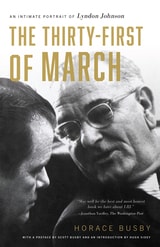
The Thirty-first of March
An Intimate Portrait of Lyndon JohnsonHorace Busby, with a Preface by Scott Busby and an Introduction by Hugh Sidey
University of Texas Press, 2023
An intimate retelling of Lyndon B. Johnson’s politics and presidency by one of his closest advisors.
Horace Busby was one of LBJ’s most trusted advisors; their close working and personal relationship spanned twenty years. In The Thirty-First of March he offers an indelible portrait of a president and a presidency at a time of crisis. From the aftereffects of the Kennedy assassination, when Busby was asked by the newly sworn-in president to sit by his bedside during his first troubled nights in office, to the concerns that defined the Great Society—civil rights, the economy, social legislation, housing, and the Vietnam War—Busby not only articulated and refined Johnson's political thinking, he also helped shape the most ambitious, far-reaching legislative agenda since FDR's New Deal.
Here is Johnson the politician, Johnson the schemer, Johnson who advised against JFK’s choice of an open limousine that fateful day in Dallas, and Johnson the father, sickened by the deaths of young men fighting and dying in Vietnam on his orders. The Thirty-first of March is a rare glimpse into the inner sanctum of Johnson's presidency, as seen through the eyes of one of the people who understood him best.