Results by title

8 books match the query '1924-2024'

cover of An Outdoor Journal: Adventures and Reflections

An Outdoor Journal

Adventures and Reflections

Jimmy Carter

University of Arkansas Press, 1994
An Outdoor Journal, first published in 1988, is President Carter’s memoir of hunting and fishing and the meaning of nature, revealing much about a man who embodies “so much of what Americans claim to admire—self-reliance, honesty, humor, modesty, intelligence—the stuff of heroes” (The New York Times Book Review).
[more]
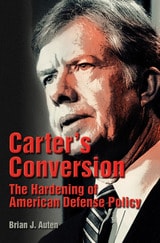
cover of Carter's Conversion: The Hardening of American Defense Policy

Carter's Conversion

The Hardening of American Defense Policy

Brian J. Auten

University of Missouri Press, 2008

When presidential candidate Jimmy Carter advocated defense budget cuts, he did so not only to save money but also with the hope of eventually abolishing nuclear weapons. Three yearslater, when President Carter announced his support of full-scale development of the MX missile and modernization of NATO’s Long-Range Theater Nuclear Force, it marked a dramatic policy shift for his administration.
In light of Carter’s cost-cutting in the first year of his administration, previous observers have attributed Carter’s subsequent shift either to the “shocks of 1979”—the Soviet Union’s move into Afghanistan and the seizure of power by Islamic revolutionaries in Iran—or to domestic political pressure, such as interest group activity, executive-legislative bargaining, or interbureaucratic conflict. Brian Auten now argues that these explanations only partially explain this midterm policy change.
In Carter’s Conversion, Auten reveals how strategic ideas and studies, allied relations, and arms control negotiations each worked to deflect Carter’s initial defense stance away from the policy path suggested by the prevailing international military environment. He also shows how the administration’s MX and Long-Range Theater Nuclear Force decisions subsequently hardened following significant adjustments to these three variables.
Employing the approach to international relations known as neoclassical realism, Auten demonstrates that Carter reassessed his strategic thinking and revised his policy stance accordingly. Integrating declassified documents, interviews, and private archives with a mountain of secondary sources, he provides a historical analysis of defense policy transformation over the first three years of the Carter administration and a detailed examination of how Carter and his national security team addressed challenges posed by the expansion of Soviet military power.
Full of rich history and cogent analysis, Carter’s Conversion presents a wealth of detailed arguments about how Carter adjusted his policy outlook, couched in a thorough understanding of weapons, arms control dynamics, and defense policy-making. As a revision ofcommon interpretations, it provides both an example of self-correcting policy change and a realist argument about the end of superpower détente and the start of the “Second Cold War.”
[more]
cover of Everything to Gain: Making the Most of the Rest of Your Life

Everything to Gain

Making the Most of the Rest of Your Life

Jimmy Carter

University of Arkansas Press, 1995

Everything to Gain, first published in 1987, is the warm account of Jimmy and Rosalynn Carter’s life after their years in the White House. They discuss their marriage and health issues, their work with Habitat for Humanity and the Carter Center, and much more.
[more]
cover of First Lady from Plains

First Lady from Plains

Rosalynn Carter

University of Arkansas Press, 1994

First Lady from Plains, first published in 1984, is Rosalynn’s Carter’s autobiography, covering her life from her childhood in Plains, Georgia, through her time as First Lady. It is “a readable, lively and revealing account of the Carters and their remarkable journey from rural Georgia to the White House in a span of ten years” (The New York Times).
[more]
cover of Keeping Faith: Memoirs of a President

Keeping Faith

Memoirs of a President

Jimmy Carter

University of Arkansas Press, 1995
In Keeping Faith, originally published in 1982, President Carter provides a candid account of his time in the Oval Office, detailing the hostage crisis in Iran, his triumph at the Camp David Middle East peace summit, his relationships with world leaders, and even glimpses into his private world. “Responsible, truthful, intelligent, earnest, rational, purposeful. Thus the man: thus the book” (The Washington Post).
[more]
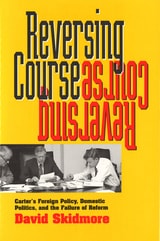
cover of Reversing Course: Carter's Foreign Policy, Domestic Politics, and the Failure of Reform

Reversing Course

Carter's Foreign Policy, Domestic Politics, and the Failure of Reform

David Skidmore

Vanderbilt University Press, 1996

An examination of the several reasons for the failure of foreign policy reform during the controversial administration of President Jimmy Carter.

In Reversing Course, David Skidmore argues that President Carter's initial foreign policy agenda required a scaling back of U.S. commitments abroad, reflecting a decline in resources, as well as influence, in a world developing in ways necessarily reducing U.S. hegemony. By probing beneath the obvious and carefully sifting the abundant but poorly understood evidence, Skidmore finds at the root of Carter's failed effort an irresistible pressure to reverse a liberal foreign-policy agenda in order to address the effect at home of well-organized conservative criticism. For Skidmore, Carter's course "reversed" toward a traditional containment strategy vis-a-vis the Soviet Union not because of Soviet intransigence or faulty idealism but because Cold War politics sold better in the polls.

While offering significant theoretical arguments, Skidmore carefully anchors his thesis in the day-to-day political give and take among those personalities and events that provoked headlines and commentaries long before they were the stuff of history. Among the telling factors and events analyzed in this book are the Vance/Brzezinski conflict, the support and opposition of Howard Baker, the SALT II Treaty, the Panama Canal Treaties, and the Soviet occupation of Afghanistan, to mention only a few.

Although Skidmore draws conclusions that apply to the Reagan, Bush, and Clinton administrations as well, his focus is not on personality but on theory and underlying structures. He provides a demonstration that this structural approach can "be helpful not only in unraveling the mysteries of policy change under Carter but also in specifying the underlying sources of policy vacillation over much of the past two decades." .
[more]
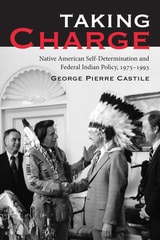
cover of Taking Charge: Native American Self-Determination and Federal Indian Policy, 1975–1993

Taking Charge

Native American Self-Determination and Federal Indian Policy, 1975–1993

George Pierre Castile

University of Arizona Press, 2006

The Indian Self-Determination Act of 1975 sought to restore self-government to peoples whose community affairs had long been administered by outsiders. This book explores whether that bold ambition was actually realized. Taking Charge is a sequel to the author’s landmark work To Show Heart, which examined Indian policy through 1975. George Castile now explores federal Indian policy in the Carter, Reagan, and first Bush administrations, tracing developments triggered by executive and congressional action—or inaction—and focusing on the dynamics of self-determination as both policy objective and byword in the wake of the landmark 1975 legislation. Drawing on unpublished presidential papers and other archival sources, Castile chronicles the efforts of three presidents to uphold Richard Nixon’s commitment to policy change, weighing such issues as the impact of Reaganomics and the advent of Indian gaming. He examines the marginalizing of Indian policy in both the executive and legislative branches in the face of larger issues, as well as the recurring tendency of policy to be driven by a single determined individual, such as South Dakota senator James Abourezk. Although self-determination is roundly advocated by all concerned with federal Indian policy, until now no book has provided a grasp of both its background and its implications. Taking Charge is an essential contribution to the critical study of that policy that allows a better understanding of contemporary Indian affairs.
[more]
cover of Why Not the Best?: The First Fifty Years

Why Not the Best?

The First Fifty Years

Jimmy Carter

University of Arkansas Press, 1996

Why Not the Best?, originally published in 1975, is President Carter’s presidential campaign autobiography, the book that introduced the world to Georgia governor Jimmy Carter and asked the American people to demand the best and highest standards of excellence from our government.
[more]