Results by title
8 books match the query '1925-1965'
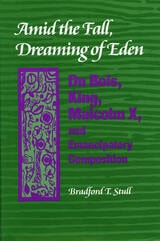
Amid the Fall, Dreaming of Eden
Du Bois, King, Malcolm X, and Emancipatory CompositionBradford T. Stull
Southern Illinois University Press, 1999
Whom, or what, does composition—defined here as an intentional process of study, either oral or written—serve? Bradford T. Stull contends that composition would do well to articulate, in theory and practice, what could be called "emancipatory composition." He argues that emancipatory composition is radically theopolitical: it roots itself in the foundational theological and political language of the American experience while it subverts this language in order to emancipate the oppressed and, thereby, the oppressors.
To articulate this vision, Stull looks to those who compose from an oppressed place, finding in the works of W. E. B. Du Bois, Martin Luther King Jr., and Malcolm X radical theopolitical practices that can serve as a model for emancipatory composition. While Stull acknowledges that there are many sites of oppression, he focuses on what Du Bois has called the problem of the twentieth century: the color line, positing that the unique and foundational nature of the color line provides a fecund place in which, from which, a theory and practice of emancipatory composition might be elucidated.
By focusing on four key theopolitical tropes—The Fall, The Orient, Africa, and Eden—that inform the work of Du Bois, King, and Malcolm X, Stull discovers the ways in which these civil rights leaders root themselves in the vocabulary of the American experience in order to subvert it so that they might promote emancipation for African Americans, and thus all Americans.
In drawing on the work of Paulo Freire, Kenneth Burke, Edward Said, Christopher Miller, Ernst Bloch, and others, Stull also locates this study within the larger cultural context. By reading Du Bois, King, and Malcolm X together in a way that they have never before been read, Stull presents a new vision of composition practice to the African American studies community and a reading of African American emancipatory composition to the rhetoric and composition community, thus extending the question of emancipatory composition into new territory.
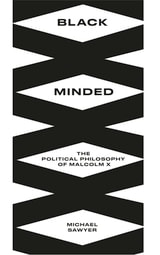
Black Minded
The Political Philosophy of Malcolm XMichael E. Sawyer
Pluto Press, 2020
Michael Sawyer argues that the foundational concepts of Malcolm X's political philosophy - economic and social justice, strident opposition to white supremacy and Black internationalism - are often obscured by an emphasis on biography. The text demonstrates the way in which Malcolm X's philosophy lies at the intersection of the thought of W.E.B. Du Bois and Frantz Fanon and is an integral part of the revolutionary politics formed to alleviate the plight of people of African descent globally.
Exploring themes of ontology, the body, geographic space and revolution, Black Minded provides a much-needed appraisal of Malcolm X's political philosophy.
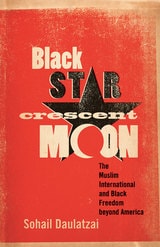
Black Star, Crescent Moon
The Muslim International and Black Freedom beyond AmericaSohail Daulatzai
University of Minnesota Press, 2012
“The same rebellion, the same impatience, the same anger that exists in the hearts of the dark people in Africa and Asia,” Malcolm X declared in a 1962 speech, “is existing in the hearts and minds of 20 million black people in this country who have been just as thoroughly colonized as the people in Africa and Asia.” Four decades later, the hip-hop artist Talib Kweli gave voice to a similar Pan-African sentiment in the song “K.O.S. (Determination)”: “The African diaspora represents strength in numbers, a giant can't slumber forever.”
Linking discontent and unrest in Harlem and Los Angeles to anticolonial revolution in Algeria, Egypt, and elsewhere, Black leaders in the United States have frequently looked to the anti-imperialist movements and antiracist rhetoric of the Muslim Third World for inspiration. In Black Star, Crescent Moon, Sohail Daulatzai maps the rich, shared history between Black Muslims, Black radicals, and the Muslim Third World, showing how Black artists and activists imagined themselves not as national minorities but as part of a global majority, connected to larger communities of resistance. Daulatzai traces these interactions and alliances from the Civil Rights movement and the Black Power era to the “War on Terror,” placing them within a broader framework of American imperialism, Black identity, and the global nature of white oppression.
From Malcolm X and Muhammad Ali to contemporary artists and activists like Rakim and Mos Def, Black Star, Crescent Moon reveals how Muslim resistance to imperialism came to occupy a central position within the Black radical imagination, offering a new perspective on the political and cultural history of Black internationalism from the 1950s to the present.
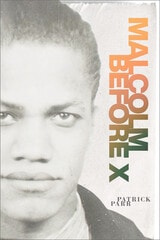
Malcolm Before X
Patrick Parr
University of Massachusetts Press, 2024
A Kirkus Reviews Best Nonfiction Book of 2024
A Spectator Best Book of the Year
Finalist for the 2025 ASALH Book Prize
Drawing upon interviews, correspondence, and nearly 2000 pages of never-before-used prison records, Malcolm Before X is the definitive examination of the prison years of civil rights icon Malcolm X.
In February 1946, when 20-year-old Malcolm Little was sentenced to eight to ten years in a maximum-security prison, he was a petty criminal and street hustler in Boston. By the time he was paroled in August 1952, he had transformed into a voracious reader, joined the Black Muslims, and was poised to become Malcolm X, one of the most prominent and important intellectuals of the civil rights era. While scholars and commentators have exhaustively detailed, analyzed, and debated Malcolm X’s post-prison life, they have not explored these six and a half transformative years in any depth.
Paying particular attention to his time in prison, Patrick Parr’s Malcolm Before X provides a comprehensive and groundbreaking examination of the first twenty-seven years of Malcolm X’s life (1925–1965). Parr traces Malcolm’s African lineage, explores his complicated childhood in the Midwest, and follows him as he moves east to live with his sister Ella in Boston’s Roxbury neighborhood, where he is convicted of burglary and sentenced.
Parr utilizes a trove of previously overlooked documents that include prison files and prison newspapers to immerse the reader into the unique cultures—at times brutal and at times instructional—of Charlestown State Prison, the Concord Reformatory, and the Norfolk Prison Colony. It was at these institutions that Malcolm devoured books, composed poetry, boxed, debated, and joined the Nation of Islam, changing the course of his life and setting the stage for a decade of antiracist activism that would fundamentally reshape American culture.
In this meticulously researched and beautifully written biography, the inspiring story of how Malcolm Little became Malcolm X is finally told.
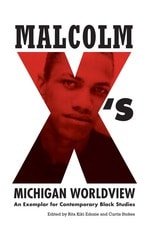
Malcolm X's Michigan Worldview
An Exemplar for Contemporary Black StudiesRita Kiki Edozie
Michigan State University Press, 2024
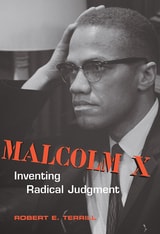
Malcolm X
Inventing Radical JudgmentRobert E. Terrill
Michigan State University Press, 2004
Few figures haunt the collective American psyche like Malcolm X. Hoodlum, convict, convert, prophet, nationalist, and martyr, Malcolm’s life spans the Civil Rights era like an index of America’s racial anxiety. Dozens of books and hundreds of articles have analyzed his life, his work, and the various ways that his image has been appropriated by American culture. Not much has been done, however, to analyze his speeches. This would be a glaring omission in the body of scholarship about almost any public figure, but is especially troubling with regard to Malcolm X. His legacy does not consist of marches preserved on newsreels, legislation passed by Congress, or holidays observed by the state; his legacy consists almost exclusively of his words.
Malcolm X, like any orator, did not fashion his discourse in a vacuum but worked within and modified modes fashioned by his predecessors. Malcolm X: Inventing Radical Judgment begins by exploring the interpretive strategies presented in key texts from the history of African American protest, establishing a spectrum against which Malcolm’s oratory can be assessed. The texts of speeches that Malcolm delivered while he was a minister for the Nation of Islam and the texts of speeches and statements he made after he left the Nation are analyzed carefully to discern the strategies of interpretation and judgment that he enacted and fostered in his audiences. Finally, this radical judgment, presented in and through Malcolm’s public discourse, is re-contextualized by using three disparate theoretical approaches. The purpose of this triangulation is not to contain the rhetoric of Malcolm X within the limitations of these vocabularies, but rather to show that the changing potential of Malcolm’s rhetoric lies, in part, in its iconoclastic refusal to be constrained by definitive boundaries.
Selma and the Liuzzo Murder Trials
The First Modern Civil Rights ConvictionsJames P. Turner
University of Michigan Press, 2018
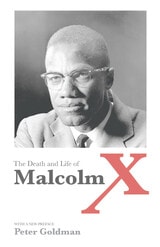
The Death and Life of Malcolm X
Peter Goldman
University of Illinois Press, 2013