Results by title
4 books match the query '1926-1997'

Allen Ginsberg's Buddhist Poetics
Tony Trigilio
Southern Illinois University Press, 2007
Allen Ginsberg’s Buddhist Poetics revives questions of poetics, religious authenticity, and political efficacy in Ginsberg's prophetic poetry. Author Tony Trigilio examines Ginsberg's Buddhism as an imperfect but deepening influence on the major poems of his career.
The first sustained scholarly effort to test Ginsberg’s work as Buddhist poetry, this volume goes beyond biography to contemporary critical theory and textual and historical analysis to show how Ginsberg’s Buddhist religious practices inform his poetry. Trigilio takes us through the poet’s first autodidactic struggles with Buddhism to his later involvement with highly trained teachers, as he follows the development of Ginsberg’s Buddhist poetics.
The book also considers the place of Ginsberg’s poetry in the cultural and aesthetic contexts of his career, covering the rise of an “American Buddhism”; the antiwar, drug decriminalization, and gay civil rights movements; and the shift from modern to postmodern strategies in contemporary U.S. poetry.
Allen Ginsberg’s Buddhist Poetics examines some of the most significant work produced by the poet after he had become a cultural icon and marks a new direction in the study of Ginsberg’s work. Of interest to scholars of Buddhism, American poetry, cultural studies, and Beat studies, this groundbreaking volume fills significant gaps in the scholarly criticism of Ginsberg’s spiritual poetics.
[more]
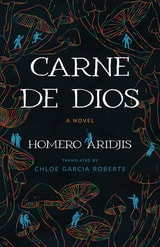
Carne de Dios
A NovelHomero Aridjis; Translated by Chloe Garcia Roberts
University of Arizona Press, 2025
In the remote mountains of Oaxaca, the Beatniks have arrived.
María Sabina, the renowned Mazatec healer, spends her days in the small town of Huautla de Jiménez selling produce at the market and foraging under the new moon for the sacred mushrooms that grow near her home—her Holy Children, Carne de Dios, or Flesh of God. But her life changes forever when an amateur mycologist from New York, with a cameraman in tow, visits her to experience for himself the mushroom ceremony, or velada, he knows only from whispers in anthropological records. When he publishes an unauthorized article about his experience in LIFE Magazine 1957, the stage is set for an explosive encounter between the burgeoning international counterculture and the woman who became an unwilling icon of the psychedelic revolution.
Homero Aridjis’s novel, vividly translated by Chloe Garcia Roberts, tells the story of the motley crew of bohemians, researchers, and holy fools, both real and imagined, who descend on the town of Huautla de Jiménez searching for inspiration, distraction, and salvation in the sacred mushrooms. These seekers melt in and out of a narrative infiltrated by the slipstream logic of dreams. As John Lennon plays jazz on the patio of the Hotel Grande, Juan Rulfo contemplates horror movies, and Allen Ginsberg recites mantras at Philip Lamantia’s wedding, María Sabina’s life is increasingly thrown into turmoil.
Carne de Dios is a masterful and often humorous blend of history, myth, and poetic imagination, captured in a translation that mirrors the hallucinatory beauty of Aridjis’s original Spanish. Aridjis’s intimate portrayal of María Sabina, informed by his personal connection to her, serves as both a tribute to her enduring legacy and a critical reflection on the wave of global interest in mushroom culture still gaining momentum today.
This English translation includes an introduction by the translator and an afterword by the author.
[more]

Dharma Lion
A Biography of Allen GinsbergMichael Schumacher
University of Minnesota Press, 2016
With the sweep of an epic novel, Michael Schumacher tells the story of Allen Ginsberg and his times, with fascinating portraits of Jack Kerouac, Neal Cassady, and William Burroughs, among others, along with many rarely seen photographs.
[more]

The Bop Apocalypse
The Religious Visions of Kerouac, Ginsberg, and BurroughsJohn Lardas
University of Illinois Press, 2000
Blending biography, cultural history, and literary criticism, The Bop Apocalypse explores the religious concerns, metaphysical realities, and spiritual pursuits that undergirded the early friendship and literary collaborations of Jack Kerouac, Allen Ginsberg, and William S. Burroughs.
Presenting a religious biography of the Beats from the mid-1940s to the late 1950s, John Lardas shows that in rejecting many of the cultural tenets of postwar America, Kerouac, Ginsberg, and Burroughs created new visions of both self and country, visions they articulated through distinctive literary forms. Lardas examines how the Beat writers distilled a theology of experience--a religious vision that animated their everyday existence as well as their art--from a flurry of disparate influences that included the saxophone wails of Charlie Parker and Lester Young, the psychology of Wilhelm Reich, the linguistic theories of Alfred Korzybski, the hipster dialects of New York City, and especially the prophecies of Oswald Spengler. Revisiting the major works the Beats produced in the 1950s in terms of critical content, Lardas considers how their lived religion was incorporated into the way they wrote.
The first sustained treatment of Beat religiosity, The Bop Apocalypse takes a sophisticated look beyond the cartoonish reductions of the Beat counterculture. The Bop Apocalypse takes the Beats at face value, interpreting their sexual openness, drug use, criminality, compulsion to travel, and madness as the logical, physical enactments of a religious representation of the world. Far from dallying irrelevantly on the fringes of society, Lardas asserts, the Beats engaged America on moral grounds through the discourse of public religion.
[more]