Results by title
4 books match the query '1926-2018'
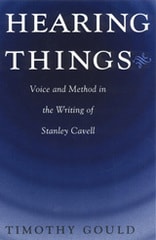
Hearing Things
Voice and Method in the Writing of Stanley CavellTimothy Gould
University of Chicago Press, 1998
Gould argues that a tension between voice and method unites Cavell's broad and often perplexing range of interests. From Wittgenstein to Thoreau, from Shakespeare to the movies, and from opera to Freud, Gould reveals the connection between the voice within Cavell's writing and the voices Cavell appeals to through the methods of ordinary language philosophy. Within Cavell's extraordinary productivity lies a new sense of philosophical method based on elements of the act of reading. Hearing Things is both an important study of Cavell's work and a major contribution to the construction of American philosophy.

Mario Barradas and Son Jarocho
The Journey of a Mexican Regional MusicYolanda Broyles-González, Rafael Figueroa Hernández, and Francisco González
University of Texas Press, 2022
Son Jarocho was born as the regional sound of Veracruz but over time became a Mexican national genre, even transnational, genre—a touchstone of Chicano identity in the United States. Mario Barradas and Son Jarocho traces a musical journey from the Gulf Coast to interior Mexico and across the border, describing the transformations of Son Jarocho along the way.
This comprehensive cultural study pairs ethnographic and musicological insights with an oral history of the late Mario Barradas, one of Son Jarocho’s preeminent modern musicians. Chicano musician Francisco González offers an insider’s account of Barradas’s influence and Son Jarocho’s musical qualities, while Rafael Figueroa Hernández delves into Barradas’s recordings and films. Yolanda Broyles-González examines the interplay between Son Jarocho’s indigenous roots and contemporary role in Mexican and US society. The result is a nuanced portrait of a vital and evolving musical tradition.
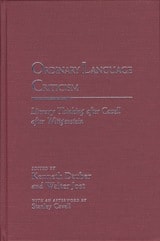
Ordinary Language Criticism
Literary Thinking after Cavell after WittgensteinKenneth Dauber and Walter Jost
Northwestern University Press, 2003
Resisting master formulations and overarching theories, Ordinary Language Criticism does not so much dismiss the excitement of the last two decades of literary theorizing as it reminds us of the excitement of the shared common enterprises to which theory may still contribute. In this, the volume and the model it offers have wide implications for the academy, in which a widespread ersatz-sophistication has shorted the circuit between literary works and the real lives of those reading and teaching them.
With a definitive introduction by editors Kenneth Dauber and Walter Jost, and elaborations and practical examples by major figures such as Cavell himself, Martha Nussbaum, Marjorie Perloff, Anthony Cascardi, and Charles Altieri, among others, this volume clearly shows and explains how ordinary language criticism differs from current trends and what it exactly it can accomplish in theory and practice. These essays prove that by attending more faithfully to what we actually do when we read, we can make reading more productive--can reveal how extraordinary and rich, how really sophisticated, the ordinary actually is.
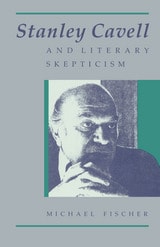
Stanley Cavell and Literary Skepticism
Michael Fischer
University of Chicago Press, 1989
Throughout his study, Fischer focuses on skepticism, a central concern of Cavell's multifaceted work. Cavell, following J. L. Austin and Wittgenstein, does not refute the radical epistemological questioning of Descartes, Hume, and others, but rather characterizes skepticism as a significant human possibility or temptation. As presented by Fischer, Cavell's accounts of both external-world and other-minds skepticism share significant affinities with deconstruction, a connection overlooked by contemporary literary theorists.
Fischer follows Cavell's lead in examining how different genres address the problems raised by skepticism and goes on to show how Cavell draws on American and English romanticism in fashioning a response to it. He concludes by analyzing Cavell's remarks about current critical theory, focusing on Cavell's uneasiness with some of the conclusions reached by its practitioners. Fischer shows that Cavell's insights, grounded in powerful analyses of Descartes, Hume, and Wittgenstein, permit a fresh view of Derrida, Miller, de Man, and Fish. The result is not only a revealing characterization of deconstruction but a much-needed and insightful introduction to Cavell's rich but difficult oeuvre.