Results by title
4 books match the query '1927-2017'
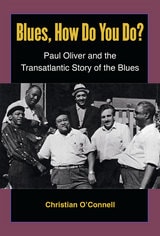
Blues, How Do You Do?
Paul Oliver and the Transatlantic Story of the BluesChristian O’Connell
University of Michigan Press, 2015
Recent revisionist scholarship has argued that representations by white “outsider” observers of black American music have distorted historical truths about how the blues came to be. While these scholarly arguments have generated an interesting debate concerning how the music has been framed and disseminated, they have so far only told an American story, failing to acknowledge that in the post-war era the blues had spread far beyond the borders of the United States. As Christian O’Connell shows in Blues, How Do You Do? Paul Oliver’s largely neglected scholarship—and the unique transatlantic cultural context it provides—is vital to understanding the blues.
O’Connell’s study begins with Oliver’s scholarship in his early days in London as a writer for the British jazz press and goes on to examine Oliver’s encounters with visiting blues musicians, his State Department–supported field trip to the US in 1960, and the resulting photographs
and oral history he produced, including his epic “blues narrative,” The Story of the Blues (1969). Blues, How Do You Do? thus aims to move away from debates that have been confined within the limits of national borders—or relied on clichés of British bands popularizing American music in America—to explore how Oliver’s work demonstrates that the blues became a reified ideal, constructed in opposition to the forces of modernity.
[more]
Our Deep Gossip
Conversations with Gay Writers on Poetry and DesireChristopher Hennessy; Foreword by Christopher Bram
University of Wisconsin Press, 2013
From Walt Whitman forward, a century and a half of radical experimentation and bold speech by gay and lesbian poets has deeply influenced the American poetic voice. In Our Deep Gossip, Christopher Hennessy interviews eight gay men who are celebrated American poets and writers: Edward Field, John Ashbery, Richard Howard, Aaron Shurin, Dennis Cooper, Cyrus Cassells, Wayne Koestenbaum, and Kazim Ali. The interviews showcase the complex ways art and life intertwine, as the poets speak about their early lives, the friends and communities that shaped their work, the histories of gay writers before them, how sex and desire connect with artistic production, what coming out means to a writer, and much more.
While the conversations here cover almost every conceivable topic of interest to readers of poetry and poets themselves, the book is an especially important, poignant, far-reaching, and enduring document of what it means to be a gay artist in twentieth- and early twenty-first-century America.
[more]
The Tribe of John
Ashbery and Contemporary PoetrySusan M. Schultz
University of Alabama Press, 1995
Fourteen essayists break new ground by focusing on a new generation of postmodern poets who are clearly indebted to John Ashbery's work
This concentration on Ashbery's influence on contemporary American poetry provides new methods for interpreting and understanding his poetic achievement.
This concentration on Ashbery's influence on contemporary American poetry provides new methods for interpreting and understanding his poetic achievement.
[more]
Uncertainty and Plenitude
Five Contemporary PoetsPeter Stitt
University of Iowa Press, 1997
From the extraordinary diversity of contemporary poetry, Peter Stitt, the distinguished critic and editor of the Gettysburg Review, has chosen in this book to write about five poets only, all premier practitioners—John Ashbery, Stephen Dobyns, Charles Simic, Gerald Stern, and Charles Wright, with a special look at Stanley Kunitz in relation to Wright. Stitt's confident and inventive assessments of these fine poets' work help us gain some focus on the “uncertainty and plenitude” of the current poetry scene, demonstrating that concentrated and knowledgeable criticism can show us ways to begin measuring the accomplishments of our poetic age.
Stitt's interest in these five poets is intellectual and aesthetic. As he states, “I chose these particular writers because their work continues to interest me deeply, both intellectually and formally, even after years of familiarity.” He uses his understanding of the philosophical implications inherent in modern physics, as they apply to both content and form, as the basis for his close analysis.
Stitt attends to the poets' writerly strategies so that we may discover in their poetry where “surface form” intersects and complements meaning and thus becomes, in John Berryman's terms, “deep form.” He explains what these poets say and how they say it and what relationships lie between. He also shows how humor plays a part in some of their work.
[more]