Results by title
3 books match the query '1928-1937'
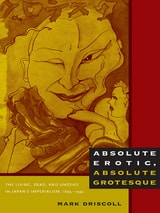
Absolute Erotic, Absolute Grotesque
The Living, Dead, and Undead in Japan's Imperialism, 1895-1945Mark Driscoll
Duke University Press, 2010
In this major reassessment of Japanese imperialism in Asia, Mark Driscoll foregrounds the role of human life and labor. Drawing on subaltern postcolonial studies and Marxism, he directs critical attention to the peripheries, where figures including Chinese coolies, Japanese pimps, trafficked Japanese women, and Korean tenant farmers supplied the vital energy that drove Japan's empire. He identifies three phases of Japan's capitalist expansion, each powered by distinct modes of capturing and expropriating life and labor: biopolitics (1895–1914), neuropolitics (1920–32), and necropolitics (1935-45). During the first phase, Japanese elites harnessed the labor of marginalized subjects as Japan colonized Taiwan, Korea, and south Manchuria, and sent hustlers and sex workers into China to expand its market hegemony. Linking the deformed bodies laboring in the peripheries with the "erotic-grotesque" media in the metropole, Driscoll centers the second phase on commercial sexology, pornography, and detective stories in Tokyo to argue that by 1930, capitalism had colonized all aspects of human life: not just labor practices but also consumers’ attention and leisure time. Focusing on Japan's Manchukuo colony in the third phase, he shows what happens to the central figures of biopolitics as they are subsumed under necropolitical capitalism: coolies become forced laborers, pimps turn into state officials and authorized narcotraffickers, and sex workers become "comfort women". Driscoll concludes by discussing Chinese fiction written inside Manchukuo, describing the everyday violence unleashed by necropolitics.
[more]
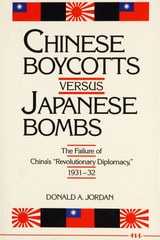
Chinese Boycotts versus Japanese Bombs
The Failure of China's "Revolutionary Diplomacy," 1931-32Donald A. Jordan
University of Michigan Press, 1991
Chinese Boycotts versus Japanese Bombs highlights economic competition as a key to understanding how China and Japan, leading trade partners, slipped toward war in the early 1930s. It describes and evaluates the Nationalist Chinese government's “Revolutionary Diplomacy” — its own brand of foreign policy toward Japan in 1931-32. This approach, which utilized popular boycotts, strikes, and demonstrations, was both innovative and a reflection of Chinas profound anger toward Japan, brought about by the desperation of Chinese industrialists in the face of the efficiency of Japanese producers. Although the anti-Japanese acts failed to break Japanese economic dominion and halt Japanese aggression in Manchuria, the sanctions enticed the United States and England to enter the Chinese market and led them into the role of codefenders against Japan. Battered by the Chinese boycott, Japanese businesses demanded military intervention. In addition, internal domestic strife in China tempted the Japanese military into seizing Manchuria and making an attack on Shanghai in 1932, thus dashing any hope for a peaceable relationship between Japan and China. These events set the stage for what was to become the Asian arena of World War Il.
[more]
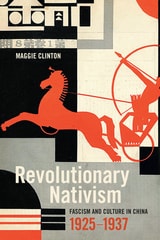
Revolutionary Nativism
Fascism and Culture in China, 1925-1937Maggie Clinton
Duke University Press, 2017
In Revolutionary Nativism Maggie Clinton traces the history and cultural politics of fascist organizations that operated under the umbrella of the Chinese Nationalist Party (GMD) during the 1920s and 1930s. Clinton argues that fascism was not imported to China from Europe or Japan; rather it emerged from the charged social conditions that prevailed in the country's southern and coastal regions during the interwar period. These fascist groups were led by young militants who believed that reviving China's Confucian "national spirit" could foster the discipline and social cohesion necessary to defend China against imperialism and Communism and to develop formidable industrial and military capacities, thereby securing national strength in a competitive international arena. Fascists within the GMD deployed modernist aesthetics in their literature and art while justifying their anti-Communist violence with nativist discourse. Showing how the GMD's fascist factions popularized a virulently nationalist rhetoric that linked Confucianism with a specific path of industrial development, Clinton sheds new light on the complex dynamics of Chinese nationalism and modernity.
[more]