Results by title

5 books match the query '1930 - 1960'
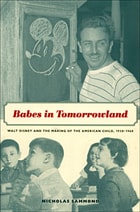
cover of Babes in Tomorrowland: Walt Disney and the Making of the American Child, 1930–1960

Babes in Tomorrowland

Walt Disney and the Making of the American Child, 1930–1960

Nicholas Sammond

Duke University Press, 2005

Linking Margaret Mead to the Mickey Mouse Club and behaviorism to Bambi, Nicholas Sammond traces a path back to the early-twentieth-century sources of “the normal American child.” He locates the origins of this hypothetical child in the interplay between developmental science and popular media. In the process, he shows that the relationship between the media and the child has long been much more symbiotic than arguments that the child is irrevocably shaped by the media it consumes would lead one to believe. Focusing on the products of the Walt Disney company, Sammond demonstrates that without a vision of a normal American child and the belief that movies and television either helped or hindered its development, Disney might never have found its market niche as the paragon of family entertainment. At the same time, without media producers such as Disney, representations of the ideal child would not have circulated as freely in American popular culture.

In vivid detail, Sammond describes how the latest thinking about human development was translated into the practice of child-rearing and how magazines and parenting manuals characterized the child as the crucible of an ideal American culture. He chronicles how Walt Disney Productions’ greatest creation—the image of Walt Disney himself—was made to embody evolving ideas of what was best for the child and for society. Bringing popular child-rearing manuals, periodicals, advertisements, and mainstream sociological texts together with the films, tv programs, ancillary products, and public relations materials of Walt Disney Productions, Babes in Tomorrowland reveals a child that was as much the necessary precursor of popular media as the victim of its excesses.
[more]
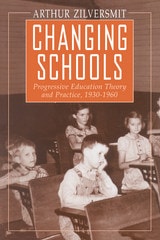
cover of Changing Schools: Progressive Education Theory and Practice, 1930-1960

Changing Schools

Progressive Education Theory and Practice, 1930-1960

Arthur Zilversmit

University of Chicago Press, 1993

Nearly one hundred years ago America's foremost philosopher of education, John Dewey, set in motion the progressive education movement—an effort to enhance both child and community by establishing schools that would focus on the needs and interests of children, thereby turning out more productive citizens. To what degree did these ideas actually change the day-to-day lives of school children? What can the progressive education movement teach us about the conditions that facilitate and impede the implementation of new ideas about schools?

Through a focus on actual classroom practices in several school systems in the Chicago area, Zilversmit examines the impact of Dewey's ideas at a national and local level. He looks at the course of progressivism from the 1930s, when its influence was at its height but reform was difficult because of the Depression, through the post-World War II period when the baby boom led to rapid school expansion. The new affluence made reform possible, but the Cold War put progressivism on the defensive.

Zilversmit's goal is to illuminate the role of the ideas of the progressives in determining school practices so we can develop a better understanding of the relationship between education ideas and educational practices. This understanding, argues Zilversmit, will better enable us to determine new directions for educational reform, and to determine how reforms can be successfully implemented.
[more]
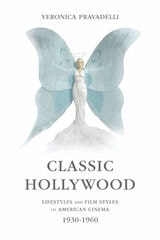
cover of Classic Hollywood: Lifestyles and Film Styles of American Cinema, 1930-1960

Classic Hollywood

Lifestyles and Film Styles of American Cinema, 1930-1960

Veronica Pravadelli

University of Illinois Press, 2015

Studies of "Classic Hollywood" typically treat Hollywood films released from 1930 to 1960 as a single interpretive mass. Veronica Pravadelli complicates this idea. Focusing on dominant tendencies in box office hits and Oscar-recognized classics, she breaks down the so-called classic period into six distinct phases that follow Hollywood's amazingly diverse offerings from the emancipated females of the "Transition Era" and the traditional men and women of the conservative 1930s that replaced it to the fantastical Fifties movie musicals that arose after anti-classic genres like film noir and women's films.
 
Pravadelli sets her analysis apart by paying particular attention to the gendered desires and identities exemplified in the films. Availing herself of the significant advances in film theory and modernity studies that have taken place since similar surveys first saw publication, she views Hollywood through strategies as varied as close textural analysis, feminism, psychoanalysis, film style and study of cinematic imagery, revealing the inconsistencies and antithetical traits lurking beneath Classic Hollywood's supposed transparency.
[more]
cover of Italian Women's Theatre, 1930-1960: An Anthology of Plays

Italian Women's Theatre, 1930-1960

An Anthology of Plays

Translations and Critical Introductions by Daniela Cavallaro

Intellect Books, 2011
Between 1930 and 1960, popular female dramatists, including Paola Riccora, Anna Bonacci, Clotilde Masci, and Gici Ganzini Granata, set the stage for a new generation of feminist theatre and the development of contemporary Italian women’s theatre as a whole. Now largely forgotten, the lives and works of these dramatists are reintroduced into the scholarly conversation in Italian Women’s Theatre, 1930–1960. Following a general introduction, the book presents a selection of dramatic works, rounded out by commentary, performance histories, critical analyses, and biographical information.  
[more]
cover of Who Goes to College: Comparison of Minnesota College Freshmen, 1930-1960

Who Goes to College

Comparison of Minnesota College Freshmen, 1930-1960

Ralph Berdie

University of Minnesota Press, 1962

[more]