Results by title

8 books match the query '1932-2014'

cover of Familiar Stranger: A Life Between Two Islands

Familiar Stranger

A Life Between Two Islands

Stuart Hall

Duke University Press, 2017

"Sometimes I feel myself to have been the last colonial." This, in his own words, is the extraordinary story of the life and career of Stuart Hall—how his experiences shaped his intellectual, political, and theoretical work and how he became one of his age's brightest intellectual lights.

Growing up in a middle-class family in 1930s Kingston, Jamaica, still then a British colony, the young Stuart Hall found himself uncomfortable in his own home. He lived among Kingston's stiflingly respectable brown middle class, who, in their habits and ambitions, measured themselves against the white elite. As colonial rule was challenged, things began to change in Kingston and across the world. In 1951 a Rhodes scholarship took Hall across the Atlantic to Oxford University, where he met young Jamaicans from all walks of life, as well as writers and thinkers from across the Caribbean, including V. S. Naipaul and George Lamming. While at Oxford he met Raymond Williams, Charles Taylor, and other leading intellectuals, with whom he helped found the intellectual and political movement known as the New Left. With the emotional aftershock of colonialism still pulsing through him, Hall faced a new struggle: that of building a home, a life, and an identity in a postwar England so rife with racism that it could barely recognize his humanity.

With great insight, compassion, and wit, Hall tells the story of his early life, taking readers on a journey through the sights, smells, and streets of 1930s Kingston while reflecting on the thorny politics of 1950s and 1960s Britain. Full of passion and wisdom, Familiar Stranger is the intellectual memoir of one of our greatest minds.
[more]
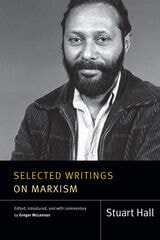
cover of Selected Writings on Marxism

Selected Writings on Marxism

Stuart Hall

Duke University Press, 2021

Throughout his career Stuart Hall engaged with Marxism in varying ways, actively rethinking it to address the political and cultural exigencies of the moment. This collection of Hall's key writings on Marxism surveys the questions central to his interpretations of and investments in Marxist theory and practice. It includes Hall's readings of canonical texts by Marx and Engels, Gramsci, and Althusser; his exchanges with other prominent thinkers about Marxism; his use of Marxist frameworks to theorize specific cultural phenomena and discourses; and some of his later work in which he distanced himself from his earlier attachments to Marxism. In addition, editor Gregor McLennan's introduction and commentary offer in-depth context and fresh interpretations of Hall's thought. Selected Writings on Marxism demonstrates that grasping Hall's complex relationship to Marxism is central to understanding the corpus of his work.
[more]
cover of Selected Writings on Race and Difference

Selected Writings on Race and Difference

Stuart Hall

Duke University Press, 2021
In Selected Writings on Race and Difference, editors Paul Gilroy and Ruth Wilson Gilmore gather more than twenty essays by Stuart Hall that highlight his extensive and groundbreaking engagement with race, representation, identity, difference, and diaspora. Spanning the whole of his career, this collection includes classic theoretical essays such as “The Whites of Their Eyes” (1981) and “Race, the Floating Signifier” (1997). It also features public lectures, political articles, and popular pieces that circulated in periodicals and newspapers, which demonstrate the breadth and depth of Hall's contribution to public discourses of race. Foregrounding how and why the analysis of race and difference should be concrete and not merely descriptive, this collection gives organizers and students of social theory ways to approach the interconnections of race with culture and consciousness, state and society, policing and freedom.
[more]
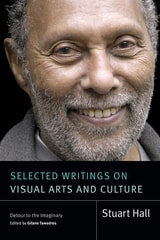
cover of Selected Writings on Visual Arts and Culture: Detour to the Imaginary

Selected Writings on Visual Arts and Culture

Detour to the Imaginary

Stuart Hall. Edited by Gilane Tawadros

Duke University Press, 2024
Stuart Hall’s work on culture, politics, race, and media is familiar to readers throughout the world. Equally important was his decades-long commitment to visual art. As the first collection to bring together Hall’s work on the visual, this volume assembles two dozen of Hall’s essays, lectures, reviews, catalog texts, and conversations on art, film, and photography. Providing rare insights into Hall’s engagement with the “radically different” intellectual and aesthetic space of the visual imaginary, these works articulate the importance of the visual as a site of contestation at the same time as it is a space in which Black artists and filmmakers reframe questions about diaspora, identity, and globalization. Selected Writings on Visual Arts and Culture demonstrates the breadth and range of Hall’s thinking on art, film, photography, archives, and museums. In so doing, it enables us to arrive at radical and innovative ways of understanding the world.
[more]
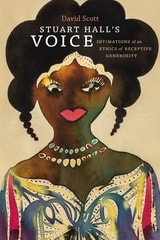
cover of Stuart Hall's Voice: Intimations of an Ethics of Receptive Generosity

Stuart Hall's Voice

Intimations of an Ethics of Receptive Generosity

David Scott

Duke University Press, 2017
Stuart Hall’s Voice explores the ethos of style that characterized Stuart Hall’s intellectual vocation. David Scott frames the book—which he wrote as a series of letters to Hall in the wake of his death—as an evocation of friendship understood as the moral and intellectual medium in which his dialogical hermeneutic relationship with Hall’s work unfolded. In this respect, the book asks: what do we owe intellectually to the work of those whom we know well, admire, and honor? Reflecting one of the lessons of Hall’s style, the book responds: what we owe should be conceived less in terms of criticism than in terms of listening. 
 
Hall’s intellectual life was animated by voice in literal and extended senses: not only was his voice distinctive in the materiality of its sound, but his thinking and writing were fundamentally shaped by a dialogical and reciprocal practice of speaking and listening. Voice, Scott suggests, is the central axis of the ethos of Hall’s style. 
 
Against the backdrop of the consideration of the voice’s aspects, Scott specifically engages Hall’s relationship to the concepts of "contingency" and "identity," concepts that were dimensions less of a method as such than of an attuned and responsive attitude to the world. This attitude, moreover, constituted an ethical orientation of Hall’s that should be thought of as a special kind of generosity, namely a "receptive generosity," a generosity oriented as much around giving as receiving, as much around listening as speaking.
[more]
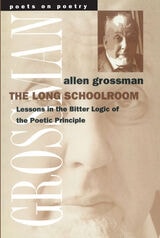
cover of The Long Schoolroom: Lessons in the Bitter Logic of the Poetic Principle

The Long Schoolroom

Lessons in the Bitter Logic of the Poetic Principle

Allen Grossman

University of Michigan Press, 1997

Allen Grossman's combined reputation as a poet and as a professor of poetry gives him an unusual importance in the landscape of contemporary American poetry. In this new collection Grossman revisits the "Long Schoolroom" of poetic principle--where he eventually learned to reconsider the notion that poetry was cultural work of the kind that contributed unambiguously to the peace of the world.
The jist of what he learned--of what his "lessons" taught him--was (in the sentence of Oliver Wendell Holmes): "Where most men have died, there is the greatest interest." According to Grossman, violence arises not merely from the "barbarian" outside of the culture the poet serves, but from the inner logic of that culture; not, as he would now say, from the defeat of cultural membership but from the terms of cultural membership itself.
Grossman analyzes the "bitter logic of the poetic principle" as it is articulated in exemplary texts and figures, including Bede's Caedmon and Milton. But the heart of The Long Schoolroom is American, ranging from essays on Whitman and Lincoln to an in-depth review of the work of Hart Crane. His final essays probe the example of postmodern Jewish and Christian poetry in this country, most notably the work of Robert Lowell and Allen Ginsburg, as it searches for an understanding of "holiness" in the production and control of violence.
Allen Grossman is author of The Ether Dome and Other Poems: New and Selected, The Sighted Singer: Two Works on Poetry for Readers and Writers (with Mark Halliday), and most recently, The Philosopher's Window. He is Mellon Professor in the Humanities at The Johns Hopkins University.
[more]
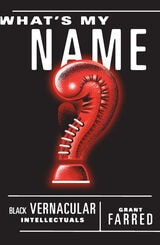
cover of What's My Name: Black Vernacular Intellectuals

What's My Name

Black Vernacular Intellectuals

Grant Farred

University of Minnesota Press, 2003

Whom does society consider an intellectual and on what grounds? Antonio Gramsci’s democratic vision of intelligence famously suggested that “all men are intellectuals,” yet within academic circles and among the general public, intellectuals continue to be defined by narrow, elite criteria. 

In this study of four celebrated citizens of the African diaspora—American boxer Muhammad Ali, West Indian Marxist critic C. L. R. James, British cultural theorist Stuart Hall, and Jamaican musician Bob Marley—Grant Farred develops a new category of engaged thinker: the vernacular intellectual. Extending Gramsci’s concept of the organic intellectual, Farred conceives of vernacular intellectuals as individuals who challenge social injustice from inside and outside traditional academic or political spheres. Muhammad Ali, for example, is celebrated as much for his dazzling verbal skills and courageous political stands as for his pugilistic talents; Bob Marley’s messages of liberation are as central to his popularity as his lyrical and melodic sophistication. Neither man is described as an intellectual, yet both perform crucial intellectual functions: shaping how people see the world, oppose hegemony, and understand their own history. In contrast, the careers of C. L. R. James and Stuart Hall reflect a dynamic blend of the traditional and the vernacular. Conventionally trained and situated,  James and Hall examine racism, history, and the lasting impact of colonialism in ways that draw on both established scholarship and more popular cultural experiences.

Challenging existing paradigms, What’s My Name offers an expansive and inclusive vision of intellectual activity that is as valid and meaningful in the boxing ring, the press conference, and the concert hall as in academia.
[more]
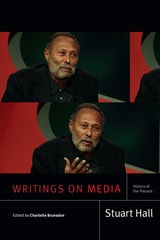
cover of Writings on Media: History of the Present

Writings on Media

History of the Present

Stuart Hall

Duke University Press, 2021

Writings on Media gathers more than twenty of Stuart Hall's media analyses, from scholarly essays such as “Encoding and Decoding in the Television Discourse” (1973) to other writings addressed to wider publics. Hall explores the practices of news photography, the development of media and cultural studies, the changing role of television, and how the nation imagines itself through popular media. He attends to Britain's imperial history and the politics of race and cultural identity as well as the media's relationship to the political project of the state. Testifying to the range and agility of Hall's critical and pedagogic engagement with contemporary media culture—and also to his collaborative mode of working—this volume reaffirms his stature as an innovative media theorist while demonstrating the continuing relevance of his methods of analysis.
[more]