Results by title
3 books match the query '1932-2016'

Arnold Wesker
Fragments and VisionsEdited by Anne Etienne and Graham Saunders
Intellect Books, 2021
After his death, Arnold Wesker (1932–2016) was hailed as one of the great overlooked figures of British drama. Despite his engagement in British cultural politics of the 1960s and an international career, only a fraction of Wesker’s dramatic output has been thoroughly studied.
Edited by leading scholars in the field and with contributions from important scholars of postwar theater, this volume considers, for the first time, the whole body of Wesker’s work. It includes chapters on Wesker’s reception in Europe, his representation of and attitude towards women, his relationship to his Jewish origins and identity, and his attitude toward politics and community. Building on existing scholarship, drawing extensively from the Arnold Wesker archive at the Harry Ransom Center at the University of Texas at Austin, and introducing new insights and perspectives, this important new essay collection remedies the recent critical neglect of the dramatist.
Edited by leading scholars in the field and with contributions from important scholars of postwar theater, this volume considers, for the first time, the whole body of Wesker’s work. It includes chapters on Wesker’s reception in Europe, his representation of and attitude towards women, his relationship to his Jewish origins and identity, and his attitude toward politics and community. Building on existing scholarship, drawing extensively from the Arnold Wesker archive at the Harry Ransom Center at the University of Texas at Austin, and introducing new insights and perspectives, this important new essay collection remedies the recent critical neglect of the dramatist.
[more]
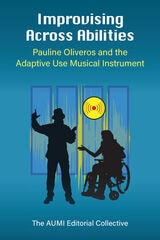
Improvising Across Abilities
Pauline Oliveros and the Adaptive Use Musical InstrumentThe AUMI Editorial Collective
University of Michigan Press, 2024
Improvising Across Abilities: Pauline Oliveros and the Adaptive Use Musical Instrument (AUMI) brings together scholars, musicians, and family members of people with disabilities to collectively recount years of personal experiences, research, and perspectives on the societal and community impact of inclusive musical improvisation. One of the lesser-known projects of composer, improviser, and humanitarian, Pauline Oliveros (1932–2016), the AUMI was designed as a liberating and affordable alternative to the constraints of instruments created only for normative bodies, thus opening a doorway for people of all ages, genders, abilities, races, and socioeconomic backgrounds to access artistic practice with others. More than a book about AUMI, this book is an invitation to readers to use AUMI in their own communities.
This book, which contains wisdom from many who have been affected by their work with the instrument and the people who use it, is a representation of how music and extemporized performance have touched the lives and minds of scholars and families alike. Not only has AUMI provided the opportunity to grow in listening to others who may speak differently (or not at all), but it has been used as an avenue for a diverse set of people to build friendships with others whom they may have never otherwise even glanced at in the street. By providing a space for every person who comes across AUMI to perform, listen, improvise, and collaborate, the continuing development of this instrument contributes to a world in which every person is heard, welcomed, and celebrated.
This book, which contains wisdom from many who have been affected by their work with the instrument and the people who use it, is a representation of how music and extemporized performance have touched the lives and minds of scholars and families alike. Not only has AUMI provided the opportunity to grow in listening to others who may speak differently (or not at all), but it has been used as an avenue for a diverse set of people to build friendships with others whom they may have never otherwise even glanced at in the street. By providing a space for every person who comes across AUMI to perform, listen, improvise, and collaborate, the continuing development of this instrument contributes to a world in which every person is heard, welcomed, and celebrated.
[more]
Jewish Education
Ari Y Kelman
Rutgers University Press, 2024
Most writing about Jewish education has been preoccupied with two questions: What ought to be taught? And what is the best way to teach it? Ari Y Kelman upends these conventional approaches by asking a different question: How do people learn to engage in Jewish life? This book, by centering learning, provides an innovative way of approaching the questions that are central to Jewish education specifically and to religious education more generally.
At the heart of Jewish Education is an innovative alphabetical primer of Jewish educational values, qualities, frameworks, catalysts, and technologies which explore the historical ways in which Jewish communities have produced and transmitted knowledge. The book examines the tension between Jewish education and Jewish Studies to argue that shifting the locus of inquiry from “what people ought to know” to “how do people learn” can provide an understanding of Jewish education that both draws on historical precedent and points to the future of Jewish knowledge.
At the heart of Jewish Education is an innovative alphabetical primer of Jewish educational values, qualities, frameworks, catalysts, and technologies which explore the historical ways in which Jewish communities have produced and transmitted knowledge. The book examines the tension between Jewish education and Jewish Studies to argue that shifting the locus of inquiry from “what people ought to know” to “how do people learn” can provide an understanding of Jewish education that both draws on historical precedent and points to the future of Jewish knowledge.
[more]