Results by title
3 books match the query '1940 - 1945'
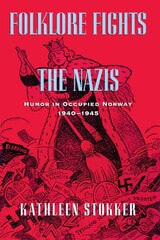
Folklore Fights the Nazis
Humor in Occupied Norway, 1940–1945Kathleen Stokker
University of Wisconsin Press, 1997
In relating this dramatic story, Kathleen Stokker draws upon her many interviews with survivors of the Occupation and upon the archives of the Norwegian Resistance Museum and the University of Oslo. Central to the book are four “joke notebooks” kept by women ranging in age from eleven to thirty, who found sufficient meaning in this humor to risk recording and preserving it. Stokker also cites details from wartime diaries of three other women from East, West, and North Norway. Placing the joking in historical, cultural, and psychological context, Stokker demonstrates how this seemingly frivolous humor in fact contributed to the development of a resistance mentality among an initially confused, paralyzed, and dispirited population, stunned by the German invasion of their neutral country.
For this paperback edition, Stokker has added a new preface offering a comparative view of resistance through humor in neighboring Denmark.
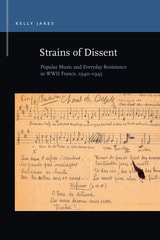
Strains of Dissent
Popular Music and Everyday Resistance in WWII France, 1940 - 1945Kelly Jakes
Michigan State University Press, 2019
War and Wartime Changes
The Transformation of Arkansas, 1940–1945C. Calvin Smith
University of Arkansas Press, 1986
This is a lively history of specific social, political, ad economic changes that all-out war brought to the home front in mid-America. Drawing from letters to the editor in local and state papers, from editorials, from personal interviews, and from the manuscript collections left by state political leaders, Calvin Smith brings into focus the impact of wartime not only upon agricultural and business economics but also upon particular social groups and the lives of individuals.
The war generated the beginnings of a rights revolution in black communities throughout the nation. The author takes a careful look at the resulting strain on relations between the state’s black and white citizens. No less important is the consideration of Japanese Americans from the West Coast who were relocated to camps in Arkansas, and of the Jehovah’s Witnesses who would not take part in the war effort either on the battlefield or at home.
War and Wartime Changes illuminates a fascinating and sometimes embarrassing segment of history which until now has not been presented in a single, cohesive work. The author details the unique experiences Arkansas had at this time as well as the patriotism its citizens felt for their country.
Here is the story for the historian, for every student of society and its ways, and for anyone who wants to understand or remember the patriotic fervor of Americans during World War II. Calvin Smith has created, with persistent and imaginative research, a rare admixture of nostalgia and solid scholarship.