Results by title
2 books match the query '1940 - 1977'
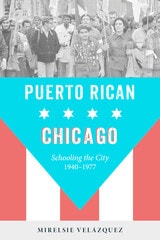
Puerto Rican Chicago
Schooling the City, 1940-1977Mirelsie Velázquez
University of Illinois Press, 2022
Winner of the Critics’ Choice Book awards of the American Educational Studies Association (AESA-CCBA)
The postwar migration of Puerto Rican men and women to Chicago brought thousands of their children into city schools. These children's classroom experience continued the colonial project begun in their homeland, where American ideologies had dominated Puerto Rican education since the island became a US territory. Mirelsie Velázquez tells how Chicago's Puerto Ricans pursued their educational needs in a society that constantly reminded them of their status as second-class citizens. Communities organized a media culture that addressed their concerns while creating and affirming Puerto Rican identities. Education also offered women the only venue to exercise power, and they parlayed their positions to take lead roles in activist and political circles. In time, a politicized Puerto Rican community gave voice to a previously silenced group--and highlighted that colonialism does not end when immigrants live among their colonizers.
A perceptive look at big-city community building, Puerto Rican Chicago reveals the links between justice in education and a people's claim to space in their new home.
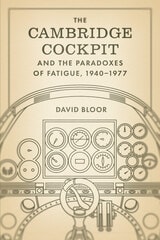
The Cambridge Cockpit and the Paradoxes of Fatigue, 1940–1977
David Bloor
University of Chicago Press, 2025
During World War II, members of the Cambridge Psychology Laboratory were commissioned to study pilot fatigue. They set up a Spitfire cockpit in the laboratory, turned it into a piece of laboratory apparatus, and carried out a series of important experiments that appeared to dramatically confirm the dangers of fatigue. Historians of psychology are aware of this episode, but the experiments, the events surrounding them, and the scientific reasoning involved have never been studied in detail. By going into the episode in depth, and by looking behind the scenes at archival material, David Bloor offers an analysis that is both original and more penetrating than anything that has been said before on the topic.
Bloor describes the Cockpit experiments themselves before turning to the theoretical interpretation of the results and the intellectual resources that informed how they were viewed. Bloor then explains a major empirical and theoretical challenge to the Cambridge Cockpit work drawn from a field study of landing accidents apparently showing that fatigue-effects were operationally negligible. Bloor delves into the consequences of this challenge, and the Cambridge reaction to it, in the post-war years. The analysis is deepened by comparison with the corresponding wartime work on fatigue carried out both in Germany and the United States. As the author demonstrates, even today the Cambridge Cockpit experiments pose a challenge to the current understanding of pilot fatigue.