Results by title
2 books match the query '1940-1991'

The Village and the Class War
Anti-Kulak Campaign in Estonia 1944-49Anu Mai Kõll
Central European University Press, 2013
Before collectivization of agriculture in Estonia, “kulaks” (better-off farmers) were persecuted and many of them were finally deported in March 1949. This book is situated on the local level; the aim is to understand what these processes meant from the perspective of the Estonian rural population, a kind of study that has been missing so far. Analyzes the mechanisms of repression, applying new aspects. Repression was mainly conducted through a bureaucratic process where individual denunciations were not even necessary. The main tool of persecution was a screening of the rural population with the help of records, censuses and local knowledge, in order to identify, or invent, “kulak families”. Moreover, in the Estonian sources, the World War II history of each individual was a crucial part of screenings. The prisoners of war of the Red Army, held in camps in Estonia, played an unexpected part in this campaign. Another result is a so far neglected wave of peaceful resistance as the kulak identifications were challenged in 1947-48. This has not been addressed in the existing literature. The results mainly answer the question “how” this process worked, whereas the question ”why” finds hypothetical responses in the life trajectories of actors.
[more]
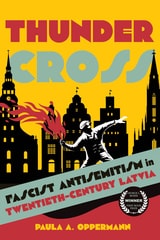
Thunder Cross
Fascist Antisemitism in Twentieth-Century LatviaPaula A. Oppermann
University of Wisconsin Press, 2025
Founded in 1932, Thunder Cross (Pērkonkrusts) was the largest and most prominent right-wing political party in Latvia in the early twentieth century. Its motto—“Latvia for Latvians!”—echoed the ultranationalist rhetoric of similar movements throughout Europe at the time. Unlike the Nazis in Germany or the Fascists in Italy, however, Thunder Cross never succeeded in seizing power. Nevertheless, Holocaust historian Paula A. Oppermann argues, its movement left an indelible mark on the country. The antisemitism at the core of Thunder Cross’s ideology remained a driving force for Latvian fascists throughout the twentieth century, persisting despite shifting historical and political contexts.
Thunder Cross is the most comprehensive study of Latvia’s fascist movement in English to date, and the only work that investigates the often neglected continuities of fascist antisemitism after World War II. Formulated as an empirical case study, this book draws on international and interdisciplinary secondary literature and sources in seven languages to broaden our understanding of fascism, antisemitism, and mass violence from Germany and Italy to the larger European context.
Thunder Cross is the most comprehensive study of Latvia’s fascist movement in English to date, and the only work that investigates the often neglected continuities of fascist antisemitism after World War II. Formulated as an empirical case study, this book draws on international and interdisciplinary secondary literature and sources in seven languages to broaden our understanding of fascism, antisemitism, and mass violence from Germany and Italy to the larger European context.
[more]