Results by title
9 books match the query '1940s'
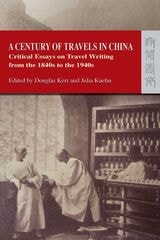
A Century of Travels in China
Critical Essays on Travel Writing from the 1840s to the 1940sEdited by Douglas Kerr and Julia Kuehn
Hong Kong University Press, 2007
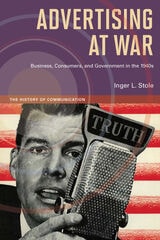
Advertising at War
Business, Consumers, and Government in the 1940sInger L. Stole
University of Illinois Press, 2012
Using archival sources, newspapers accounts, and trade publications, Stole demonstrates that the war elevated and magnified the seeming contradictions of advertising and allowed critics of these practices one final opportunity to corral and regulate the institution of advertising. Exploring how New Dealers and consumer advocates such as the Consumers Union battled the advertising industry, Advertising at War traces the debate over two basic policy questions: whether advertising should continue to be a tax-deductible business expense during the war, and whether the government should require effective standards and labeling for consumer products, which would render most advertising irrelevant. Ultimately the postwar climate of political intolerance and reverence for free enterprise quashed critical investigations into the advertising industry. While advertising could be criticized or lampooned, the institution itself became inviolable.
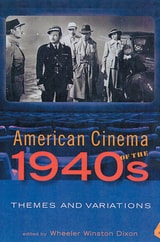
American Cinema of the 1940s
Themes and VariationsDixon, Wheeler Winston
Rutgers University Press, 2005
The 1940s was a watershed decade for American cinema and the nation. Shaking off the grim legacy of the Depression, Hollywood launched an unprecedented wave of production, generating some of its most memorable classics, including Citizen Kane, Rebecca, The Lady Eve, Sergeant York, and How Green Was My Valley. In 1942, Hollywood joined the national war effort with a vengeance, creating a series of patriotic and escapist films, such as Casablanca, Mrs. Miniver, The Road to Morocco, and Yankee Doodle Dandy.
With the end of the war, returning GIs faced a new America, in which the country had been transformed overnight. Film noir reflected a new public mood of pessimism and paranoia, in such classic films of betrayal and conflict as Kiss of Death, Force of Evil, Caught, and Apology for Murder, depicting a poisonous universe of femme fatales, crooked lawyers, and corrupt politicians.
With the threat of the atom bomb lurking in the background and the beginnings of the Hollywood Blacklist, the 1940s was a decade of crisis and change. Featuring essays by a group of respected film scholars and historians, American Cinema of the 1940s brings this dynamic and turbulent decade to life. Illustrated with many rare stills and filled with provocative insights, the volume will appeal to students, teachers, and to all those interested in cultural history and American film of the twentieth century.
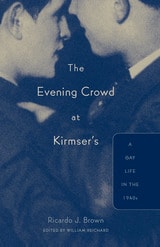
Evening Crowd at Kirmser’s
A Gay Life In The 1940SRicardo J. Brown
University of Minnesota Press, 2003
A surprising and vivid remembrance of gay life in the wake of World War II
It is often difficult to imagine gay gathering places in the decades before the Stonewall riots of the 1960s, and nearly impossible to think of such communities outside the nation’s largest cities. Yet such places did exist, and their histories tell amazing stories of survival and the struggle for acceptance and self-respect.
Kirmser’s was such a place. In the 1940s, this bar in downtown St. Paul was popular with blue-collar customers during the day, then became an unofficial home to working-class gay men and lesbians at night. After Ricardo J. Brown was discharged from the navy for revealing his sexual orientation in 1945, he returned home to Minnesota and discovered in Kirmser’s a space where he could develop his new self-awareness and fulfill his desire to find people like himself.The Evening Crowd at Kirmser’s is Brown’s compelling memoir of his experiences as a young gay man in St. Paul. In an engaging and open writing style, and through stories both humorous and tragic, Brown introduces us to his family, companions, and friends, such as Flaming Youth, a homely, sardonic man who carried the nickname from his youth ironically into middle age; Dale, who suddenly loses his job of six years after an anonymous note informed his employer that he was gay; and Bud York, an attractive and confident man with a fondness for young boys.
Obsessive Images
Symbolism in Poetry of the 1930s and 1940sJoseph Warren BeachWilliam Van O’Connor, Editor
University of Minnesota Press, 1960
Obsessive Images was first published in 1960. Minnesota Archive Editions uses digital technology to make long-unavailable books once again accessible, and are published unaltered from the original University of Minnesota Press editions.
As Mark Schorer comments, this is "the last, unfinished work of a distinguished, well loved critic, poet, and professor." After the death of Joseph Warren Beach, his colleague and friend William Van O'Connor, professor of English at the University of Minnesota, prepared the unfinished manuscript of this work for publication and wrote the foreword.
The work is primarily a study of certain words, phrases, and images that turn up with unusual frequency in modern American poetry, especially that of the decades of the 1930's and 1940's, and which are used in unusual senses, to carry special symbolisms, or to imply peculiar philosophical attitudes. Since the study is concerned with such recurring images and themes, many poets of distinction, in whose work they are not to be found, are left out, but Professor Beach also discusses the significance of the absence of these poets.
Students and critics will gain insight through this work into the characteristic attitudes of a generation of poets. The book is, moreover, a delight to read, reflecting, as it does, Mr. Beach's own love for the study of poetry. As Professor O'Connor points out, the tone is much more personal than that of Mr. Beach's other books.

Rainbow at Midnight
LABOR AND CULTURE IN THE 1940SGeorge Lipsitz
University of Illinois Press, 1994
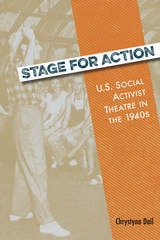
Stage for Action
U.S. Social Activist Theatre in the 1940sChrystyna Dail
Southern Illinois University Press, 2016
Exploring the intersection between performance and politics and the direct impact of the arts on social activism, Dail argues Stage for Action is a theatrical reflection of progressivism and the pro-working-class theatrical aesthetic of the 1940s. The theatre group, which used performance to encourage direct action and personal responsibility for change, eventually would function as the theatrical voice of the United States Progressive Party in the failed presidential campaign of former vice president Henry A. Wallace.
Calling into question the widely held belief that U.S. theatre in the early years of the Cold War was indifferent to activism, Stage for Action offers historians a new interpretation of social activist performance at midcentury.
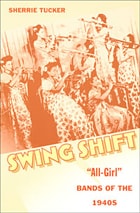
Swing Shift
"All-Girl" Bands of the 1940sSherrie Tucker
Duke University Press, 2001
Filled with firsthand accounts of more than a hundred women who performed during this era and complemented by thorough—and eye-opening—archival research, Swing Shift not only offers a history of this significant aspect of American society and culture but also examines how and why whole bands of dedicated and talented women musicians were dropped from—or never inducted into—our national memory. Tucker’s nuanced presentation reveals who these remarkable women were, where and when they began to play music, and how they navigated a sometimes wild and bumpy road—including their experiences with gas and rubber rationing, travel restrictions designed to prioritize transportation for military needs, and Jim Crow laws and other prejudices. She explains how the expanded opportunities brought by the war, along with sudden increased publicity, created the illusion that all female musicians—no matter how experienced or talented—were “Swing Shift Maisies,” 1940s slang for the substitutes for the “real” workers (or musicians) who were away in combat. Comparing the working conditions and public representations of women musicians with figures such as Rosie the Riveter, WACs, USO hostesses, pin-ups, and movie stars, Tucker chronicles the careers of such bands as the International Sweethearts of Rhythm, Phil Spitalny’s Hours of Charm, The Darlings of Rhythm, and the Sharon Rogers All-Girl Band.
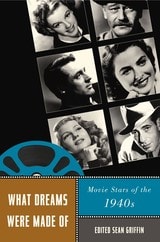
What Dreams Were Made Of
Movie Stars of the 1940sGriffin, Sean
Rutgers University Press, 2011