Results by title
2 books match the query '1945 - 1951'
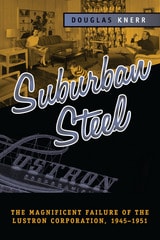
SUBURBAN STEEL
The Magnificent Failure of the Lustron Corporation, 1945–1951Douglas Knerr
The Ohio State University Press, 2004
Suburban Steel chronicles the rise and fall of the Lustron Corporation, once the largest and most completely industrialized housing company in U.S. history. Beginning in 1947, Lustron manufactured porcelain-enameled steel houses in a one-million-square-foot plant in Columbus, Ohio. With forty million dollars in federal funds and support from the highest levels of the Truman administration, the company planned to produce one hundred houses per day, each neatly arranged on specially designed tractor-trailers for delivery throughout the country. Lustron’s unprecedented size and scope of operations attracted intense scrutiny. The efficiencies of uninterrupted production, integrated manufacturing, and economies of scale promised to lead the American housing industry away from its decentralized, undercapitalized, and inefficient past toward a level of rationalization and organization found in other sectors of the industrial economy.
The company’s failure marked a watershed in the history of the American housing industry. Although people did not quit talking about industrialized housing, enthusiasm for its role in the transformation of the housing industry at large markedly waned. Suburban Steel considers Lustron’s magnificent failure in the context of historical approaches to the nation’s perpetual shortage of affordable housing, arguing that had Lustron’s path not been interrupted, affordable and desirable housing for America’s masses would be far more prevalent today.
The Japanese On Trial
Allied War Crimes Operations in the East, 1945–1951By Philip R. Piccigallo
University of Texas Press, 1979
This comprehensive treatment of post–World War II Allied war crimes trials in the Far East is a significant contribution to a neglected subject. While the Nuremberg and, to a lesser degree, Tokyo tribunals have received considerable attention, this is the first full-length assessment of the entire Far East operation, which involved some 5,700 accused and 2,200 trials.
After discussing the Tokyo trial, Piccigallo systematically examines the operations of each Allied nation, documenting procedure and machinery as well as the details of actual trials (including hitherto unpublished photographs) and ending with a statistical summary of cases.
This study allows a completely new assessment of the Far East proceedings: with a few exceptions, the trials were carefully and fairly conducted, the efforts of defense counsel and the elaborate review procedures being especially noteworthy. Piccigallo’s approach to this emotion-filled subject is straightforward and evenhanded throughout. He concludes with a discussion of the broader implications of such war crimes trials, a matter of interest to the general reader as well as to specialists in history, law, and international affairs.