Results by title
4 books match the query '1945 - 1960'
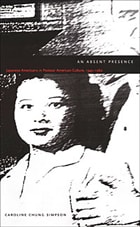
An Absent Presence
Japanese Americans in Postwar American Culture, 1945-1960Caroline Chung Simpson
Duke University Press, 2001
Simpson argues that when popular journals or social theorists engaged the topic of Japanese American history or identity in the Cold War era they did so in a manner that tended to efface or diminish the complexity of their political and historical experience. As a result, the shadowy figuration of Japanese American identity often took on the semblance of an “absent presence.” Individual chapters feature such topics as the case of the alleged Tokyo Rose, the Hiroshima Maidens Project, and Japanese war brides. Drawing on issues of race, gender, and nation, Simpson connects the internment episode to broader themes of postwar American culture, including the atomic bomb, McCarthyism, the crises of racial integration, and the anxiety over middle-class gender roles.
By recapturing and reexamining these vital flashpoints in the projection of Japanese American identity, Simpson fills a critical and historical void in a number of fields including Asian American studies, American studies, and Cold War history.
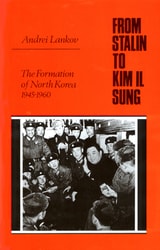
From Stalin to Kim Il Sung
The Formation of North Korea, 1945-1960Lankov, Andrei
Rutgers University Press, 2002
To understand how North Korea has survived as the worlds last Stalinist regime despite international isolationand at enormous human costs to its peopleone must look at how its political system was created. The countrys foundations were laid in the late 1940s and 1950s as a result of interaction between the Soviet Stalinist model, imposed from outside, and local traditions.
Andrei Lankov traces the formation of the North Korean state and the early years of Kim Il Sungs rule, when the future "Great Leader" and his entourage were consolidating their power base. Surveying the situation in North Korea after 1945, Lankov explores the internal composition of the ruling elite, the role of the Soviets, and the uneasy relations between various political groups. He also focuses on how in 1956 Kim Il Sung defeated the only known attempt to oust him and thereby established absolute personal rule beyond either Soviet or Chinese control.
The book is based on previously secret Soviet documents from Russian archives, as well as interviews with Russian and Korean participants.

Not June Cleaver
Women and Gender in Postwar America, 1945-1960June Meyerowitz
Temple University Press, 1994
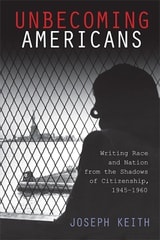
Unbecoming Americans
Writing Race and Nation from the Shadows of Citizenship, 1945-1960Keith, Joseph
Rutgers University Press, 2013
During the Cold War, Ellis Island no longer served as the largest port of entry for immigrants, but as a prison for holding aliens the state wished to deport. The government criminalized those it considered un-assimilable (from left-wing intellectuals and black radicals to racialized migrant laborers) through the denial, annulment, and curtailment of citizenship and its rights. The island, ceasing to represent the iconic ideal of immigrant America, came to symbolize its very limits.
Unbecoming Americans sets out to recover the shadow narratives of un-American writers forged out of the racial and political limits of citizenship. In this collection of Afro-Caribbean, Filipino, and African American writers—C.L.R. James, Carlos Bulosan, Claudia Jones, and Richard Wright—Joseph Keith examines how they used their exclusion from the nation, a condition he terms “alienage,” as a standpoint from which to imagine alternative global solidarities and to interrogate the contradictions of the United States as a country, a republic, and an empire at the dawn of the "American Century.”
Building on scholarship linking the forms of the novel to those of the nation, the book explores how these writers employed alternative aesthetic forms, including memoir, cultural criticism, and travel narrative, to contest prevailing notions of race, nation, and citizenship. Ultimately they produced a vital counter-discourse of freedom in opposition to the new formations of empire emerging in the years after World War II, forms that continue to shape our world today.