Results by title
2 books match the query '1945 - 1991'

Art of the Baltics
The Struggle for Freedom of Artistic Expression under the Soviets, 1945-1991Edited by Alla Rosenfeld
Rutgers University Press, 2001
Art of the Baltics is the first major survey of the development of modernist art in Estonia, Lithuania, and Latvia during the post-World War II Soviet period. The contributors discuss and reappraise the art of Baltic artists working in modernist styles. They argue that Estonian, Lithuanian, and Latvian art did not develop in similar ways. Estonia, for example, had closer contact with Scandinavian countries, while Lithuania clearly was part of Central Europe, and was more influenced by Poland.
This book contains nearly three hundred illustrations—many in color—that serve to visually compare the art of the three Baltic countries. It also has three useful historical timelines that contextualize the art presented. In addition to historical overviews of each country, Art of theBaltics contains essays on the art of the region, written by both Baltic and American scholars. The articles extensively cover the Baltic art of the 1960s through the 1980s, which reflect the Zimmerli Art Museum’s holdings of the Norton and Nancy Dodge Collection of Nonconformist Art from the Soviet Union. To round out the scope of this work, contributors also discuss the pre-Soviet art of the region, as well as the recent creative developments that resulted from these small countries gaining independence in 1991.
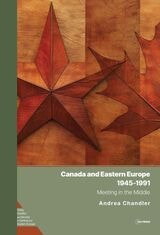
Canada and Eastern Europe, 1945–1991
Meeting in the MiddleAndrea Chandler
Central European University Press, 2024
How democratic regimes should engage with authoritarian regimes, or self-proclaimed authorities in states under occupation, has long been a subject of debate. The work examines Canada's relations with member-states of the Warsaw Pact during the Cold War. Central and East European communist states were nominally independent but established under occupation. Canadian leaders explored whether engaging in foreign relations with these countries would encourage liberalization or embolden dictatorships. Over time, Canada's position evolved as a policy of encouraging bilateral and multilateral diplomacy, while calling for the respect of human rights. However, Canada's economic relationship with East European states was at times at cross-purposes with its democratic principles. Andrea Chandler concludes that while Canada did play a role in encouraging democratization, the country's leaders did not sufficiently consider the impact of these policies on the citizens of Warsaw Pact countries.
This book treats Canada’s engagement with Hungary, Poland, the German Democratic Republic, Romania, Bulgaria and Czechoslovakiaduring the Cold War, in which the Western countries of the North Atlantic Treaty Organization (including Canada) had an adversarial relation with the Soviet bloc nations.