Results by title
5 books match the query '1945-1976'
Precarious Workers
History of Debates, Political Mobilization, and Labor Reforms in ItalyEloisa Betti
Central European University Press, 2023
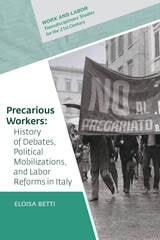
The recent vast upsurge in social science scholarship on job precarity has generally little to say about earlier forms of this phenomenon. Eloisa Betti’s monograph convincingly demonstrates on the example of Italy that even in the post-war phase of Keynesian stability and welfare state, precarious labor was an underlying feature of economic development. She examines how in this short period exceptional politics of labor stability prevailed. The volume then presents the processes whereby labor precarity regained momentum— under the name of flexibility— in the post-Fordist phase from the early 1980s, taking on new forms in the Craxi and Berlusconi eras.
Multiple actors are addressed in the analysis. The book gives voice to intellectuals, scholars, politicians and trade unionists as they have framed the concept and debates on precarious work from the 1950s onwards. Views of labor law experts, politicians and public servants are investigated in regard to labor regulations. Positions of the very precarians are explored, ranging from rural women, industrial homeworkers and blue-collar workers to physicians, university researchers and trainees, unveiling the emergence of anti-precarity social movements. The continuous role of women’s associations and feminist groups in opposing labor precarity since the 1950s is prominently exposed.
The Cinema of Economic Miracles
Visuality and Modernization in the Italian Art FilmAngelo Restivo
Duke University Press, 2002
Restivo studies numerous films of the period, focusing mainly on the works of Pier Paolo Pasolini and Michelangelo Antonioni. He finds that these auteurs’ films reworked the neorealist aesthetic developed in the 1940s and 1950s, explored issues brought to the fore by the subsequent consumer boom, and presaged developments central to both critical theory and the visual arts in the 1980s and 1990s. Drawing on the theories of Lacan, Zizek, Benjamin, Foucault, Jameson, and Deleuze, he shines new light on such films as Pasolini’s Accattone and Teorema, and Antonioni’s Red Desert and Blow-Up. Restivo’s model for understanding the relationship of the 1960s Italian art film to its cultural contexts also has implications that extend to the developing national cinemas of countries such as Brazil and Taiwan.
The Cinema of Economic Miracles will interest scholars and students in all areas of film studies, especially those studying theories of the image, national cinema theory, and Italian cinema, and to those engaged in poststructuralist theory, philosophy, and comparative literature.
The Devil and the Dolce Vita
Catholic Attempts to Save Italy's Soul, 1948-1974Roy Domenico
Catholic University of America Press, 2021
The Montesi Scandal
The Death of Wilma Montesi and the Birth of the Paparazzi in Fellini's RomeKaren Pinkus
University of Chicago Press, 2003
How this news item of everyday life exploded into one of the greatest scandals of a modern democracy is the story Karen Pinkus tells in The Montesi Scandal. Wilma's death brought to the surface every simmering element of Italian culture: bitter aspiring actresses, corrupt politicians, nervous Jesuits in sunglasses, jaded princes. Italians of all types lined up to testify-in court or to journalists of varying legitimacy-about the death of the middle-class carpenter's daughter, in the process creating a media frenzy and the modern culture of celebrity. Witnesses sold their stories to the tabloids, only to retract them. They posed for pictures, pretending to shun the spotlight. And they in turn became celebrities in their own right.
Pinkus takes us through the alleys and entryways of Rome in the 1950s, linking Wilma's death to the beginnings of the dolce vita, now synonymous with modern Roman life. Pinkus follows the first paparazzi on their scooters as they shoot the protagonists and gives us an insider's view of the stories and trials that came to surround this lonely figure that washed up on the shores of Ostia. Full of the magnificent paparazzi photos of the protagonists in the drama and film stills from the era's landmark movies, The Montesi Scandal joins true crime with "high" culture in an original form, one true to both the period and the cinematic conception of life it created. More than a meditation of the intricate ties among movies, paparazzo photography, and Italian culture, The Montesi Scandal narrates Wilma's story and its characters as the notes for an unrealized film, but one that, as the reader discovers, seems impossible to produce.
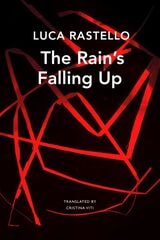
The Rain's Falling Up
Luca Rastello
Seagull Books, 2022
What was it really like to be a teenager growing up in Italy in the 1970s, during a time it has become all too easy to file away under “years of lead,” as the fathers’ betrayed ideals came face to face with the sons’ and daughters’ rebellions? What was happening in schools, in assemblies, social centers, and occupied factories as the postwar “economic miracle” was being dismantled from within? What moved the foremost French intellectuals of the time to sign an appeal against the repression of the student and workers’ movement in Italy? What did the bullets and heroin bring to a halt, and where did they come from? How does it feel when strategies of terror and police brutality become as ordinary as a TV dinner and as eerie as the plots of the science fiction novels you are plagiarizing to impress a girl? How are metropolitan geographies alchemized in the muscles of a young body crossing the shady lines between ages and sexes?
Luca Rastello raises these and other questions in an astonishing novel that splices chunks of plot and historical reconstruction into the free flow of memory and dream. Rain’s Falling Up tracks the trajectory of a generation while refusing to romanticize its protagonists or resolve the tensions that powered its volatile energy.