Results by title
8 books match the query '1945-1980'
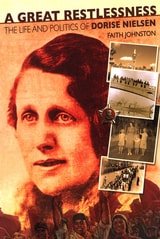
A Great Restlessness
The Life and Politics of Dorise NielsenFaith Johnston
University of Manitoba Press, 2006
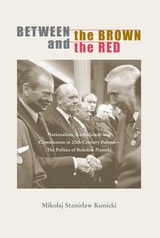
Between the Brown and the Red
Nationalism, Catholicism, and Communism in Twentieth-Century Poland—The Politics of Boleslaw PiaseckiMikolaj Stanislaw Kunicki
Ohio University Press, 2012
Between the Brown and the Red captures the multifaceted nature of church-state relations in communist Poland, relations that oscillated between mutual confrontation, accommodation, and dialogue. Ironically, under communism the bond between religion and nation in Poland grew stronger. This happened in spite of the fact that the government deployed nationalist themes in order to portray itself as more Polish than communist. Between the Brown and the Red also introduces one of the most fascinating figures in the history of twentieth-century Poland and the communist world.
In this study of the complex relationships between nationalism, communism, authoritarianism, and religion in twentieth-century Poland, Mikołaj Kunicki shows the ways in which the country’s communist rulers tried to adapt communism to local traditions, particularly ethnocentric nationalism and Catholicism. Focusing on the political career of Bolesław Piasecki, a Polish nationalist politician who began his surprising but illuminating journey as a fascist before the Second World War and ended it as a procommunist activist, Kunicki demonstrates that Polish communists reinforced an ethnocentric self-definition of Polishness and—as Piasecki’s case demonstrates—thereby prolonged the existence of Poland’s nationalist Right.
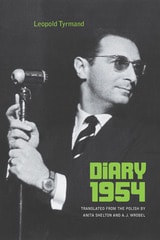
Diary 1954
Leopold Tyrmand
Northwestern University Press, 2014
Leopold Tyrmand, a Polish Jew who survived World War II by working in Germany under a false identity, would go on to live and write under Poland’s Communist regime for twenty years before emigrating to the West, where he continued to express his deeply felt anti-Communist views. Diary 1954—written after the independent weekly paper that employed him was closed for refusing to mourn Stalin’s death—is an account of daily life in Communist Poland. Like Czesław Miłosz, Václav Havel, and other dissidents who described the absurdities of Soviet-backed regimes, Tyrmand exposes the lies—big and small—that the regimes employed to stay in power. Witty and insightful, Tyrmand’s diary is the chronicle of a man who uses seemingly minor modes of resistance—as a provocative journalist, a Warsaw intellectual, the "spiritual father" of Polish hipsters, and a promoter of jazz in Poland—to maintain his freedom of thought.
My Family's Role in the World Revolution
and Other ProseBora Cosic
Northwestern University Press, 1997
During the German occupation of Belgrade, a family—including an alarmist mother, an eternally drunk father, two young aunts who swoon over American movie stars, and a playboy uncle—attempt to find any kind of work they can do at home. When the postwar Socialist society is being ushered in after the war, the narrator becomes the slogan-spouting ideological leader of the household, while his family tries—and often fails miserably—to take part in the "great change."
This volume also includes several Ćosić short stories, and recent essays on the war in the former Yugoslavia.
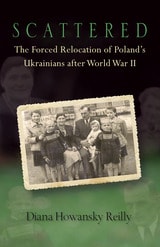
Scattered
The Forced Relocation of Poland’s Ukrainians after World War IIDiana Howansky Reilly
University of Wisconsin Press, 2013
Born in the Lemko region of southeastern Poland, Petro, Melania, and Hania Pyrtej survived World War II only to be separated by political decisions over which they had no control. Petro relocated with his wife to Soviet Ukraine during the population exchange of 1944–46, while his sisters Melania and Hania were resettled to western Poland through Operation Vistula in 1947. As the Ukrainian Insurgent Army fought resettlement, the Polish government meanwhile imprisoned suspected sympathizers within the Jaworzno concentration camp. Melania, Reilly's maternal grandmother, eventually found her way to the United States during Poland's period of liberalization in the 1960s.
Drawing on oral interviews and archival research, Reilly tells a fascinating, true story that provides a bottom-up perspective and illustrates the impact of extraordinary historical events on the lives of ordinary people. Tracing the story to the present, she describes survivors' efforts to receive compensation for the destruction of their homes and communities.
Silver Medal for World History, Independent Publisher Book Awards
Finalist, Housatonic Book Awards
Finalist in History, Foreword Books of the Year
Solidarity And Contention
Networks Of Polish OppositionMaryjane Osa
University of Minnesota Press, 2003
Offers an innovative model for understanding how social movements occur in repressive societies
After a series of failed attempts at mobilizing society, Poland’s opposition sprang to surprising—and newly effective—life with the formation of the Solidarity trade union in 1980. If not for those past failures, this book suggests, Solidarity might never have succeeded. Solidarity and Contention deftly reconstructs the networks of protest in Communist Poland to show how waves of dissent during the 1950s, 1960s, and 1970s left an organizational residue that both instructed and enabled Solidarity and, ultimately, the Polish revolution.
Using newly available documentary sources, Maryjane Osa establishes links between activists during three waves of protest: 1954 to 1959, 1966 to 1970, and 1976 to 1980. She shows how political challengers, applying lessons drawn from past failures, developed an ideological formula to de-emphasize divisive issues and promote symbolic concerns, thus facilitating coalition building. Solidarity was therefore able to take advantage of a large opposition network already well in place before the founding of the union. An important case study in itself, the book also answers one of the most intriguing questions in social movement research: how can movements emerge in authoritarian states—where media are state controlled, the rights of assembly and speech are restricted, and the risks of collective action are high?
TITO
Yugoslavia’s Great Dictator, A ReassessmentStevan K. Pavlowitch
The Ohio State University Press, 1992
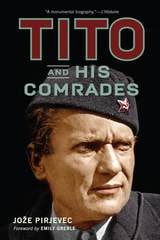
Tito and His Comrades
Jože Pirjevec, Foreword by Emily Greble
University of Wisconsin Press, 2018
With his Partisans he fought Hitler during World War II, and after the war he shrewdly resisted the Soviet Union's grasp. A leader of the non-aligned nations, he long enjoyed a reputation in the West as "the only good Communist" despite a dubious human rights record at home. Jože Pirjevec employs impressive research from archives in eight languages to offer this illuminating, definitive portrait of a complex man in turbulent times.
Pirjevec recounts how Tito, with little schooling but an astute intellect and driving ambition, rose through Communist Party ranks to shape and rule the Yugoslav federation. Surviving multiple assassination attempts by Nazis, Soviet spies, and others, Tito boldly threatened Stalin in return and may have, Pirjevec reveals, contrived Stalin's death. The narrative follows Tito's personal and political life into old age, as the specter of a Soviet invasion haunted him until his death at age eighty-seven. Available in English for the first time, this edition includes new material from Pirjevec and a foreword by Emily Greble.