Results by title

15 books match the query '1945-1990'
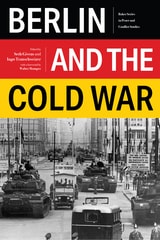
cover of Berlin and the Cold War

Berlin and the Cold War

Seth Givens; Ingo Trauschweizer

Ohio University Press, 2024

The Cold War is back in the news. So is history, in the sense of past geopolitical confrontations that for a span of a few decades were thought to be largely decoupled from present-day political developments. Of course, such reflexive reactions lack nuance and, until the Russian invasion of Ukraine in February 2022, tended to refer more to tensions between the United States and China. We should neither see Russia’s aggressive war in Ukraine immediately as part of a new cold war—though it could certainly become one of its foundation pieces—nor define history simply in terms of warfare and conflict. Yet such history has great appeal in efforts to understand the dizzying and depressing events of recent years. For example, correspondents and commentators have likened the delivery of weapons systems, protective gear, and humanitarian aid to a beleaguered Ukraine to the Berlin Airlift of 1948–49. But relying on history as a guide may mislead as much as enlighten. No city symbolizes the Cold War quite as Berlin does. When we think of the Cold War and of Berlin, we tend to emphasize the crises—the 1948–49 blockade and airlift, perhaps the 1953 East German workers’ uprising, surely the 1958­–61 crisis, during which the Berlin Wall was built—and the climactic ending of the Cold War in Europe when the wall came down. Berlin may conjure up iconic moments and tropes, from a statement attributed to Nikita Khrushchev in 1963 that Berlin was “the testicles of the West,” to John F. Kennedy’s insistence that all free men had to be invested in the defense of Berlin, to Ronald Reagan’s exhortation to Mikhail Gorbachev to “tear down this wall.” For American presidents (or presidential hopefuls), Berlin and the Brandenburg Gate have remained powerful images, even in the twenty-first century. A presence in Berlin signals strong leadership in the West, even though the proximate reasons why the West, as a political construct, emerged in the first place may be gone. In that sense, Berlin also stands for overcoming the past: first, West Berlin as the counterpoint not only to eastern communism but also to defeated fascism, and second, the new Berlin as the capital of a unified Germany and as a symbol that the West has won.
[more]
cover of Couplings

Couplings

Peter Schneider

University of Chicago Press, 1998

Eduard Hoffman is a microbiologist with an interest in relationships. He believes he's found "a strain of separation virus" raging in West Berlin in 1983, which terminates every relationship within three years, 167 days, and 2 hours. As Eduard attempts to evade the virus, he tangles with Germany's Nazi guilt, memories of his father, a wayward mouse, and other threats to his identity in a divided country.

"A little Don Giovanni, a little café sociology, a little laboratory science, a little Berlin wit—it's a pleasant mix."—Suzanne Ruta, New York Times Book Review

"With its poignant valedictory to its protagonists' waning youth and its rueful placing of them in the firing line of history, Couplings achieves a balance of light and dark that is utterly persuasive."—Michael Upchurch, San Francisco Chronicle Book Review

[more]
cover of Germany 1945-1990: A Parallel History

Germany 1945-1990

A Parallel History

Jürgen Weber

Central European University Press, 2004

This book offers lively description and convincing interpretation of the most significant events, cruxes and ongoing themes in German history from the end of the Second World War up to the present. The main features of the last fifty years are not only succinctly and vividly presented and interpreted, they are also placed in the context of international political developments.

The chronologies that accompany each chapter record the most important dates, facts and names occurring in the narrative. Jürgen Weber’s text supplies the reader with a combination of vivid descriptive history, easily absorbed chronology, and a reliable reference work for the parallel lives of the two Germanies, a product of the Cold War.
[more]
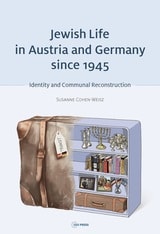
cover of Jewish Life in Austria and Germany Since 1945: Identity and Communal Reconstruction

Jewish Life in Austria and Germany Since 1945

Identity and Communal Reconstruction

Susanne Cohen-Weisz

Central European University Press, 2016
Based on published primary and secondary materials and oral interviews with some eighty communal and organizational leaders, experts and scholars, this book provides a comparative account of the reconstruction of Jewish communal life in both Germany and in Austria (where 98% live in the capital, Vienna) after 1945. The author explains the process of reconstruction over the next six decades, and its results in each country. The monograph focuses on the variety of prevailing perceptions about topics such as: the state of Israel, one’s relationship to the country of residence, the Jewish religion, the aftermath of the Holocaust, and the influx of post-soviet immigrants. Cohen-Weisz examines the changes in Jewish group identity and its impact on the development of communities. The study analyzes the similarities and differences in regard to the political, social, institutional and identity developments within the two countries, and their changing attitudes and relationships with surrounding societies; it seeks to show the evolution of these two country’s Jewish communities in diverse national political circumstances and varying post-war governmental policies.
[more]
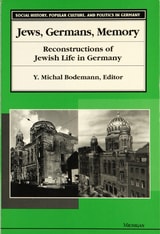
cover of Jews, Germans, Memory: Reconstructions of Jewish Life in Germany

Jews, Germans, Memory

Reconstructions of Jewish Life in Germany

Y. Michal Bodemann, Editor

University of Michigan Press, 1996

How was it possible that a new and sizeable Jewish community developed after the Holocaust in Germany of all places? Jews, Germans, Memory undertakes to assess the past, present, and future of German-Jewish relations in the light of recent political changes and the opening up of historical resources. This welcome new volume investigates how the groundwork was laid for the new Jewish community in the post-war period, with different objectives by Jewish leaders and German politicians. Its contributors touch upon history, literature, the media, ethnicity, politics, and social movements, and attempt to answer the question of how Jews are socially constructed and how the glorious German Jewish past and the Holocaust have been remembered in the course of recent decades. In recent years, German Jewry has seen fundamental transformations with the influx from Eastern Europe and a new leadership in the community. A new self-definition, even self-assurance and reappraisal in Israel and elsewhere, has evolved. Historians, scholars of cultural studies, and those interested in debates on memory and ethnicity will all find something of interest in this diverse volume. Jews, Germans, Memory joins in debate Michael Brenner, Micha Brumlik, Dan Diner, Cilly Kugelmann, and Martin Löw-Beer, among the most prominent younger Jewish intellectuals in Germany today, with others who have long observed Germany from both inside and outside: Y. Michal Bodemann, John Borneman, Andrei Markovits, Robin Ostrow, Moishe Postone, Frank Stern, and Jack Zipes. Y. Michal Bodemann is Professor of Sociology, University of Toronto.
[more]
cover of Kibbutz Buchenwald: Survivors and Pioneers

Kibbutz Buchenwald

Survivors and Pioneers

Judith Tydor Baumel

Rutgers University Press, 1997

Kibbutz Buchenwald is the story of a nightmare that became a dream and a dream that became a reality. Emerging from the depths of the liberated concentration camp Buchenwald in the spring of 1945, a group of sixteen gaunt and battered young men organized and formed Kibbutz Buchenwald, the first agricultural collective in postwar Germany designed to prepare Jews for emigation to Palestine. What caused a handful of survivors to take their fate into their own hands within days of their liberation, at a time when most survivors were passively awaiting orders from the occupying forces? From what wellsprings did they draw the physical and emotional strength to begin life anew as Zionist pioneers in a world which had turned upside down?

Judith Baumel's moving account of this courageous group is divided into two parts. Part One, entitled "The Dream," examines the kibbutz from its creation in Germany until the departure of the founding group for Palestine in the summer of 1945. Part Two, "The Reality," follows the members of Kibbutz Buchenwald into Palestine, where they eventually established their own independent settlement in 1948. This settlement exists as Kibbutz Netzer Sereni today.

Drawing from the diaries of the kibbutz's founding members, Baumel provides a detailed account of an incredible story and places the central narrative in the larger contexts of communal living, European politics after the war, and the link between European Jewry and Israeli postwar nationhood. An afterword, "Where Are They Now," briefly describes the later life of each of the original kibbutz members.
[more]
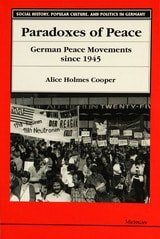
cover of Paradoxes of Peace: German Peace Movements Since 1945

Paradoxes of Peace

German Peace Movements Since 1945

Alice Holmes Cooper

University of Michigan Press, 1996
Given the militarism of the Empire and Nazi Germany, why did postwar West Germany experience massive waves of peace protest in the 1950s, 1960s, and 1980s? How have postwar peace movements shaped German political culture? Will the cultural norms that frown on the use of military force constrain foreign policy in the new, unified, Germany? In Paradoxes of Peace, Alice Holmes Cooper traces the evolution of peace movements in West Germany (1945-90) and in united Germany since 1990. Cooper examines the domestic and international constellations that gave rise to the peace movements, the sources of their multi-faceted ideologies and participants, and their organizational structures and strategies. The author then investigates the peace movement's response to the challenges of the post-Cold War world. Whereas previous work on German peace movements has concentrated on one period of mobilization or on elite security-policy debates, this comprehensive study examines all phases of mobilization since 1945, taking into account the full spectrum of actors, movement organization and strategy, and the broad political, social, and economic environments spawning peace protest. Arguing that theories of resource mobilization, changes in values, and crises of modernity are insufficient to explain peace movements, Paradoxes of Peace tailors a "political process" approach to postwar German movements. It investigates the political opportunities--the changing domestic and international constellation--which most favored peace mobilization since 1945. It examines the process through which the peace movement transformed popular consciousness and created a peace constituency. It analyzes how German peace movements gradually built an indispensable organizational infrastructure autonomous from parties and other social institutions. Cooper argues that the convergence of these factors determined the movement's capacity to mobilize and have political impact and allowed these to grow over time. Alice Holmes Cooper is Assistant Professor of Government, University of Virginia.
[more]
cover of Rebuilding Jewish Life in Germany

Rebuilding Jewish Life in Germany

Jay Howard Geller

Rutgers University Press, 2020

Seventy-five years after the Holocaust, 100,000 Jews live in Germany. Their community is diverse and vibrant, and their mere presence in Germany is symbolically important. In Rebuilding Jewish Life in Germany, scholars of German-Jewish history, literature, film, television, and sociology illuminate important aspects of Jewish life in Germany from 1949 to the present day.  In West Germany, the development of representative bodies and research institutions reflected a desire to set down roots, despite criticism from Jewish leaders in Israel and the Diaspora.  In communist East Germany, some leftist Jewish intellectuals played a prominent role in society, and their experience reflected the regime’s fraught relationship with Jewry.  Since 1990, the growth of the Jewish community through immigration from the former Soviet Union and Israel have both brought heightened visibility in society and challenged preexisting notions of Jewish identity in the former “land of the perpetrators.”

 
[more]
cover of The British Army of the Rhine: Turning Nazi Enemies into Cold War Partners

The British Army of the Rhine

Turning Nazi Enemies into Cold War Partners

Peter Speiser

University of Illinois Press, 2016

Between 1945 and 1957, West Germany made a dizzying pivot from Nazi bastion to Britain's Cold War ally against the Soviet Union. Successive London governments, though often faced with bitter public and military opposition, tasked the British Army of the Rhine (BAOR) to serve as a protecting force while strengthening West German integration into the Western defense structure.

Peter Speiser charts the BAOR's fraught transformation from occupier to ally by looking at the charged nexus where British troops and their families interacted with Germany's civilian population. Examining the relationship on many levels, Speiser ranges from how British mass media representations of Germany influenced BAOR troops to initiatives taken by the Army to improve relations. He also weighs German perceptions, surveying clashes between soldiers and civilians and comparing the popularity of the British services with that of the other occupying powers. As Speiser shows, the BAOR's presence did not improve the relationship between British servicemen and the German populace, but it did prevent further deterioration during a crucial and dangerous period of the early Cold War.

An incisive look at an under-researched episode, The British Army of the Rhine sheds new light on Anglo-German diplomatic, political, and social relations after 1945, and evaluates their impact on the wider context of European integration in the postwar era.
[more]
cover of The Postwar Transformation of Germany: Democracy, Prosperity and Nationhood

The Postwar Transformation of Germany

Democracy, Prosperity and Nationhood

John S. Brady, Beverly Crawford, and Sarah Elise Wiliarty, Editors

University of Michigan Press, 1999
As Germany celebrates the fiftieth anniversary of the founding of the Federal Republic of Germany--the former West Germany-- leading scholars take stock in this volume of the political, social, and economic progress Germany made as it built a democratic political system and a powerful economy, survived the Cold War, and dealt with the challenges of reunification.
The contributors address issues such as Germany's response to extremists, the development of a professional civil service, judicial review, the maintenance of the welfare state, the nature of contemporary German nationalism, and Germany's role in the world.
Contributors are Thomas Banchoff, Thomas U. Berger, Patricia Davis, Ernst Haas, Jost Halfmann, Christard Hoffmann, Carl-Lugwig Holtfrerich, Donald P. Kommers, Wolfgang Krieger, Peter Krueger, Gregg O. Kvistad, Ludger Lindlar, Charles Maier, Andrei Markovitz, Peter Merkl, Claus Offe, Simon Reich, and Michaela Richter.
John S. Brady and Sarah Elise Wiliarty are doctoral candidates in the Department of Political Science, University of California, Berkeley. Beverly Crawford is Professor of Political Science, Senior Lecturer in Political Economy of Industrial Societies, and Associate Director, Center for German and European Studies, University of California, Berkeley.
[more]
cover of The Ruin Dwellers: Progress and Its Discontents in the West German Counterculture

The Ruin Dwellers

Progress and Its Discontents in the West German Counterculture

Jake P. Smith

University of Chicago Press, 2025

Traces the shifting dynamics within leftist activism in 1970s and ’80s Europe and its experiments in art, life, and politics.

The Ruin Dwellers takes readers into the urban spaces of youth revolts during the 1970s and ’80s in West Germany and elsewhere in western and central Europe. Whereas earlier generations of leftist activists were primarily oriented toward the utopian future, participants in the youth movements of the 1970s and ’80s developed a more complex set of temporal practices that sought to scramble the borders between the past, present, and future.
 
Examining a rich corpus of radical texts and practices, historian Jake P. Smith shows that squatters and their leftist allies in this period engaged in social, cultural, and aesthetic experiments with modes of autonomous living. Smith brings to life the real and imagined landscapes conjured in squatted houses and street protests; in art, dress, music, graffiti, and film; and in philosophical, poetic, and political texts. In so doing, he offers an eye-opening look at anarchic world-making practices that found new ways of imagining an emancipated future through inhabiting the fractured past.
[more]
cover of The Sins of the Fathers: Germany, Memory, Method

The Sins of the Fathers

Germany, Memory, Method

Jeffrey K. Olick

University of Chicago Press, 2016

National identity and political legitimacy always involve a delicate balance between remembering and forgetting. All nations have elements in their past that they would prefer to pass over—the catalog of failures, injustices, and horrors committed in the name of nations, if fully acknowledged, could create significant problems for a country trying to move on and take action in the present. Yet denial and forgetting carry costs as well.

Nowhere has this precarious balance been more potent, or important, than in the Federal Republic of Germany, where the devastation and atrocities of two world wars have weighed heavily in virtually every moment and aspect of political life. The Sins of the Fathers confronts that difficulty head-on, exploring the variety of ways that Germany’s leaders since 1949 have attempted to meet this challenge, with a particular focus on how those approaches have changed over time. Jeffrey K. Olick asserts that other nations are looking to Germany as an example of how a society can confront a dark past—casting Germany as our model of difficult collective memory.

[more]
cover of Waiting for Hope: Jewish Displaced Persons in Post-World War II Germany

Waiting for Hope

Jewish Displaced Persons in Post-World War II Germany

Angelika Konigseder

Northwestern University Press, 2001

After the defeat of Germany in World War II, more than a hundred thousand Jewish survivors of the Holocaust were transported to camps maintained by the allies for displaced persons (DPs). In this new history, historians Angelika Königseder and Juliane Wetzel offer a social and cultural history of the post-WWII displaced persons camps.

Starting with the discovery of death camps by Allied forces, Königseder and Wetzel describe the inadequate preparations made for the survivors. The soldiers were ill equipped to deal with the physical wreckage and mental anguish of their charges, but American rabbis soon arrived to perform invaluable work helping the survivors cope. The historians also devote attention to autonomous Jewish life in and near the camps: theater groups and orchestras prospered, schools were founded, a tuberculosis hospital and clinic for DPs was established, and underground organizations handled illegal immigration to Israel and trained soldiers to fight in Palestine.

Drawing on original documents and the work of other historians, Waiting for Hope sheds light on a largely unknown period in postwar Jewish history and shows that the suffering of the survivors did not end with the war.
[more]
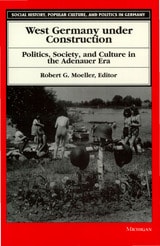
cover of West Germany under Construction: Politics, Society, and Culture in the Adenauer Era

West Germany under Construction

Politics, Society, and Culture in the Adenauer Era

Robert G. Moeller, Editor

University of Michigan Press, 1997

From the perspective of the 1990s, it is possible to see the road to the Bonn Republic and West Germany's "social market economy" as the "correct" postwar German path. But unified Germany continues to confront enormous problems of social inequality and widespread resistance to the acceptance of a truly multi-cultural society. By exploring how West Germans confronted -- or failed to confront -- similar problems in the early history of the Federal Republic, this collection makes a crucial contribution to understanding the present. Moving beyond accounts of high politics and international relations, the essays brought together here focus on the intersections between the politics of daily life and the politics of the nation-state. Building on the approaches of women's history, social history, and cultural studies, they emphasize that the process of defining West Germany in the 1950s took place not only in the geopolitical arena of the Cold War but also in dance halls and at the movies, in worker-training programs, and in patterns of consumption. West Germany under Construction not only expands our understanding of the early formation of West German society, it also outlines ways to continue the excavation of that past. It will be mandatory reading for students and scholars alike.
[more]
cover of Writing and the West German Protest Movements: The Textual Revolution

Writing and the West German Protest Movements

The Textual Revolution

Mererid Puw Davies

University of London Press, 2016

The 1960s protest movements marked an astonishing moment for West Germany. They developed a political critique, but are above all distinctive for their overwhelming emphasis on culture and the symbolic. In particular, reading and writing had a uniquely prestigious status for West German protesters, who produced an extraordinary textual culture ranging from graffiti and flyers to agit-prop poetry and autobiographical prose. By turns witty, provocative, reflective and offensive, the avantgarde roots of anti-authoritarianism are as palpable in their texts as their debt to high literature. But due to this culture’s (apparently) anti-literary tone, it has often remained illegible to traditional criticism. This volume presents close readings and analyses of emblematic examples of texts, some forgotten, others better known, embedding them in historical, cultural, theoretical and aesthetic context, and illuminating representative moments and preoccupations in anti-authoritarian culture, from the Vietnam War to the Nazi past, to dirt and hygiene. They outline an anti-authoritarian poetics and uncover some of the texts’ latent content, revealing often hidden tensions and contradictions, above all in relation to the German past and questions of authority.
[more]