Results by title
8 books match the query '1945-1992'
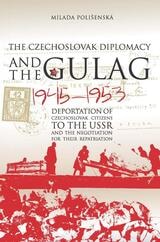
Czechoslovak Diplomacy and the Gulag
Deportation of Czechoslovak Citizens to the USSR and the Negotiation for their Repatriation, 1945-1953Milada Polisenská
Central European University Press, 2016

Limits and Possibilities
The Crisis of Yugoslav Socialism and State Socialist SystemsBogdan Denitch
University of Minnesota Press, 1990
Limits and Possibilities was first published in 1990. Minnesota Archive Editions uses digital technology to make long-unavailable books once again accessible, and are published unaltered from the original University of Minnesota Press editions.
The nature of the Eastern European Socialist state and its potential for transformation without sacrificing its specific identity is the subject of extensive current debate. Limits and Possibilities is the first book to be written that deals conceptually and historically with the myriad kinds of change a state might undergo. Bogdon Denitch has chosen the Yugoslavian model to frame his analysis because it initiated these "modernizing" changes in the 1960s and can therefore provide a case study of the limits of reforms possible in Communist regimes. In using the Yugoslav case paradigmatically, the volume addresses in a more general sense the issues of decentralization, autonomy for nonparty and nonstate institutions, multi-ethnicity, new social movements, including the "greens," and the role of women and women's movements.
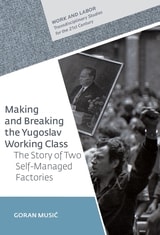
Making and Breaking the Yugoslav Working Class
The Story of Two Self-Managed FactoriesGoran Music
Central European University Press, 2021
Workers' self-management was one of the unique features of communist Yugoslavia. Goran Musić has investigated the changing ways in which blue-collar workers perceived the recurring crises of the regime. Two self-managed metal enterprises, one in Serbia another in Slovenia, provide the frame of the analysis in the time span between 1945 and 1989. These two factories became famous for strikes in 1988 that evoked echoes in popular discourses in former Yugoslavia. Drawing on interviews, factory publications and other media, local archives, and secondary literature, Musić analyzes the two cases, going beyond the clichés of political manipulation from the top and workers' intrinsic attraction to nationalism.
The author explains how, in the later phase of communist Yugoslavia, growing social inequalities among the workers and undemocratic practices inside the self-managed enterprises facilitated the spread of a nationalist and pro-market ideology on the shop floors. Yet rather than being a mass taken advantage of by populist leaders, the working class Musić presents is one with agency and voice, a force that played an important role in shaping the fate of the country. The book thus seeks to open a debate on the social processes leading up to the dissolution of Yugoslavia.
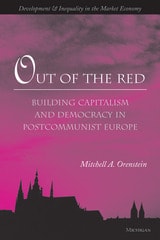
Out of the Red
Building Capitalism and Democracy in Postcommunist EuropeMitchell A. Orenstein
University of Michigan Press, 2001
A detailed analysis of Poland and the Czech Republic suggests that alternation between strategies has been the secret to the success of East-Central European countries.
This comparative case analysis identifies the significance of reform mistakes during transition and the corrective benefits of policy alternation, its claims illustrated with an in-depth study of privatization policy in the two countries.
Mitchell A. Orenstein delves into the historic struggle to build capitalism and democracy during a decade of post- communist transition in East-Central Europe and develops a model that explains why democratic policy alternation may accelerate policy learning under conditions of uncertainty and constraint.
Out of the Red is accessible to a general audience and as such is suitable for both graduate and undergraduate courses on political economy. It will be of particular interest to economists, political scientists, sociologists, students of postcommunism, and anyone interested in the relations between capitalism and democracy in the contemporary world.
Mitchell A. Orenstein is Assistant Professor of Political Science, Syracuse University.
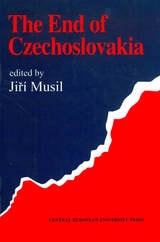
The End of Czechoslovakia
Jirí Musil
Central European University Press, 1995
Scholars and practitioners from both sides of the divide, Czech and Slovak, as well as international experts, take an in-depth look at the causes of Czechoslovakia's break-up, and explain why a seemingly successful country should disintegrate so quickly after the collapse of the communist regime. Besides exploring the political processes leading to the split, the authors analyse the underlying social, economic and cultural differences between the two nations and examine the historical roots of the problems. Particular attention is paid to changing Czech and Slovak attitudes towards the common state and towards each other, from the heyday of the First Republic to the disillusionment of the post-1989 period.
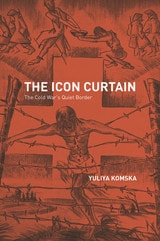
The Icon Curtain
The Cold War's Quiet BorderYuliya Komska
University of Chicago Press, 2015
Yuliya Komska transports readers to the western edge of the Bohemian Forest, one of Europe’s oldest borderlands, where in the 1950s civilians set out to shape the so-called prayer wall. A chain of new and repurposed pilgrimage sites, lookout towers, and monuments, the prayer wall placed two long-standing German obsessions, forest and border, at the heart of the century’s most protracted conflict. Komska illustrates how civilians used the prayer wall to engage with and contribute to the new political and religious landscape. In the process, she relates West Germany’s quiet sylvan periphery to the tragic pitch prevalent along the Iron Curtain’s better-known segments.
Steeped in archival research and rooted in nuanced interpretations of wide-ranging cultural artifacts, from vandalized religious images and tourist snapshots to poems and travelogues, The Icon Curtain pushes disciplinary boundaries and opens new perspectives on the study of borders and the Cold War alike.

The Prague Spring, 1968
The National Security Archive Navratíl
Central European University Press, 1998
Presented in a highly readable form, the book offers top-level documents from Kremlin Politburo meetings, multi-lateral sessions of the Warsaw Pact leading up to the decision to invade, and even transcriptions of KGB-recorded phone conversations between Leonid Brezhnev and Alexander Dubcek. Once highly classified American documents from the National Security Council, CIA, and other relevant agencies acquired through the U.S. Freedom of Information Act have also been included.
In order to provide a historical and political context, the editors have included an introductory essay for each section of the volume. A chronology, glossary, and bibliography offer further background information for the reader. As members of the commission appointed by Václav Havel to investigate the events of 1967-1970, the editors have a unique Czech-Slovak perspective to offer to foreign audiences.
The Shape of Populism
Serbia before the Dissolution of YugoslaviaMarko Grdešic
University of Michigan Press, 2019