Results by title
93 books match the query '1946-' and 4 start with a
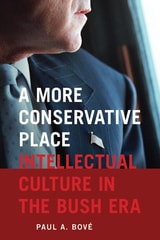
A More Conservative Place
Intellectual Culture in the Bush EraPaul A. Bové
Dartmouth College Press, 2013
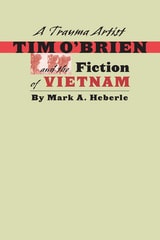
A Trauma Artist
Tim O'Brien and the Fiction of VietnamMark A. Heberle
University of Iowa Press, 2001
A Trauma Artist examines how O'Brien's works variously rewrite his own traumatization during the war in Vietnam as a never-ending fiction that paradoxically "recovers" personal experience by both recapturing and (re)disguising it. Mark Heberle considers O'Brien's career as a writer through the prisms of post-traumatic stress disorder, postmodernist metafiction, and post-World War II American political uncertainties and public violence.
Based on recent conversations with O'Brien, previously published interviews, and new readings of all his works through 1999, this book is the first study to concentrate on the role and representation of trauma as the central focus of all O'Brien's works, whether situated in Vietnam, in post-Vietnam America, or in the imagination of protagonists suspended between the two. By doing so, Heberle redefines O'Brien as a major U.S. writer of the late twentieth century whose representations of self-damaging experiences and narratives of recovery characterize not only the war in Vietnam but also relationships between fathers and sons and men and women in the post-traumatic culture of the contemporary United States.
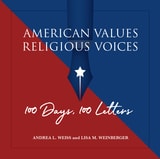
American Values, Religious Voices
100 Days. 100 LettersAndrea L. Weiss and Lisa M. Weinberger
University of Minnesota Press, 2018
American Values, Religious Voices: 100 Days, 100 Letters is a collection of letters written by some of America’s most accomplished and thoughtful scholars of religion during the first 100 days of the Trump presidency. While the letters are addressed to the president, vice president, and members of the 115th Congress and Trump administration, they speak to a broad audience of Americans looking for wisdom and encouragement at this tumultuous time in our nation’s history.
This unique volume assembles the 100 letters, plus four new supplemental essays and many of the graphic illustrations that enhanced the campaign.
Published near the midway point of the Trump presidency, this book showcases a wide range of ancient sacred texts that pertain to our most pressing contemporary issues. At a time of great division in our country, this post-election project models how people of different backgrounds can listen to and learn from one another. The letters offer insight and inspiration, reminding us of the enduring values that make our nation great.
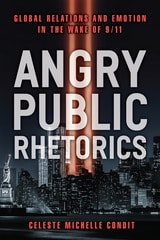
Angry Public Rhetorics
Global Relations and Emotion in the Wake of 9/11Celeste Michelle Condit
University of Michigan Press, 2018
These voices show that anger is more effective for producing some collective actions, such as rallying supporters, reifying existing worldviews, motivating attack, enforcing shared norms, or threatening from positions of power; and less effective for others, like broadening thought, attracting new allies, adjudicating justice across cultural norms, or threatening from positions of weakness. Because social anger requires shared norms, collectivized anger cannot serve social justice. In order for anger to be a force for global justice, the world’s peoples must develop shared norms to direct discussion of international relations. Angry Public Rhetorics provides guidance for such public forums.