Results by title
5 books match the query '1946-1974'
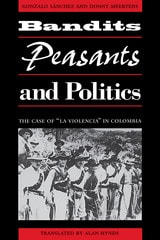
Bandits, Peasants, and Politics
The Case of "La Violencia" in ColombiaBy Gonzalo Sánchez and Donny Meertens
University of Texas Press, 2001
The years 1945-1965 saw heavy partisan conflict in the rural areas of Colombia, with at least 200,000 people killed. This virtual civil war began as a sectarian conflict between the Liberal and Conservative parties, with rural workers (campesinos) constituting the majority of combatants and casualties. Yet La Violencia resists classification as a social uprising, since calls for social reform were largely absent during this phase of the struggle. In fact, once the elite leadership settled on a power-sharing agreement in 1958, the conflict appeared to subside.
This book focuses on the second phase (1958-1965) of the struggle, in which the social dimensions of the conflict emerged in a uniquely Colombian form: the campesinos, shaped by the earlier violence, became social and political bandits, no longer acting exclusively for powerful men above them but more in defense of the peasantry. In comparing them with other regional expressions of bandolerismo, the authors weigh the limited prospects for the evolution of Colombian banditry into full-scale social revolution.
Published originally in 1983 as Bandoleros, gamonales y campesinos and now updated with a new epilogue, this book makes a timely contribution to the discourse on social banditry and the Colombian violencia. Its importance rests in the insights it provides not only on the period in question but also on Colombia's present situation.
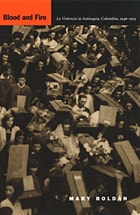
Blood and Fire
La Violencia in Antioquia, Colombia, 1946-1953Mary Roldan
Duke University Press, 2003
Through an analysis of the evolution of violence in Antioquia, which at the time was the wealthiest and most economically diverse region of Colombia, Roldán demonstrates how tensions between regional politicians and the weak central state, diverse forms of social prejudice, and processes of economic development combined to make violence a preferred mode of political action. Privatization of state violence into paramilitary units and the emergence of armed resistance movements exacted a horrible cost on Colombian civic life, and these processes continue to plague the country.
Roldan’s reading of the historical events suggests that Antioquia’s experience of la Violencia was the culmination of a brand of internal colonialism in which regional identity formation based on assumptions of cultural superiority was used to justify violence against racial or ethnic "others" and as a pretext to seize land and natural resources. Blood and Fire demonstrates that, far from being a peculiarity of the Colombians, la Violencia was a logical product of capitalist development and state formation in the modern world.
This is the first study to analyze intersections of ethnicity, geography, and class to explore the genesis of Colombian violence, and it has implications for the study of repression in many other nations.
My Life As A Revolutionary
Reflections Of A Former GuerrilleraMaria Eugenia Vasquez Perdomo
Temple University Press, 2005
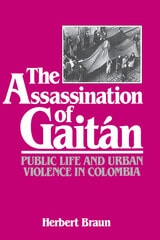
The Assassination of Gaitán
Public Life and Urban Violence in ColombiaHerbert Braun
University of Wisconsin Press, 1985
Drawn in part from personal interviews with participants and witnesses, Herbert Braun’s analysis of the riot’s roots, its patterns and consequences, provides a dramatic account of this historic turning point and an illuminating look at the making of modern Colombia.
Braun’s narrative begins in the year 1930 in Bogotá, Colombia, when a generation of Liberals and Conservatives came to power convinced they could kept he peace by being distant, dispassionate, and rational. One of these politicians, Jorge Eliécer Gaitán, was different. Seeking to bring about a society of merit, mass participation, and individualism, he exposed the private interests of the reigning politicians and engendered a passionate relationship with his followers. His assassination called forth urban crowds that sought to destroy every visible evidence of public authority of a society they felt no longer had the moral right to exist.
This is a book about behavior in public: how the actors—the political elite, Gaitán, and the crowds—explained and conducted themselves in public, what they said and felt, and what they sought to preserve or destroy, is the evidence on which Braun draws to explain the conflicts contained in Colombian history. The author demonstrates that the political culture that was emerging through these tensions offered the hope of a peaceful transition to a more open, participatory, and democratic society.
“Most Colombians regard Jorge Eliécer Gaitán as a pivotal figure in their nation’s history, whose assassination on April 9, 1948 irrevocably changed the course of events in the twentieth century. . . . As biography, social history, and political analysis, Braun’s book is a tour de force.”—Jane M. Rausch, Hispanic American Historical Review
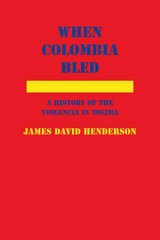
When Colombia Bled
A History of the Violencia in TolimaJames David Henderson
University of Alabama Press, 1985
A definitive account of the conflict that transformed twentieth-century Colombia.0false18 pt18 pt00falsefalsefalse
When Colombia Bled: A History of the Violencia in Tolima by James D. Henderson is a compelling and deeply researched examination of one of the most traumatic periods in modern Colombian history. Focusing on the department of Tolima, the book chronicles La Violencia, the undeclared civil war between Colombia's Liberal and Conservative parties that engulfed the nation from the late 1940s through the early 1960s. Through a richly detailed narrative, Henderson traces the political tensions, social divisions, and local rivalries that transformed regional disputes into a devastating cycle of violence affecting countless rural communities.
Drawing on extensive archival research, government records, contemporary accounts, and regional sources, Henderson reveals how national political struggles intersected with local circumstances to create a uniquely destructive conflict. The book explores the experiences of political leaders, campesinos, community activists, and ordinary citizens whose lives were shaped by insecurity, displacement, and armed confrontation. By focusing on Tolima, one of the regions most deeply affected by the conflict, Henderson offers a nuanced perspective on the broader forces that influenced Colombia's political development and social transformation.
Both an authoritative regional study and a major contribution to Latin American history, When Colombia Bled provides essential insight into the historical roots of political violence in Colombia and the enduring legacy of a conflict that helped shape the nation's modern identity.