Results by title

6 books match the query '1948-1994'
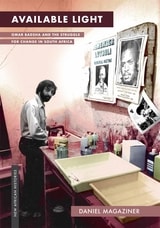
cover of Available Light: Omar Badsha and the Struggle for Change in South Africa

Available Light

Omar Badsha and the Struggle for Change in South Africa

Daniel Magaziner

Ohio University Press, 2024
Available Light tells the story of an activist, an artist, a uniquely South African individual, and his community and family across the second half of the twentieth century. Omar Badsha was born in Durban, on the country’s southeastern coast in 1945. His was the third generation of his Gujarati family to call South Africa home. Before he turned five, the country’s white electorate had voted to institute apartheid to strip the rights and privileges of citizenship from most of the population, including Badsha’s Indian community and especially the country’s Black majority. By the time he turned fifteen, nonviolent protest against apartheid had been quashed; by the time he turned twenty, so too had the armed struggle to dislodge white supremacy within the country. The ongoing, resilient, and oft-rebuffed struggle against apartheid was a definitive factor in Badsha’s life. Furthermore, Badsha was raised in a community where art—painting, carving, music, poetry, theater—was inseparable from other values, whether Islamic and conservative or radical and urgently committed. When Badsha struggled in school, he, like his father, turned to art to express what he otherwise had difficulty conveying. Art brought him into contact with people of disparate backgrounds from far beyond Durban. In time, his friendships with other artists helped him refine his voice, first in drawing and eventually in photography, and capture the political ethic by which he strove to live his life and which he shared with similarly committed artist-activists. Daniel Magaziner chronicles how art and politics became intertwined in South Africa and explains what it takes to maintain a critical aesthetic approach to political crises in the past and present. The book tracks the personal and social costs that commitment can incur, while also appreciating how Badsha and others like him have maintained their vision of an equitable, transformed society even today, when the ideals that once animated the South African struggle are on the back foot worldwide.
[more]
cover of Brutal Fantasies: Imagining North Korea in the Long Cold War

Brutal Fantasies

Imagining North Korea in the Long Cold War

Christine Kim

Duke University Press, 2025

In Brutal Fantasies, Christine Kim examines how Western cultural representations of North Korea depend on fantasies of the inhuman. Drawing on films, fiction, and defectors’ life writings from the last two decades, Kim analyzes how these representations construct North Korea as a site of brutality and inhumanity. She recasts these stories through Asian American and global Asian frameworks that move beyond common Cold War binaries to critique how US imperialism persists in global understandings of North Korea. Kim shows how human rights discourses simultaneously instrumentalize and dehumanize North Korea while demonstrating that North Korea is a site of contradiction that complicates Western interpretive constraints. She also explores the Korean diaspora’s complex relationship with North Korea and highlights the vulnerability and marginalization of diasporic subjects. In so doing, Kim pulls back the veil on prevailing cultural myths enshrouding North Korea, offering alternative ways of understanding its role in global and regional imaginaries.
[more]
cover of Letters from Robben Island: A Selection of Ahmed Kathrada's Prison Correspondence, 1964-1989

Letters from Robben Island

A Selection of Ahmed Kathrada's Prison Correspondence, 1964-1989

Robert D. Vassen

Michigan State University Press, 1999

Late one night in July, 1963, a South African police unit surrounded the African National Congress headquarters in Rivonia and arrested a group of Movement leaders gathered inside. Eventually eight of them, including Nelson Mandela, who was already serving a sentence, Walter Sisulu, Dennis Goldberg, Govan Mbeki, Raymond Mhlaba, Elias Motsoledi, Andrew Mangeni, and Ahmed Kathrada, were convicted of sabotage and, on June 12, 1964, sentenced to life in prison. Soon, these men became widely known as the "Rivonia Trialists." Despite their imprisonment, the Trialists played active roles in the struggle against South Africa's racist regime. Instead of being forgotten, as apartheid officials had hoped, they became enduring symbols in a struggle against injustice and racism. 
     Kathrada and his colleagues were classified as high security prisoners, segregated from others and closely watched. Every activity was regulated and monitored. Among the many indignities visited upon them, the prisoners were prohibited from keeping copies of incoming and outgoing correspondence. Kathrada, or "Kathy" as he is known, successfully hid both. 
     Letters From Robben Island contains a selection of 86 of the more than 900 pieces of correspondence Ahmed Kathrada wrote during his 26 years on Robben Island and at Pollsmoor Prison. Some were smuggled out by friends; others were written in code to hide meaning and content from prison censors. These are among his most poignant, touching, and eloquent communications. They are testimonies to Kathrada, his colleagues, and to their commitment to obtaining human dignity and freedom for all South Africans.
[more]
cover of Spear of the Nation: Umkhonto weSizwe: South Africa’s Liberation Army, 1960s–1990s

Spear of the Nation

Umkhonto weSizwe: South Africa’s Liberation Army, 1960s–1990s

Janet Cherry

Ohio University Press, 2011

Umkhonto weSizwe, Spear of the Nation, was arguably the last of the great liberation armies of the twentieth century—but it never got to “march triumphant into Pretoria.” MK—as it was known—was the armed wing of the African National Congress, South Africa’s liberation movement, that challenged the South African apartheid government. A small group of revolutionaries committed to the seizure of power, MK discovered its principal members engaged in negotiated settlement with the enemy and was disbanded soon after.

The history of MK is one of paradox and contradiction, of successes and failures. In this short study, which draws widely on the personal experiences of—and commentary by—MK soldiers, Janet Cherry offers a new and nuanced account of the Spear of the Nation. She presents in broad outline the various stages of MK’s thirty-year history, considers the difficult strategic and moral problems the revolutionary army faced, and argues that its operations are likely to be remembered as a just war conducted with considerable restraint.
[more]
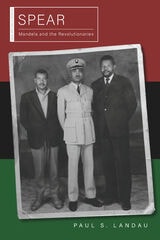
cover of Spear: Mandela and the Revolutionaries

Spear

Mandela and the Revolutionaries

Paul S. Landau

Ohio University Press, 2022

A revelatory and definitive account of how Nelson Mandela and his peers led South Africa to the brink of revolution against the postwar twentieth century’s most infamously racist regime. Spear: Mandela and the Revolutionaries brings to life the brief revolutionary period in which Nelson Mandela and his comrades fought apartheid not just with words but also with violence. After the 1960 Sharpeville police shootings of civilian protesters, Mandela and his comrades in the mass-resistance order of the African National Congress (ANC) and the Communist Party pioneered the use of force and formed Umkhonto we Sizwe (MK), or Spear of the Nation. A civilian-based militia, MK stockpiled weapons and waged a war of sabotage against the state with pipe bombs, Molotov cocktails, and dynamite. In response, the state passed draconian laws, militarized its police, and imprisoned its enemies without trial. Drawing from several hundred first-person accounts, most of which are unpublished, Paul Landau traces Mandela’s allies—and opponents—in communist, pan-Africanist, liberal, and other groups involved in escalating resistance alongside the ANC. After Mandela’s capture, the Pan Africanist Congress planned to initiate street violence, and MK organized Operation Mayibuye, an uprising to be led by trained commandos. The state short-circuited those plans and subsequently jailed, exiled, tortured, and murdered revolutionaries. The era of high apartheid then began. Spear reshapes our understanding of Mandela by focusing on this intense but relatively neglected period of escalation in the movement against apartheid. Landau’s book is not a biography, nor is it a history of a militia or an army; rather, it is a riveting story about ordinary civilians debating and acting together in extremis. Contextualizing Mandela and MK’s activities amid anticolonial change and Black Marxism in the early 1960s, Spear also speaks to today’s transnational antiracism protests and worldwide struggles against oppression.
[more]
cover of The ANC and the Liberation Struggle: A Critical Political Biography

The ANC and the Liberation Struggle

A Critical Political Biography

Dale T. McKinley

Pluto Press, 1997

'Written from inside the movement of which it is so critical, McKinley's book is
eloquent testimony of the  continuing vitality of the South African left' Modern African Studies

The African National Congress, the ANC, negotiated a transition of government and power in South Africa in the early 1990s and gained widespread respect and legitimacy when Nelson Mandela was voted in as President in 1994.

In this controversial and radical critique of the ANC and the struggle for liberation in South Africa, Dale T. McKinley challenges conventional public perceptions of the organisation and its celebrated rise to power.  McKinley offers the first detailed analysis of the ANC's leadership, tactics and strategies from the 1920s, through the years of exile, to the 1990s, focusing on its close alliance with the South African Communist Party.  he reveals that the organisation, despite historical claims to the contrary, failed to stay in touch with the south African masses.  The ANC made fundamental compromises to gain political power, and in so doing has ensured that the economic power-base of the ruling elites in South Africa remains essentially unaltered.
[more]