Results by title
10 books match the query '1961-1969'
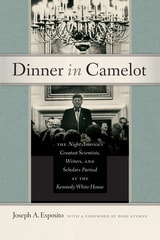
Dinner in Camelot
The Night America's Greatest Scientists, Writers, and Scholars Partied at the Kennedy White HouseJoseph A. Esposito
University Press of New England, 2018
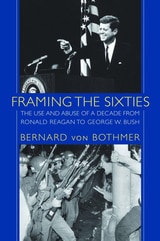
Framing the Sixties
The Use and Abuse of a Decade from Ronald Reagan to George W. BushBernard von Bothmer
University of Massachusetts Press, 2010
Over the past quarter century, American liberals and conservatives alike have invoked memories of the 1960s to define their respective ideological positions and to influence voters. Liberals recall the positive associations of what might be called the “good Sixties”—the “Camelot” years of JFK, the early civil rights movement, and the dreams of the Great Society—while conservatives conjure images of the “bad Sixties”—a time of urban riots, antiwar protests, and countercultural revolt.
In Framing the Sixties, Bernard von Bothmer examines this battle over the collective memory of the decade primarily through the lens of presidential politics. He shows how four presidents—Ronald Reagan, George H. W. Bush, Bill Clinton, and George W. Bush—each sought to advance his political agenda by consciously shaping public understanding of the meaning of “the Sixties.” He compares not only the way that each depicted the decade as a whole, but also their commentary on a set of specific topics: the presidency of John F. Kennedy, Lyndon Johnson's “Great Society” initiatives, the civil rights movement, and the Vietnam War.
In addition to analyzing the pronouncements of the presidents themselves, von Bothmer draws on interviews he conducted with more than one hundred and twenty cabinet members, speechwriters, advisers, strategists, historians, journalists, and activists from across the political spectrum—from Julian Bond, Daniel Ellsberg, Todd Gitlin, and Arthur Schlesinger to James Baker, Robert Bork, Phyllis Schlafly, and Paul Weyrich.
It is no secret that the upheavals of the 1960s opened fissures within American society that have continued to affect the nation's politics and to intensify its so-called culture wars. What this book documents is the extent to which political leaders, left and right, consciously exploited those divisions by “framing” the memory of that turbulent decade to serve their own partisan interests.

My Life with President Kennedy
Christopher Clausen
University of Iowa Press, 1994
As its title implies, this book reflects in varying ways the experiences and attitudes of one who came of age in the first half of that now mythical decade, the 1960s. In an unusual combination of history, criticism, and autobiography, one of our best literary and cultural critics explores life and death in the late twentieth century and some of the older worlds that made American culture what it is today.
Sixties survivors, as Christopher Clausen points out, do not necessarily hold more beliefs or tastes in common than any other group. Nevertheless they may be more likely than most people born earlier or later to consider the relations between public and private life—the political and the personal—a problem, sometimes even an unresolvable problem. While this is not primarily a book about the 1960s, most of it occupies the noisy crossroads where public worlds intersect the private, mysterious lives of individuals and families, where ordinary people pursue their own destinies and desires while submitting consciously or unconsciously to the pressures of the public sphere—a set of demands or aspirations common to people in a particular time and place.
In modern America, where most of these essays are set, any individual is likely to live in several worlds at any given moment, as well as to pass through several more over a lifetime. Because of rapid transitions in public life and culture while they were still at an impressionable age, members of the “Kennedy generation” became almost morbidly conscious of the persistence of the past in the present. The often unpredictable effect on individual lives of historical forces is the main subject of Clausen's fascinating account.
Oppenheimer Is Watching Me
A MemoirJeff Porter
University of Iowa Press, 2007

Sights On The Sixties
Tischler, Barbara L.
Rutgers University Press, 1992
Barbara Tischler's goal is to understand the historical and cultural legacy of the 1960s. During the Gulf War, as politicians advocated positions and strategies, they made simplistic comparisons with the '60s. Such comparisons reinforced our need to understand that decade more clearly. With these papers Tischler brings together a group of scholars from a variety of disciplines, including American Studies, anthropology, film studies, history, literature, sociology, and theater. She notes how their contributions, taken separately and together, transcend the "good sixties/bad sixties" typology that has pervaded past analyses of the period. Several authors deal with movement leaders and great events, but the majority write about lesser-known events and people, to add depth and balance to our understanding of the decade.
1. Multi-disciplinary collection
2. Emphasis on less well-known events of the period
3. Presents balanced picture of the decade

Street of Dreams
The Nature and Legacy of the 1960sDouglas M. Knight
Duke University Press, 1989
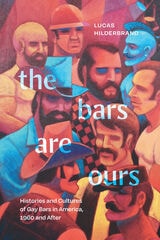
The Bars Are Ours
Histories and Cultures of Gay Bars in America,1960 and AfterLucas Hilderbrand
Duke University Press, 2024
The House on Rondo
Debra J Stone
University of Minnesota Press, 2025
A young girl reckons with the demolition of a Black Saint Paul neighborhood to make way for the Interstate in the early 1960s
When thirteen-year-old Zenobia has to leave her friends and spend the summer at Grandma’s while Mama recovers from a stroke, life seems so unfair. But then the eviction letters start arriving throughout her grandparents’ neighborhood, and white men chalk arrows to mark the gas and water lines, and a new world of unfairness unfolds before her. It’s 1963, and Zenobia’s grandparents’ house on Rondo Avenue in Saint Paul—like all the homes in this thriving Black community—is targeted for demolition to make way for the new Interstate Highway 94.
As Zenobia gradually learns about what’s planned for the Rondo neighborhood and what this means for everyone who lives there, she discovers how her story is intertwined with the history of her family, all the way back to Great Grandma Zenobia and the secrets Grandma Essie held close about the reason for her light skin. With the destruction of the neighborhood looming, Zenobia takes a stand on behalf of her community, joining her no-nonsense neighbor, onetime cowgirl Mrs. Ruby Pearl, in a protest and ultimately getting arrested. Though Zenobia is grounded for a month, her punishment seems of little consequence in comparison to what is happening all around her. Even though the demolition continues, she is proud to discover the power and connection in protesting injustice.
The House on Rondo captures the heartbreak, resistance, and resilience that marks a community sacrificed in the name of progress—a “progress” that never seems to favor Black families and neighborhoods and that haunts cities like Saint Paul to this day. As Zenobia learns what can be destroyed and what cannot, her story teaches us that joy, community, and love persist, even amid violence and loss.
The World Sixties Made
Politics And Culture In Recent Americaedited by Van Gosse and Richard Moser
Temple University Press, 2003
When America Turned
Reckoning with 1968David Wyatt
University of Massachusetts Press, 2013
Wyatt explores these questions as he retraces the decisive moments of 1968—the Tet Offensive, the McCarthy campaign, the assassinations of Martin Luther King Jr. and Robert Kennedy, the student revolt at Columbia, the "police riot" at the Democratic Convention in Chicago, Lyndon Johnson's capitulation, and Richard Nixon's ascendency to power. Seeking to recover the emotions surrounding these events as well as analyze their significance, Wyatt draws on the insights of what Michael Herr has called "straight" and "secret" histories. The first category consists of work by professional historians, traditional journalists, public figures, and political operatives, while the second includes the writings of novelists, poets, New Journalists, and memoirists.
The aim of this parallel approach is to uncover two kinds of truth: a "scholarly truth" grounded in the documented past and an "imaginative truth" that occupies the more ambiguous realm of meaning. Only by reckoning with both, Wyatt believes, can Americans come to understand the true legacy of the 1960s.