Results by title
10 books match the query '1969-1974'
Assault on the Media
The Nixon YearsWilliam E. Porter and Thomas A. Mascaro
University of Michigan Press, 2024
Informed by a half-century of historical analyses and released documents, this expanded edition of William E. Porter’s award-winning Assault on the Media analyzes new documents of significance; synthesizes recent historical analyses; incorporates legal evaluations by journalism scholars; and traces how Nixon-era plans cultivated the divisive state of 21st-century society and amplified assaults on journalism. It also evaluates lasting concerns about the Supreme Court’s Pentagon Papers decision and journalists cited for contempt as a form of prior restraint; the currencies of power and race in protecting confidential sources; and regulatory decisions that hamper effective journalism. Assault on the Media not only documents the incidents and circumstances of governmental intimidation, harassment, and regulation of the news media during the Nixon presidency, but it offers insights into the long-term effects and their relevance today.
Beyond the Quagmire
New Interpretations of the Vietnam WarGeoffrey W. Jensen
University of North Texas Press, 2019

Johnson, Nixon, and the Doves
Small, Melvin
Rutgers University Press, 1988
Nixon's Court
His Challenge to Judicial Liberalism and Its Political ConsequencesKevin J. McMahon
University of Chicago Press, 2011
Most analysts have deemed Richard Nixon’s challenge to the judicial liberalism of the Warren Supreme Court a failure—“a counterrevolution that wasn’t.” Nixon’s Court offers an alternative assessment. Kevin J. McMahon reveals a Nixon whose public rhetoric was more conservative than his administration’s actions and whose policy towards the Court was more subtle than previously recognized. Viewing Nixon’s judicial strategy as part political and part legal, McMahon argues that Nixon succeeded substantially on both counts.
Many of the issues dear to social conservatives, such as abortion and school prayer, were not nearly as important to Nixon. Consequently, his nominations for the Supreme Court were chosen primarily to advance his “law and order” and school desegregation agendas—agendas the Court eventually endorsed. But there were also political motivations to Nixon’s approach: he wanted his judicial policy to be conservative enough to attract white southerners and northern white ethnics disgruntled with the Democratic party but not so conservative as to drive away moderates in his own party. In essence, then, he used his criticisms of the Court to speak to members of his “Silent Majority” in hopes of disrupting the long-dominant New Deal Democratic coalition.
For McMahon, Nixon’s judicial strategy succeeded not only in shaping the course of constitutional law in the areas he most desired but also in laying the foundation of an electoral alliance that would dominate presidential politics for a generation.
Social Controversy and Public Address in the 1960s and Early 1970s
A Rhetorical History of the United States, Volume IXRichard J. Jensen
Michigan State University Press, 2017
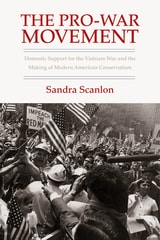
The Pro-War Movement
Domestic Support for the Vietnam War and the Making of Modern American ConservatismSandra Scanlon
University of Massachusetts Press, 2013
In the vast literature on the Vietnam War, much has been written about the antiwar movement and its influence on U.S. policy and politics. In this book, Sandra Scanlon shifts attention to those Americans who supported the war and explores the war's impact on the burgeoning conservative political movement of the 1960s and early 1970s.
Believing the Vietnam War to be a just and necessary cause, the pro-war movement pushed for more direct American military intervention in Southeast Asia throughout the Kennedy administration, lobbied for intensified bombing during the Johnson years, and offered coherent, if divided, endorsements of Nixon's policies of phased withdrawal. Although its political wing was dominated by individuals and organizations associated with Barry Goldwater's presidential bids, the movement incorporated a broad range of interests and groups united by a shared antipathy to the New Deal order and liberal Cold War ideology.
Appealing to patriotism, conservative leaders initially rallied popular support in favor of total victory and later endorsed Nixon's call for “peace with honor.” Yet as the war dragged on with no clear end in sight, internal divisions eroded the confidence of pro-war conservatives in achieving their aims and forced them to reevaluate the political viability of their hardline Cold War rhetoric. Conservatives still managed to make use of grassroots patriotic campaigns to marshal support for the war, particularly among white ethnic workers opposed to the antiwar movement. Yet in so doing, Scanlon concludes, they altered the nature and direction of the conservative agenda in both foreign and domestic policy for years to come.
The Seventies Now
Culture as SurveillanceStephen Paul Miller
Duke University Press, 1999
The concept of surveillance and its attendant social ramifications have been powerful agents in U.S. culture for many decades, but in describing how during the 1970s Americans learned to “survey” themselves, Miller shines surprising new light on such subjects as the women’s movement, voting rights enforcement, the Ford presidency, and environmental legislation. He illuminates the significance of what he terms “microperiods” and analyzes relevant themes in many of the decade’s major films—such as The Deer Hunter, Network, Jaws, Star Wars, and Apocalypse Now—and in the literature of writers including John Ashbery, Toni Morrison, Adrienne Rich, and Sam Shepard. In discussing the reverberations of the 1969 Stonewall riots, technological innovations, the philosophy of Michel Foucault, and a host of documents and incidents, Miller shows how the 1970s marked an important period of transition, indeed a time of many transitions, to the world we confront at the end of the millennium.
The Seventies Now will interest students and scholars of cultural studies, American history, theories of technology, film and literature, visual arts, and gay and lesbian studies.
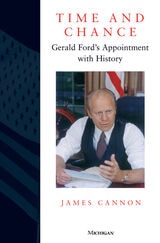
Time and Chance
Gerald Ford's Appointment with HistoryJames Cannon
University of Michigan Press, 1998
"James Cannon, formerly national affairs editor at Newsweek and Ford's domestic policy advisor, has written a superbly provocative and arresting biography that traces Ford's life from his July 4, 1913, birth in Omaha, Nebraska, to his September 8,1974, decision to pardon Nixon of the Watergate conspiracy." --Washington Post Book World
James M. Cannon is a journalist and was Domestic Policy Adviser to President Ford and Chief of Staff to Senate Majority Leader Howard Baker.
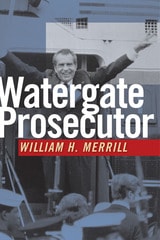
Watergate Prosecutor
William H. Merrill
Michigan State University Press, 2008
DC. Both of these crimes were eventually traced back to the "plumbers unit," which was directed by John Ehrlichman, President Nixon's top domestic aide. As he convincingly recounts, Merrill sought the job as Assistant Special Prosecutor for one reason: to bring these criminals to justice. In addition, as this revelatory account makes clear, he pursued that goal tenaciously.
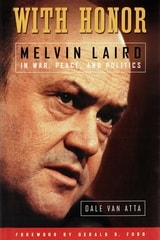
With Honor
Melvin Laird in War, Peace, and PoliticsVan Atta
University of Wisconsin Press, 2008
The first book ever to focus on Laird’s legacy, this authorized biography reveals his central and often unrecognized role in managing the crisis of national identity sparked by the Vietnam War—and the challenges, ethical and political, that confronted him along the way. Drawing on exclusive interviews with Laird, Henry Kissinger, Gerald Ford, and numerous others, author Dale Van Atta offers a sympathetic portrait of a man striving for open government in an atmosphere fraught with secrecy. Van Atta illuminates the inner workings of high politics: Laird’s behind-the-scenes sparring with Kissinger over policy, his decisions to ignore Nixon’s wilder directives, his formative impact on arms control and health care, his key role in the selection of Ford for vice president, his frustration with the country’s abandonment of Vietnamization, and, in later years, his unheeded warning to Donald Rumsfeld that “it’s a helluva lot easier to get into a war than to get out of one.”