Results by title
5 books match the query '1971-1981'
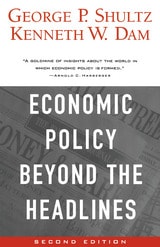
Economic Policy Beyond the Headlines
George P. Shultz and Kenneth W. Dam
University of Chicago Press, 1998
"A model of brevity and lucidity . . . [Economic Policy Beyond the Headlines] incorporates a unique and rewarding blend of economic reasoning with a high level of political awareness . . . enriched by the wide personal experience in government of the authors."—Albert T. Sommers, Across the Board
"[Shultz and Dam] help foreign readers to understand why the world looks so different from Washington. . . . This book should provide the model."—The Economist
"A wise and valuable book showing great insight into the realities of economic policy making."—Henry A. Kissinger
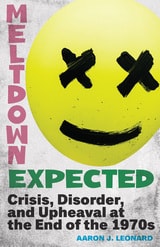
Meltdown Expected
Crisis, Disorder, and Upheaval at the end of the 1970sAaron J. Leonard
Rutgers University Press, 2024
Meltdown Expected tells the story of the power shifts from late 1978 through 1979 whose repercussions are still being felt. Iran’s revolution led to a hostage crisis while neighbouring Afghanistan became the site of a proxy war between the USSR and the US, who supplied aid to Islamic mujahideen fighters that would later form the Taliban. Meanwhile, as tragedies like the Jonestown mass suicide and the assassination of Harvey Milk captured the nation’s attention, the government quietly reasserted and expanded the FBI’s intelligence powers. Drawing from recently declassified government documents and covering everything from Three Mile Island to the rise of punk rock, Aaron J. Leonard paints a vivid portrait of a tumultuous yet pivotal time in American history.
Rational Expectations and Economic Policy
Edited by Stanley Fischer
University of Chicago Press, 1982
"This is a most timely and valuable contribution. . . . The contributors and commentators are highly distinguished and the editor has usefully collated comments and the ensuing discussion. Unusually for a conference proceedings the book is well indexed and it is also replete with numerous and up-to-date references. . . . This is the first serious book to examine the rational expectations thesis in any depth, and it will prove invaluable to anyone involved with macroeconomic policy generally and with monetary economics in particular."—G. K. Shaw, The Economic Journal
The Barbaric Counter Revolution
Cause and CureBy W. W. Rostow
University of Texas Press, 1983
In the 1980s, troubled Americans saw interest rates in the United States climb to an alltime high, unemployment grow to over 10 percent, the federal deficit reach near monumental proportions, and the world economy as a whole fall stagnant.
Why did a once booming world economy give way to stagflation? Economist W. W. Rostow finds the roots of the problem in the phenomenon he terms the Barbaric Counter-Revolution—the effort to wring inflation out of the economic system by the rigorous application of a restricted rate of increase in the money supply. This policy was launched by the Carter administration in October 1979, reinforced by President Reagan in mid 1980, and abandoned in August 1982. In the end, it provided the United States with no mechanism for rapid recovery that did not bring with it a return to high interest rates, resumed inflation, and, soon, another recession.
In what he terms a Civilized Synthesis, Rostow sets forth a series of new policies that would permit rapid, sustained growth with inflation under control. He argues that fiscal and monetary policy must be joined by an incomes policy that would gear the rate of increase of wages and salaries to the average rate of increase in productivity. He explores how this could be accomplished within the context of American politics and existing institutions. Finally, Rostow identifies four directions for investment that, together, would yield economic and social benefits.
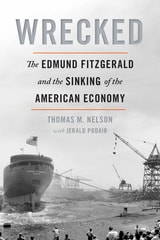
Wrecked
The Edmund Fitzgerald and the Sinking of the American EconomyThomas M Nelson
Michigan State University Press, 2025