Results by title
4 books match the query '1973-1993'

Imperial Israel and the Palestinians
The Politics of ExpansionNur Masalha
Pluto Press, 2000
This book is a history of Israel's expansionist policies, focusing on the period from the June War of 1967 to the present day. He demonstrates that imperialist tendencies in Israel run the political gamut, from Left to Right.
Masalha argues that the heart of the conflict between Zionist immigrants/settlers and the native Palestinians has always been about land, territory, demography and water. He documents how Israeli policy has made it a priority to expel the Palestinians, either by war or peaceful measures. But these imperialist tendencies are not restricted to extremist zealots. The author uncovers the expansionist policies found in Labour Zionism and Kookist ideology.
Chapters cover the Whole Land of Israel Movement, Zionist Revisionism and the Likud Party, Gush Emunim and the religious fundamentalists, parties and movements of the far right and the evolution of Israeli Jewish public attitudes since 1967.
[more]
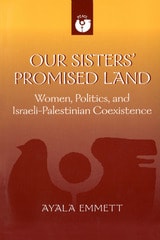
Our Sisters' Promised Land
Women, Politics, and Israeli-Palestinian CoexistenceAyala Emmett
University of Michigan Press, 2003
In this powerful and timely book, Ayala H. Emmett examines the political roles of women in the Israeli-Palestinian peace process. Emmett's insights come from numerous trips to the region that included in-depth interviews with many of the participants. Excerpts from the interviews give voice to the women who played vitally important yet often overlooked roles in the political transformations of the contemporary Middle East. Emmett's observations on women's actions in political venues have global implications, transcending the specific political and social contexts of the region and shedding light on both the strengths of female activism and the resistances of male political institutions.
Emmett investigates the successes and failures of women in the Israeli political landscape, particularly the harassment experienced during the leadership of Right and ultra-Right groups before the ascension to office of the late Prime Minister Yitzhak Rabin. Her account of women's activism in Israel provides a rich backdrop for viewing the compelling events that have taken place in the Middle East throughout the 1990s and offer insights into the future of women's political activism, both in the ever-changing Israeli political climate and in the broader world of women in politics.
"Brilliant in conception and theory, based on superb fieldwork, and clearly written for both specialist and non-specialist reader." --Maurie Sacks, Montclair State University
"A groundbreaking study. . . .Ayala Emmett brings an unusual voice of clarity into the muddled politics of the Middle East. Where most studies ignore or marginalize women's role in the peace process, Emmett highlights women as political actors and shows their capacity to bridge the chasm between two hostile peoples." --Cynthia Saltzman, Rutgers University, Camden
Ayala Emmett is Associate Professor of Anthropology, University of Rochester.
[more]
The Kingdom of Strangers
Elias Khoury
University of Arkansas Press, 1996
[more]
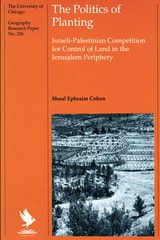
The Politics of Planting
Israeli-Palestinian Competition for Control of Land in the Jerusalem PeripheryShaul Ephraim Cohen
University of Chicago Press, 1993
On the open landscape of Israel and the West Bank, where pine and cypress forests grow alongside olive groves, tree planting has become symbolic of conflicting claims to the land. Palestinians cultivate olive groves as a vital agricultural resource, while the Israeli government has made restoration of mixed-growth forests a national priority. Although both sides plant for a variety of purposes, both have used tree planting to assert their presence on—and claim to—disputed land.
Shaul Ephraim Cohen has conducted an unprecedented study of planting in the region and the control of land it signifies. In The Politics of Planting, he provides historical background and examines both the politics behind Israel's afforestation policy its consequences. Focusing on the open land surrounding Jerusalem and four Palestinian villages outside the city, this study offers a new perspective on the conflict over land use in a region where planting has become a political tool.
For the valuable data it presents—collected from field work, previously unpublished documents, and interviews—and the insight it provides into this political struggle, this will be an important book for anyone studying the Israeli-Palestinian conflict.
[more]