Results by title

11 books match the query '1976-2002'
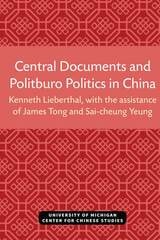
cover of Central Documents and Politburo Politics in China

Central Documents and Politburo Politics in China

Kenneth Lieberthal, with the assistance of James Tong and Sai-cheung Yeung

University of Michigan Press, 1978
Virtually every analysis of Chinese politics views the Politburo as the nerve center of the system, but questions abound as to how this center governs itself and how it interacts with the system around it. Specifically, how much consultation occurs during the drafting of major Politburo documents, and who is brought into this process? How is information channeled up to this body, and what are the rules that govern the access of the Politburo members themselves to data generated by the bureaucracies? How are the political strategies of individual leaders and political factions attuned to this system of information channeling? What types of decisions are reached by the Politburo? To whom are they communicated? How rigidly must they be followed? How institutionalized is this entire decision making system, and has it become more—or less—institutionalized over the years? How has the factional legacy of the Cultural Revolution affected its mode of operations? Indeed, in the wake of the Cultural Revolution, how much in control of the system has the Politburo itself been?
Central Documents in Politburo Politics in China seeks to better understand these questions by analyzing a particular stream of largely bureaucratic communications in the Chinese system: the so-called “Central Documents” (CDs). This is a series of documents through which the top Party leadership directly communicates with the rest of the political system. [1]
[more]
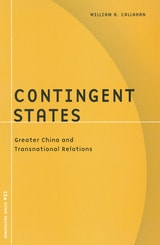
cover of Contingent States: Greater China And Transnational Relations

Contingent States

Greater China And Transnational Relations

William A. Callahan

University of Minnesota Press, 2004
In the 1990s, Greater China became the subject of debate as the site of either the danger of the “China threat” or the promise of Confucian capitalism. William A. Callahan argues that Greater China presents challenges not only to economic and political order but also to international relations theory. In fact, Greater China, though absent from geopolitical maps and international law, is very much present in economic and cultural exchange and exemplifies the contingent state of international politics. Callahan deconstructs the mainstream geopolitical and political-economic understandings of Greater China, tracing its emergence through an ethnographic analysis of four political “problems” in East Asia: the South China Sea disputes, Sino-Korean relations, the return of Hong Kong, and cross-straits relations. Callahan shows how bureaucrats, outlaws, tycoons, academics, workers, politicians, and hooligans alike produce Greater China through networks of relations in local, national, regional, global, and transnational space. Finally, Contingent States reveals how each of the “problems” provoked theoretical innovations that depart from standard conceptions of sovereignty, democracy, and the nation-state.William A. Callahan is senior lecturer of international politics and deputy director of the Center for Contemporary Chinese Studies at the University of Durham, England, and the author of Imagining Democracy: Reading “The Events of May” in Thailand and Pollwatching, Elections, and Civil Society in Southeast Asia.
[more]
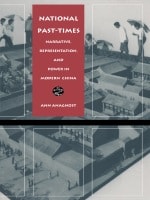
cover of National Past-Times: Narrative, Representation, and Power in Modern China

National Past-Times

Narrative, Representation, and Power in Modern China

Ann Anagnost

Duke University Press, 1997

In National Past-Times, Ann Anagnost explores the fashioning and refashioning of modern Chinese subjectivity as it relates to the literal and figurative body of the nation. In essays revealing the particular temporality of the modern Chinese nation-state, Anagnost examines the disparate eras of its recent past and its propensity for continually looking backward in order to face the future.
Using interviews and participant observation as well as close readings of official documents, propaganda materials, and popular media, Anagnost notes the discontinuities in the nation’s narrative—moments where this narrative has been radically reorganized at critical junctures in China’s modern history. Covering a broad range of issues relating to representation and power—issues that have presented themselves with particular clarity in the years since the violent crackdown on the student movement of 1989—National Past-Times critiques the ambiguous possibilities produced by the market, as well as new opportunities for "unfreedom" in the discipline of labor and the commodification of women. Anagnost begins with a retrospective reflection on the practice of "speaking bitterness" in socialist revolutionary practice. Subsequent essays discuss the culture debates of the 1980s, the discourse of social disorder, the issue of population control, the film The Story of Qiu Ju, and anomalies at the theme park "Splendid China."
[more]
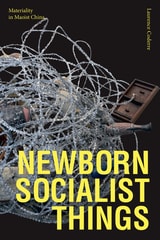
cover of Newborn Socialist Things: Materiality in Maoist China

Newborn Socialist Things

Materiality in Maoist China

Laurence Coderre

Duke University Press, 2021
Contemporary China is seen as a place of widespread commodification and consumerism, while the preceeding Maoist Cultural Revolution is typically understood as a time when goods were scarce and the state criticized what little consumption was possible. Indeed, with the exception of the likeness and words of Mao Zedong, both the media and material culture of the Cultural Revolution are often characterized as a void out of which the postsocialist world of commodity consumption miraculously sprang fully formed. In Newborn Socialist Things, Laurence Coderre explores the material culture of the Cultural Revolution to show how it paved the way for commodification in contemporary China. Examining objects ranging from retail counters and porcelain statuettes to textbooks and vanity mirrors, she shows how the project of building socialism in China has always been intimately bound up with consumption. By focusing on these objects—or “newborn socialist things”—along with the Cultural Revolution’s media environment, discourses of materiality, and political economy, Coderre reconfigures understandings of the origins of present-day China.
[more]
cover of Postmodernism and China

Postmodernism and China

Arif Dirlik and Xudong Zhang, eds.

Duke University Press, 2000

Few countries have been so transformed in recent decades as China. With a dynamically growing economy and a rapidly changing social structure, China challenges the West to understand the nature of its modernization. Using postmodernism as both a global frame of periodization and a way to break free from the rigid ideology of westernization as modernity, this volume’s diverse group of contributors argues that the Chinese experience is crucial for understanding postmodernism.
Collectively, these essays question the implications of specific phenomena, like literature, architecture, rock music, and film, in a postsocialist society. Some essays address China’s complicity in—as well as its resistance to—the culture of global capitalism. Others evaluate the impact of efforts to redefine national culture in terms of enhanced freedoms and expressions of the imagination in everyday life. Still others discuss the general relaxation of political society in post-Mao China, the emergence of the market and its consumer mass culture, and the fashion and discourse of nostalgia. The contributors make a clear case for both the historical uniqueness of Chinese postmodernism and the need to understand its specificity in order to fully grasp the condition of postmodernity worldwide. Although the focus is on mainland China, the volume also includes important observations on social and cultural realities in Hong Kong and Taiwan, whose postmodernity has so far been confined—in both Chinese and English-speaking worlds—to their economic and consumer activities instead of their political and cultural dynamism.
First published as a special issue of boundary 2, Postmodernism and China includes seven new essays. By juxtaposing postmodernism with postsocialism and by analyzing China as a producer and not merely a consumer of the culture of the postmodern, it will contribute to critical discourses on globalism, modernity, and political economics, as well as to cultural and Asian studies.

Contributors. Evans Chan, Arif Dirlik, Dai Jinhua, Liu Kang, Anthony D. King, Jeroen de Kloet, Abidin Kusno, Wendy Larson, Chaoyang Liao, Ping-hui Liao, Sebastian Hsien-hao Liao, Sheldon Hsiao-peng Lu, Wang Ning, Xiaobing Tang, Xiaoying Wang, Chen Xiaoming, Xiaobin Yang, Zhang Yiwu, Xudong Zhang

[more]
cover of Postsocialism and Cultural Politics: China in the Last Decade of the Twentieth Century

Postsocialism and Cultural Politics

China in the Last Decade of the Twentieth Century

Xudong Zhang

Duke University Press, 2008

In Postsocialism and Cultural Politics, Xudong Zhang offers a critical analysis of China’s “long 1990s,” the tumultuous years between the 1989 Tiananmen Square crackdown and China’s entry into the World Trade Organization in 2001. The 1990s were marked by Deng Xiaoping’s market-oriented reforms, the Taiwan missile crisis, the Asian financial crisis, and the end of British colonial rule of Hong Kong. Considering developments including the state’s cultivation of a market economy, the aggressive neoliberalism that accompanied that effort, the rise of a middle class and a consumer culture, and China’s entry into the world economy, Zhang argues that Chinese socialism is not over. Rather it survives as postsocialism, which is articulated through the discourses of postmodernism and nationalism and through the co-existence of multiple modes of production and socio-cultural norms. Highlighting China’s uniqueness, as well as the implications of its recent experiences for the wider world, Zhang suggests that Chinese postsocialism illuminates previously obscure aspects of the global shift from modernity to postmodernity.

Zhang examines the reactions of intellectuals, authors, and filmmakers to the cultural and political conflicts in China during the 1990s. He offers a nuanced assessment of the changing divisions and allegiances within the intellectual landscape, and he analyzes the postsocialist realism of the era through readings of Mo Yan’s fiction and the films of Zhang Yimou. With Postsocialism and Cultural Politics, Zhang applies the same keen insight to China’s long 1990s that he brought to bear on the 1980s in Chinese Modernism in the Era of Reforms.
[more]
cover of Power, Money, and Media: Communication Patterns and Bureaucratic Control in Cultural China

Power, Money, and Media

Communication Patterns and Bureaucratic Control in Cultural China

Chin-Chuan Lee

Northwestern University Press, 2000
This book addresses, as few books in English have, a broad range of topics pertaining to China's expanding media and telecommunications systems. American and Chinese experts in journalism, communication, government, and political science use fieldwork, including participant observations, surveys, and in-depth interviews conducted within media organizations, to provide richly detailed analyses of the issues and of the changing face of media in China.
[more]
cover of Searching for Life's Meaning: Changes and Tensions in the Worldviews of Chinese Youth in the 1980s

Searching for Life's Meaning

Changes and Tensions in the Worldviews of Chinese Youth in the 1980s

Luo Xu

University of Michigan Press, 2002

How did a self-centered "me generation" engage in a student movement that developed into the largest urban protest in modern Chinese history? Searching for Life's Meaning explores the profound changes in the beliefs and values of Chinese youth that occurred during the 1980s and that ultimately led to the confrontation in Tiananmen Square in 1989.
Drawing on his own experience as a teacher at Capital Normal University in Beijing, China during the 1980s, as well as exhaustive research, Luo Xu investigates the social and political climate of 1980s China in order to help better define the culture that ultimately drove the events at Tiananmen. Supporting his arguments with solid primary source documents, Xu contends that the contemplation of the meaning of life, along with other philosophical questions, were integral components of the general social crisis leading up to the movement of 1989.
Elegantly written and accessible to a general readership, this study will also be useful to specialists. Searching for Life's Meaning is a concise but detailed introduction to the mentalities of the Chinese generation presently assuming leadership in China. It should be valuable reading in courses on Chinese history and politics, and will be of interest to scholars in the related fields of Asian studies, anthropology, cultural studies, and youth studies. The book will also appeal to business- people and other professionals concerned with managing relations with the world's fastest growing polity.
Luo Xu is Assistant Professor of History, State University of New York College at Cortland.
[more]
cover of The Cultural Revolution and Post-Mao Reforms: A Historical Perspective

The Cultural Revolution and Post-Mao Reforms

A Historical Perspective

Tang Tsou

University of Chicago Press, 1986
"Tsou, one of the country's senior and most widely respected China scholars, has for more than a generation been producing timely and deeply informed essays on Chinese politics as it develops. Eight of these (from a wide variety of sources) are gathered here with a substantial new introduction. Tsou considers events not simply from the point of view of a widely read political scientist (even political philosopher) and a concerned Chinese, but also in the light of history, the dynamics of Marxism-Leninism, individual personalities, and humane realism."—Charles W. Hayford, Library Journal
[more]
cover of Training the Body for China: Sports in the Moral Order of the People's Republic

Training the Body for China

Sports in the Moral Order of the People's Republic

Susan Brownell

University of Chicago Press, 1995

Competing in the 1986 National College Games of the People's Republic of China, Susan Brownell earned both a gold medal in the heptathlon and fame throughout China as "the American girl who won glory for Beijing University." Now an anthropologist, Brownell draws on her direct experience of Chinese athletics in this fascinating look at the culture of sports and the body in China.

Training the Body for China is the first book on Chinese sports based on extended fieldwork by a Westerner. Brownell introduces the notion of "body culture" to analyze Olympic sports as one element in a whole set of Chinese body practices: the "old people's disco dancing" craze, the new popularity of bodybuilding (following reluctant official acceptance of the bikini), mass calisthenics, martial arts, military discipline, and more.

Translating official and dissident materials into English for the first time and drawing on performance theory and histories of the body, Brownell uses the culture of the body as a focal point to explore the tensions between local and global organizations, the traditional and the modern, men and women. Her intimate knowledge of Chinese social and cultural life and her wide range of historic examples make Training the Body for China a unique illustration of how gender, the body, and the nation are interlinked in Chinese culture.
[more]
cover of Whither China?: Intellectual Politics in Contemporary China

Whither China?

Intellectual Politics in Contemporary China

Xudong Zhang, ed.

Duke University Press, 2001

Whither China? presents an in-depth and wide-angled picture of Chinese intellectual life during the last decade of the millennium, as China struggled to move beyond the shadow of the Tiananmen tragedy. Because many cultural and intellectual paradigms of the previous decade were left in ruins by that event, Chinese intellectuals were forced in the early 1990s to search for new analytical and critical frameworks. Soon, however, they found themselves engulfed by tidal waves of globalization, surrounded by a new social landscape marked by unabashed commodification, and stunned by a drastically reconfigured socialist state infrastructure.
The contributors to Whither China? describe how, instead of spearheading the popular-mandated and state-sanctioned project of modernization, intellectuals now find themselves caught amid rapidly changing structures of economic, social, political, and cultural relations that are both global in nature and local in an irreducibly political sense. Individual essays interrogate the space of Chinese intellectual production today, lay out the issues at stake, and cover major debates and discursive interventions from the 1990s. Those who write within the Chinese context are joined by Western observers of contemporary Chinese cultural and intellectual life. Together, these two groups undertake a truly international intellectual struggle not only to interpret but to change the world.

Contributors. Rey Chow, Zhiyuan Cui, Michael Dutton, Gan Yang, Harry Harootunian, Peter Hitchcock, Rebecca Karl, Louisa Schein, Wang Hui, Wang Shaoguang, Xudong Zhang

[more]