Results by title
29 books match the query '1980-2020'
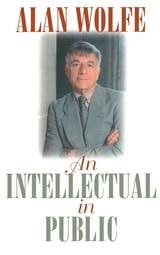
An Intellectual in Public
Alan Wolfe
University of Michigan Press, 2004
". . . proof that the spirit of the free-ranging public intellectual is still very much alive."
-Newsday
"Alan Wolfe is one of liberalism's last and most loyal sons. His mind is naturally decent and diversified; large enough and fair enough to contain both conviction and doubt. His profound respect for real people does not interfere with his profound respect for real thought. The criticism that he practices is, I fear, a dying art, but it is also one of the glories of American democracy."
-Leon Wieseltier, New Republic
"Alan Wolfe is one of America's indispensable essayists. On a broad range of topics-race, religion, politics, the marketplace, the university, and more-he combines a scholar's erudition with a historian's feel for the past and a journalist's keen attunement to the shifting patterns of the current scene. Above all he is a true writer, graceful but fearless, who ponders the deep questions so often ignored in the clamor of our ongoing civic conversation. Anyone who wonders what the term 'public intellectual' really means will find the answer-in fact many answers-in this scintillating collection."
-Sam Tanenhaus, Vanity Fair
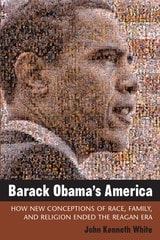
Barack Obama's America
How New Conceptions of Race, Family, and Religion Ended the Reagan EraJohn Kenneth White
University of Michigan Press, 2009
"White's Barack Obama's America eloquently captures both the important nuances of the current political scene and its long-term consequences."
---Richard Wirthlin, former pollster for Ronald Reagan
"This delightfully written and accessible book is the best available account of the changes in culture, society, and politics that have given us Barack Obama's America."
---Stan Greenberg, pollster for Bill Clinton and Chairman and CEO of Greenberg Quinlan Rosner Research
"From one of the nation's foremost experts on how values shape our politics, a clear and compelling account of the dramatic shifts in social attitudes that are transforming American political culture. White's masterful blend of narrative and data illuminates the arc of electoral history from Reagan to Obama, making a powerful case for why we are entering a new progressive political era."
---Matthew R. Kerbel, Professor of Political Science, Villanova University, and author of Netroots
"John Kenneth White is bold. He asks the big questions . . . Who are we? What do we claim to believe? How do we actually live? What are our politics? John Kenneth White writes compellingly about religion and the role it played in making Barack Obama president. White's keen insight into America's many faiths clarifies why Barack Obama succeeded against all odds. It is a fascinating description of religion and politics in twenty-first-century America---a must-read."
---Kathleen Kennedy Townsend, former Lieutenant Governor of Maryland and author of Failing America's Faithful
"In Barack Obama's America, John Kenneth White has written the political equivalent of Baedeker or Michelin, the definitive guide to and through the new, uncharted political landscape of our world. White captures and explains what America means---and what it means to be an American---in the twenty-first century."
---Mark Shields, nationally syndicated columnist and political commentator for PBS NewsHour
"John White has always caught important trends in American politics that others missed. With his shrewd analysis of why Barack Obama won, he's done it again."
---E. J. Dionne, Jr., Senior Fellow, Brookings Institution, and University Professor in the Foundations of Democracy and Culture at Georgetown University
The election of Barack Obama to the presidency marks a conclusive end to the Reagan era, writes John Kenneth White in Barack Obama's America. Reagan symbolized a 1950s and 1960s America, largely white and suburban, with married couples and kids at home, who attended church more often than not.
Obama's election marks a new era, the author writes. Whites will be a minority by 2042. Marriage is at an all-time low. Cohabitation has increased from a half-million couples in 1960 to more than 5 million in 2000 to even more this year. Gay marriages and civil unions are redefining what it means to be a family. And organized religions are suffering, even as Americans continue to think of themselves as a religious people. Obama's inauguration was a defining moment in the political destiny of this country, based largely on demographic shifts, as described in Barack Obama's America.
John Kenneth White is Professor of Politics at the Catholic University of America in Washington, D.C.
Cover image: "Out of many, we are one: Dare to Hope: Faces from 2008 Obama Rallies" by Anne C. Savage, view and buy full image at http://revolutionaryviews.com/obama_poster.html.
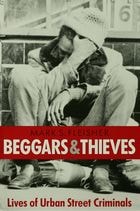
Beggars and Thieves
Lives of Urban Street CriminalsMark S. Fleisher
University of Wisconsin Press, 1995
As the incidence of violent crime rises in the United States, so does the public demand for a solution. But what will work?
Mark S. Fleisher has spent years among inmates in jails and prisons and on the streets with thieves, gang members, addicts, and life-long criminals in Seattle and other cities across the country. In Beggars and Thieves, he writes about how and why they become and remain offenders, and about the actual role of jails and prisons in efforts to deter crime and rehabilitate criminals. Fleisher shows, with wrenching firsthand accounts, that parents who are addicts, abusers, and criminals beget irreversibly damaged children who become addicts, abusers, and criminals. Further, Fleisher contends that many well-intentioned educational and vocational training programs are wasted because they are offered too late to help. And, he provides sobering evidence that many youthful and adult offenders find themselves better off in prison—with work to do, medical care, a clean place to sleep, regular meals, and stable social ties—than they are in America’s cities.
Fleisher calls for anti-crime policies that are bold, practical, and absolutely imperative. He prescribes life terms for violent offenders, but in prisons structured as work communities, where privileges are earned through work in expanded, productive industries that reduce the financial burden of incarceration on the public. But most important, he argues that the only way to prevent street crime, cut prison growth, and reduce the waste of money and human lives is to permanently remove brutalized children from criminal, addicted, and violent parents.
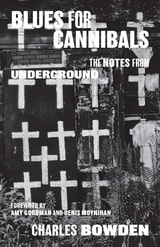
Blues for Cannibals
The Notes from UndergroundBy Charles Bowden
University of Texas Press, 2018
Cultivated from the fierce ideas seeded in Blood Orchid, Blues for Cannibals is an elegiac reflection on death, pain, and a wavering confidence in humanity’s own abilities for self-preservation. After years of reporting on border violence, sex crimes, and the devastation of the land, Bowden struggles to make sense of the many ways in which we destroy ourselves and whether there is any way to survive. Here he confronts a murderer facing execution, sex offenders of the most heinous crimes, a suicidal artist, a prisoner obsessed with painting portraits of presidents, and other people and places that constitute our worst impulses and our worst truths. Painful, heartbreaking, and forewarning, Bowden at once tears us apart and yearns for us to find ourselves back together again.
Broken Heartland
The Rise of America's Rural GhettoOsha Gray Davidson
University of Iowa Press, 1996
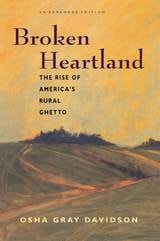
Between 1940 and the mid 1980s, farm production expenses in America's Heartland tripled, capital purchases quadrupled, interest payments jumped tenfold, profits fell by 10 percent, the number of farmers decreased by two-thirds, and nearly every farming community lost population, businesses, and economic stability. Growth for these desperate communities has come to mean low-paying part-time jobs, expensive tax concessions, waste dumps, and industrial hog farming, all of which come with environmental and psychological price tags. In Broken Heartland, Osha Gray Davidson chronicles the decline of the Heartland and its transformation into a bitterly divided and isolated regional ghetto. Through interviews with more than two hundred farmers, social workers, government officials, and scholars, he puts a human face on the farm crisis of the 1980s.
In this expanded edition Davidson emphasizes the tenacious power of far-right-wing groups; his chapter on these burgeoning rural organizations in the original edition of Broken Heartland was the first in-depth look—six years before of the Oklahoma City bombing—at the politics of hate they nurture. He also spotlights NAFTA, hog lots, sustainable agriculture, and the other battles and changes over the past six years in rural America.

Capital, Class & Technology in Contemporary American Culture
Projecting Post-FordismNick Heffernan
Pluto Press, 2000
He turns to the stories we generate and tell ourselves - via fiction, film journalism, theory - to see how change is registered. By investigating a variety of texts, he observes how structural change affects the way people organise their lives economically, socially and culturally. Case studies include Ridley Scott's Blade Runner, William Gibson's cyberspace trilogy, Thomas Pynchon's The Crying of Lot 49, and Wim Wenders's Until the End of the World.
Using the links between narrative cultural forms and the process of historical understanding, he brings together debates that have so far been conducted largely within the separate domains of political economy, social theory and cultural criticism to provide a compelling analysis of contemporary cultural change. By relocating postmodernism in the context of changing modes of capitalism, Heffernan puts the question of class and class agency back at the centre of the critical agenda.
Chic Ironic Bitterness
R. Jay Magill, Jr.
University of Michigan Press, 2009
A brilliant and timely reflection on irony in contemporary American culture
“This book is a powerful and persuasive defense of sophisticated irony and subtle humor that contributes to the possibility of a genuine civic trust and democratic life. R. Jay Magill deserves our congratulations for a superb job!”
—Cornel West, University Professor, Princeton University
“A well-written, well-argued assessment of the importance of irony in contemporary American social life, along with the nature of recent misguided attacks and, happily, a deep conviction that irony is too important in our lives to succumb. The book reflects wide reading, varied experience, and real analytical prowess.”
—Peter Stearns, Provost, George Mason University
“Somehow, Americans—a pragmatic and colloquial lot, for the most part—are now supposed to speak the Word, without ironic embellishment, in order to rebuild the civic culture. So irony’s critics decide it has become ‘worthy of moral condemnation.’ Magill pushes back against this new conventional wisdom, eloquently defending a much livelier American sensibility than the many apologists for a somber ‘civic culture’ could ever acknowledge."
—William Chaloupka, Chair and Professor, Department of Political Science, Colorado State University
The events of 9/11 had many pundits on the left and right scrambling to declare an end to the Age of Irony. But six years on, we're as ironic as ever. From The Simpsons and Borat to The Daily Show and The Colbert Report, the ironic worldview measures out a certain cosmopolitan distance, keeping hypocrisy and threats to personal integrity at bay.
Chic Ironic Bitterness is a defense of this detachment, an attitude that helps us preserve values such as authenticity, sincerity, and seriousness that might otherwise be lost in a world filled with spin, marketing, and jargon. And it is an effective counterweight to the prevailing conservative view that irony is the first step toward cynicism and the breakdown of Western culture.
R. Jay Magill, Jr., is a writer and illustrator whose work has appeared in American Prospect, American Interest, Atlantic Monthly, Foreign Policy, International Herald Tribune, New York Times, Wall Street Journal, and Print, amongother periodicals and books. A former Harvard Teaching Fellow and Executive Editor of DoubleTake, he holds a Ph.D. in American Studies from the University of Hamburg in Germany. This is his first book.
Collective Action
A Bad Subjects AnthologyEdited by Megan Shaw Prelinger and Joel Schalit
Pluto Press, 2004
Constructing the Political Spectacle
Murray Edelman
University of Chicago Press, 1988
Embodying American Slavery in Contemporary Culture
Lisa Woolfork
University of Illinois Press, 2008
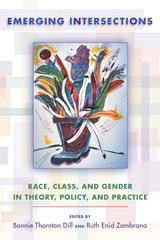
Emerging Intersections
Race, Class, and Gender in Theory, Policy, and PracticeDill, Bonnie Thornton
Rutgers University Press, 2009
Emerging Intersections, an anthology of ten previously unpublished essays, looks at the problems of inequality and oppression from new angles and promotes intersectionality as an interpretive tool that can be utilized to better understand the ways in which race, class, gender, ethnicity, and other dimensions of difference shape our lives today. The book showcases innovative contributions that expand our understanding of how inequality affects people of color, demonstrates the ways public policies reinforce existing systems of inequality, and shows how research and teaching using an intersectional perspective compels scholars to become agents of change within institutions. By offering practical applications for using intersectional knowledge, Emerging Intersections will help bring us one step closer to achieving positive institutional change and social justice.
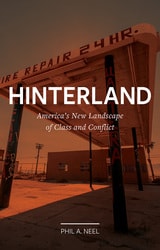
Hinterland
America's New Landscape of Class and ConflictPhil A. Neel
Reaktion Books, 2018
Urgent and unsparing, this book opens our eyes to America’s new heart of darkness. Driven by an ever-expanding socioeconomic crisis, America’s class structure is recomposing itself in new geographies of race, poverty, and production. The center has fallen. Riots ricochet from city to city led by no one in particular. Anarchists smash financial centers as a resurgent far right builds power in the countryside. Drawing on his direct experience of recent popular unrest, from the Occupy movement to the wave of riots and blockades that began in Ferguson, Missouri, Phil A. Neel provides a close-up view of this landscape in all its grim but captivating detail. Inaugurating the new Field Notes series, published in association with the Brooklyn Rail, Neel’s book tells the intimate story of a life lived within America’s hinterland.
Mapping Multiculturalism
Gordon, Avery F.
University of Minnesota Press, 1996

Mexican Americans and the U.S. Economy
Quest for Buenos DíasArturo González
University of Arizona Press, 2002

Myths about the Powerless
Contesting Social InequalitiesM. Brinton Lykes
Temple University Press, 1996
Over the Edge
The Growth of Homelessness in the 1980sMartha M. Burt
Russell Sage Foundation, 1992
Problem of the Century
Racial Stratification in the United StatesElijah Anderson
Russell Sage Foundation, 2001
Profiles of Popular Culture
A ReaderEdited by Ray B. Browne
University of Wisconsin Press, 2005
Somebody Told Me
The Newspaper Stories of Rick BraggRick Bragg
University of Alabama Press, 2000
Over the past twenty years, writer Rick Bragg has earned legions of fans with his award-winning newspaper stories and with his critically aclaimed memoir All Over but the Shoutin'. His unique storytelling talent and his sympathy for the day-to-day struggles of everyday people set him apart from journalists who focus on political intrigue and the foibles of the rich and famous.
This collection showcases Bragg's talent for turning seemingly ordinary situations into extraordinary stories by bringing together more than sixty of his most recent feature articles, most of them written for the New York Times. Bragg explores such questions as: What happens to someone released from prison for a crime he didn't commit? Who takes care of the graves of poor people? What keeps an elderly woman from selling her land for a tidy profit? Bragg's curiosity often leads him to society's margins, where he wins the confidence of those who have good reason to mistrust others.
Bragg has reported on some of the most newsworthy tragedies in the nation, and his unfolding coverage of events such as the Oklahoma City bombing and the Susan Smith child murders is included here. Once again, though, his special ability to connect with people allows him accesss and perspectives that many other reporters do not achieve.
Whether he's profiling the sheriff who broke the Smith case or relating the efforts of Alabama churchgoers to understand a Sunday morning tornado strike, Bragg writes with genuine compassion and sentiment but without being sensationalist. He looks where others don’t and gets behind the headlines to the people standing there stunned and often, until he finds them, voiceless. When asked how he came up with his remarkable stories, Bragg has his answer down pat: “Somebody told me.”
TV Family Values
Gender, Domestic Labor, and 1980s SitcomsAlice Leppert
Rutgers University Press, 2019
The Changing Terrain of Race and Ethnicity
Maria Krysan
Russell Sage Foundation, 2004
The Conquest of Cool
Business Culture, Counterculture, and the Rise of Hip ConsumerismThomas Frank
University of Chicago Press, 1997
"[Thomas Frank is] perhaps the most provocative young cultural critic of the moment."—Gerald Marzorati, New York Times Book Review
"An indispensable survival guide for any modern consumer."—Publishers Weekly, starred review
"Frank makes an ironclad case not only that the advertising industry cunningly turned the countercultural rhetoric of revolution into a rallying cry to buy more stuff, but that the process itself actually predated any actual counterculture to exploit."—Geoff Pevere, Toronto Globe and Mail
"The Conquest of Cool helps us understand why, throughout the last third of the twentieth century, Americans have increasingly confused gentility with conformity, irony with protest, and an extended middle finger with a populist manifesto. . . . His voice is an exciting addition to the soporific public discourse of the late twentieth century."—T. J. Jackson Lears, In These Times
"An invaluable argument for anyone who has ever scoffed at hand-me-down counterculture from the '60s. A spirited and exhaustive analysis of the era's advertising."—Brad Wieners, Wired Magazine
"Tom Frank is . . . not only old-fashioned, he's anti-fashion, with a place in his heart for that ultimate social faux pas, leftist politics."—Roger Trilling, Details
The Cynical Society
The Culture of Politics and the Politics of Culture in American LifeJeffrey C. Goldfarb
University of Chicago Press, 1991
The Politics of Gay Rights
Edited by Craig A. Rimmerman, Kenneth D. Wald, and Clyde Wilcox
University of Chicago Press, 2000
Forcefully argued and accessibly written, this collection is an important contribution to the current discussion about civil rights for gays and lesbians.
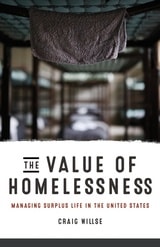
The Value of Homelessness
Managing Surplus Life in the United StatesCraig Willse
University of Minnesota Press, 2015
It is all too easy to assume that social service programs respond to homelessness, seeking to prevent and understand it. The Value of Homelessness, however, argues that homelessness today is an effect of social services and sciences, which shape not only what counts as such but what will?or ultimately won’t?be done about it.
Through a history of U.S. housing insecurity from the 1930s to the present, Craig Willse traces the emergence and consolidation of a homeless services industry. How to most efficiently allocate resources to control ongoing insecurity has become the goal, he shows, rather than how to eradicate the social, economic, and political bases of housing needs. Drawing on his own years of work in homeless advocacy and activist settings, as well as interviews conducted with program managers, counselors, and staff at homeless services organizations in New York, Los Angeles, San Francisco, and Seattle, Willse provides the first analysis of how housing insecurity becomes organized as a governable social problem.
An unprecedented and powerful historical account of the development of contemporary ideas about homelessness and how to manage homelessness, The Value of Homelessness offers new ways for students and scholars of social work, urban inequality, racial capitalism, and political theory to comprehend the central role of homelessness in governance and economy today.
The World Sixties Made
Politics And Culture In Recent Americaedited by Van Gosse and Richard Moser
Temple University Press, 2003
Toward Better Problems
New Perspectives on Abortion, Animal Rights, the Environment, and JusticeAnthony Weston
Temple University Press, 1992
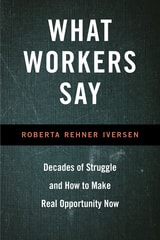
What Workers Say
Decades of Struggle and How to Make Real Opportunity NowRoberta Rehner Iversen
Temple University Press, 2022
What have jobs really been like for the past 40 years and what do the workers themselves say about them? In What Workers Say, Roberta Iversen shows that for employees in labor market industries—like manufacturing, construction, printing—as well as those in service-producing jobs, like clerical work, healthcare, food service, retail, and automotive—jobs are often discriminatory, are sometimes dangerous and exploitive, and seldom utilize people’s full range of capabilities. Most importantly, they fail to provide any real opportunity for advancement.
What Workers Say takes its cue from Studs Terkel’s Working, as Iversen interviewed more than 1,200 workers to present stories about their labor market jobs since 1980. She puts a human face on the experiences of a broad range of workers indicating what their jobs were and are truly like. Iversen reveals how transformations in the political economy of waged work have shrunk or eliminated opportunity for workers, families, communities, and productivity. What Workers Say also offers an innovative proposal for compensated civil labor that could enable workers, their communities, labor market organizations, and the national infrastructure to actually flourish.
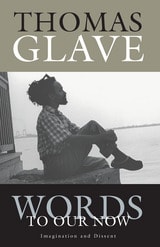
Words to Our Now
Imagination and DissentThomas Glave
University of Minnesota Press, 2007
In these lyrical and powerful essays, Thomas Glave draws on his experiences as a politically committed, gay Jamaican American to deliver a condemnation of the prejudices, hatreds, and inhumanities that persist in the United States and elsewhere. Exposing the hypocrisies of liberal multiculturalism, Glave offers instead a politics of heterogeneity in which difference informs the theory and practice of democracy. At the same time, he experiments with language to provide a model of creative writing as a tool for social change. From the death of black gay poet Essex Hemphill to the revelations of abuse at Abu Ghraib, Glave puts forth an ethical understanding of human rights to make vital connections across nations, races, genders, and sexualities.
Thomas Glave is assistant professor of English at SUNY Binghamton. He is author of Whose Song? and Other Stories.