Results by title

11 books match the query '1981-2001'

cover of In the Barrios: Latinos and the Underclass Debate

In the Barrios

Latinos and the Underclass Debate

Joan Moore

Russell Sage Foundation, 1993

The image of the "underclass," framed by persistent poverty, long-term joblessness, school dropout, teenage pregnancy, and drug use, has become synonymous with urban poverty. But does this image tell us enough about how the diverse minorities among the urban poor actually experience and cope with poverty? No, say the contributors to In the Barrios. Their portraits of eight Latino communities—in New York, Los Angeles, Miami, Houston, Chicago, Albuquerque, Laredo, and Tucson—reveal a far more complex reality. In the Barrios responds directly to current debates on the origins of the "underclass" and depicts the cultural, demographic, and historical forces that have shaped poor Latino communities. These neighborhoods share many hardships, yet they manifest no "typical" form of poverty. Instead, each group adapts its own cultural and social resources to the difficult economic circumstances of American urban life. The editors point to continued immigration as an issue of overriding importance in understanding urban Latino poverty. Newcomers to concentrated Latino areas build a local economy that provides affordable amenities and promotes ethnic institutional development. In many of these neighborhoods, a network of emotional as well as economic support extends across families and borders. The first major assessment of inner-city Latino communities in the United States, In the Barrios will change the way we approach the current debate on urban poverty, immigration, and the underclass.
[more]
cover of Mexican Americans and the U.S. Economy: Quest for Buenos Días

Mexican Americans and the U.S. Economy

Quest for Buenos Días

Arturo González

University of Arizona Press, 2002
As workers and consumers, Mexican Americans are a viable—and valuable—part of the broad U.S. economy. Despite that many are hindered by low education (and consequently low wages) and limited opportunities, they have continuously struggled for, and continue to seek, better days and the opportunity to realize their share of the American dream. This book examines the problems that Mexican Americans have experienced in attaining economic parity with non-Hispanic whites. It examines four major topics of particular concern to the economic status of the Mexican American community: - immigration, reviewing the Bracero Program, the Immigration Reform and Control Act of 1986, legislation from the 1990s, and the problems faced by immigrants today - education, stressing the importance of economic incentives to invest in education - wealth and poverty, evaluating opportunities and roadblocks as Mexican Americans aspire to middle-class standards of living - the labor market, covering such topics as employment, income, and discrimination. Arturo González has drawn on recent census data to present for the first time in one volume a detailed economic analysis of three generations of Mexican Americans. These statistics reveal a people who are steadily improving economically and provide evidence that stereotypes of Mexican Americans are outdated or erroneous. Mexican Americans and the U.S. Economy shows that economics is an important aspect of the Mexican American experience. The book helps broaden students' understanding of the community’s ongoing struggle, putting the quest for buenos días in clearer perspective.
[more]
cover of Newcomers In Workplace: Immigrants and the Restructing of the U.S. Economy

Newcomers In Workplace

Immigrants and the Restructing of the U.S. Economy

edited by Louise Lamphere, Alex Stepick and Guillermo Grenier

Temple University Press, 1994

Newcomers in the Workplace documents and dramatizes the changing face of the American workplace, transformed in the 1980s by immigrant workers in all sectors. This collection of excellent ethnographies captures the stench of meatpacking plants, the clatter of sewing machines, the sweat of construction sites, and the strain of management-employee relations in hotels and grocery stores as immigrant workers carve out crucial roles in a struggling economy.

Case studies focus on three geographical regions—Philadelphia, Miami, and Garden City, Kansas—where the active workforce includes increasing numbers of Cubans, Haitians, Koreans, Puerto Ricans, Laotians, Vietnamese, and other new immigrants. The portraits show these newcomers reaching across ethnic boundaries in their determination to retain individualism and to insure their economic survival.


In the series Labor and Social Change, edited by Paula Rayman and Carmen Sirianni.
 

[more]
cover of Prosperity For All?: The Economic Boom and African Americans

Prosperity For All?

The Economic Boom and African Americans

Robert Cherry

Russell Sage Foundation, 2000
With the nation enjoying a remarkable long and robust economic expansion, AfricanAmerican employment has risen to an all-time high. Does this good news refute the notion of a permanently disadvantaged black underclass, or has one type of disadvantage been replaced by another? Some economists fear that many newly employed minority workers will remain stuck in low-wage jobs, barred from better-paying, high skill jobs by their lack of educational opportunities and entrenched racial discrimination. Prosperity for All? draws upon the research and insights of respected economists to address these important issues. Prosperity for All? reveals that while African Americans benefit in many ways from a strong job market, serious problems remain. Research presented in this book shows that the ratio of black to white unemployment has actually increased over recent expansions. Even though African American men are currently less likely to leave the workforce, the number of those who do not find work at all has grown substantially, indicating that joblessness is now concentrated among the most alienated members of the population. Other chapters offer striking evidence that racial inequality is still pervasive. Among men, black high school dropouts have more difficulty finding work than their Latino or white counterparts. Likewise, the glass ceiling that limits minority access to higher paying promotions persists even in a strong economy. Prosperity for All? ascribes black disadvantage in the labor force to employer discrimination, particularly when there is strong competition for jobs. As one study illustrates, economic upswings do not appear to change racial preferences among employers, who remain less willing to hire African Americans for more skilled low-wage jobs. Prosperity for All? offers a timely investigation into the impact of strong labor markets on low-skill African-American workers, with important insights into the issues engendered by the weakening of federal assistance, job training, and affirmative action programs.
[more]
cover of State of the Union: America in the 1990s, Economic Trends

State of the Union

America in the 1990s, Economic Trends

Reynolds Farley

Russell Sage Foundation, 1995
 "The Census is a most valuable source of information about our lives; these volumes make the story it has to tell accessible to all who want to know." —Lee Rainwater, Center for Advanced Study in the Behavioral Sciences "A lucid and balanced overview of major trends in the United States and essential reading for policymakers. State of the Union is a reality check that provides the factual basis for policy analysis."—Peter Gottschalk, Boston College State of the Union: America in the 1990s is the definitive new installment to the United States Census Series, carrying forward a tradition of census-based reports on American society that began with the 1930 Census. These two volumes offer a systematic, authoritative, and concise interpretation of what the 1990 Census reveals about the American people today. •Volume One: Economic Trends focuses on the schism between the wealthy and the poor that intensified in the 1980s as wages went up for highly educated persons but fell for those with less than a college degree. This gap was reflected geographically, as industries continued their migration from crumbling inner cities to booming edge cities, often leaving behind an impoverished minority population. Young male workers lost ground in the 1980s, but women made substantial strides, dramatically reducing the gender gap in earnings. The amount of family income devoted to housing rose over the decade, but while housing quality improved for wealthy, older Americans, it declined for younger, poorer families. •Volume Two: Social Trends examines the striking changes in American families and the rapid shifts in our racial and ethnic composition. Americans are marrying much later and divorcing more often, and increasing numbers of unmarried women are giving birth. These shifts have placed a growing proportion of children at risk of poverty. In glaring contrast, the elderly were the only group to make gains in the 1980s, and are now healthier and more prosperous than ever before. The concentrated immigration of Asians and Latinos to a few states and cities created extraordinary pockets of diversity within the population. Throughout the 1990s, the nation will debate questions about the state of the nation and the policies that should be adopted to address changing conditions. Will continued technological change lead to even more economic polarization? Will education become an increasingly important factor in determining earnings potential? Did new immigrants stimulate the economy or take jobs away from American-born workers? Will we be able to support the rapidly growing population of older retirees? State of the Union will help us to answer these questions and better understand how well the nation is adapting to the pervasive social and economic transformations of our era. A Volume in the Russell Sage Foundation Census Series
[more]
cover of State of the Union: America in the 1990s, Social Trends

State of the Union

America in the 1990s, Social Trends

Reynolds Farley

Russell Sage Foundation, 1995
 "The Census is a most valuable source of information about our lives; these volumes make the story it has to tell accessible to all who want to know." —Lee Rainwater, Center for Advanced Study in the Behavioral Sciences "A lucid and balanced overview of major trends in the United States and essential reading for policymakers. State of the Union is a reality check that provides the factual basis for policy analysis."—Peter Gottschalk, Boston College State of the Union: America in the 1990s is the definitive new installment to the United States Census Series, carrying forward a tradition of census-based reports on American society that began with the 1930 Census. These two volumes offer a systematic, authoritative, and concise interpretation of what the 1990 Census reveals about the American people today. •Volume One: Economic Trends focuses on the schism between the wealthy and the poor that intensified in the 1980s as wages went up for highly educated persons but fell for those with less than a college degree. This gap was reflected geographically, as industries continued their migration from crumbling inner cities to booming edge cities, often leaving behind an impoverished minority population. Young male workers lost ground in the 1980s, but women made substantial strides, dramatically reducing the gender gap in earnings. The amount of family income devoted to housing rose over the decade, but while housing quality improved for wealthy, older Americans, it declined for younger, poorer families. •Volume Two: Social Trends examines the striking changes in American families and the rapid shifts in our racial and ethnic composition. Americans are marrying much later and divorcing more often, and increasing numbers of unmarried women are giving birth. These shifts have placed a growing proportion of children at risk of poverty. In glaring contrast, the elderly were the only group to make gains in the 1980s, and are now healthier and more prosperous than ever before. The concentrated immigration of Asians and Latinos to a few states and cities created extraordinary pockets of diversity within the population. Throughout the 1990s, the nation will debate questions about the state of the nation and the policies that should be adopted to address changing conditions. Will continued technological change lead to even more economic polarization? Will education become an increasingly important factor in determining earnings potential? Did new immigrants stimulate the economy or take jobs away from American-born workers? Will we be able to support the rapidly growing population of older retirees? State of the Union will help us to answer these questions and better understand how well the nation is adapting to the pervasive social and economic transformations of our era. A Volume in the Russell Sage Foundation Census Series
[more]
cover of The New Dollars and Dreams: American Incomes in the Late 1990s

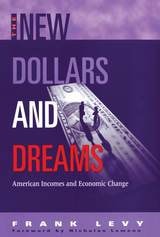
The New Dollars and Dreams

American Incomes in the Late 1990s

Frank Levy

Russell Sage Foundation, 1998
Foreword by Nicholas Lemann "A brilliant book that both clarifies and explains the seemingly contradictory trends of a booming economy, wage stagnation, and growing income inequality." —Thomas B. Edsall, author, The New Politics of Inequalityand political reporter atThe Washington Post More than a decade ago, Frank Levy's classic Dollars and Dreams offered an incisive analysis of the dramatic changes then taking place in the American standard of living. As wage stagnation and rising income inequality in the 1970s and early 80s began to undermine Americans' traditional economic optimism, Levy's book provided the first diagnosis of what he called the quiet depression. Since then, the U.S. economy has made a dramatic comeback, but economic insecurity remains widespread. New technologies, increased immigration, and global competition have opened up a new economic playing field, one with new rules and new winners and losers. The New Dollars and Dreams explores this puzzling economic landscape, in which low unemployment goes hand in hand with sluggish wage growth and high income inequality. This completely revised and expanded version of Levy's original book offers an invaluable guide to the sweeping economic, social, and political changes that have remade life in the United States over the past twenty-five years. Levy tells a fascinating and insightful story about what happened to American incomes and jobs. His plot resists the simple truths of everyday journalism, and explains the economic and political twists and turns that have shaped the current American economy—including the oil and food price inflations of the 1970s, the market deregulations and corporate downsizings of the 1980s, the emergence of women as sole breadwinners in many families, the migration of jobs to the suburbs, and the computerization of work. The New Dollars and Dreams illuminates the key sources of inequality, with chapters that examine the disparate employment progress of whites, minorities, men, and women, and it carefully investigates the claim that the concentration of very high incomes is the result of a winner-take-all economy. Although the growth of the service economy is often blamed for inequality, Levy locates a more fundamental cause in the rising educational and skill demands brought about by restructuring of work in all sectors of the economy. An important part of the story also involves the transformation of the American family from extended and two-parent households to those headed by single mothers and lone individuals. By making sense of these complex trends, The New Dollars and Dreams offers crucial insights into why, despite a thriving economy, many Americans no longer feel secure in their financial futures. A Volume in the Russell Sage Foundation Census Series
[more]
cover of The Roaring Nineties: Can Full Employment Be Sustained?

The Roaring Nineties

Can Full Employment Be Sustained?

Alan B. Krueger

Russell Sage Foundation, 2001
The positive social benefits of low unemployment are many—it helps to reduce poverty and crime and fosters more stable families and communities. Yet conventional wisdom—born of the stagflation of the 1970s—holds that sustained low unemployment rates run the risk of triggering inflation. The last five years of the 1990s—in which unemployment plummeted and inflation remained low—called this conventional wisdom into question. The Roaring Nineties provides a thorough review of the exceptional economic performance of the late 1990s and asks whether it was due to a lucky combination of economic circumstances or whether the new economy has somehow wrought a lasting change in the inflation-safe rate of unemployment. Led by distinguished economists Alan Krueger and Robert Solow, a roster of twenty-six respected economic experts analyzes the micro- and macroeconomic factors that led to the unexpected coupling of low unemployment and low inflation. The more macroeconomically oriented chapters clearly point to a reduction in the inflation-safe rate of unemployment. Laurence Ball and Robert Moffitt see the slow adjustment of workers' wage aspirations in the wake of rising productivity as a key factor in keeping inflation at bay. And Alan Blinder and Janet Yellen credit sound monetary policy by the Federal Reserve Board with making the best of fortunate circumstances, such as lower energy costs, a strong dollar, and a booming stock market. Other chapters in The Roaring Nineties examine how the interaction between macroeconomic and labor market conditions helped sustain high employment growth and low inflation. Giuseppe Bertola, Francine Blau, and Lawrence M. Kahn demonstrate how greater flexibility in the U.S. labor market generated more jobs in this country than in Europe, but at the expense of greater earnings inequality. David Ellwood examines the burgeoning shortage of skilled workers, and suggests policies—such as tax credits for businesses that provide on-the-job-training—to address the problem. And James Hines, Hilary Hoynes, and Alan Krueger elaborate the benefits of sustained low unemployment, including budget surpluses that can finance public infrastructure and social welfare benefits—a perspective often lost in the concern over higher inflation rates. While none of these analyses promise that the good times of the 1990s will last forever, The Roaring Nineties provides a unique analysis of recent economic history, demonstrating how the nation capitalized on a lucky confluence of economic factors, helping to create the longest peacetime boom in American history. Copublished with The Century Foundation
[more]
cover of Understanding Mainland Puerto Rican Pov

Understanding Mainland Puerto Rican Pov

Susan Baker

Temple University Press, 2002

For too long the study of impoverished Puerto Ricans living in the fifty states has been undermined by the use of broad generalizations. Puerto Ricans have been statistically grouped with all Latinos, studied with models developed for understanding African-American life, and written about as if New York's Puerto Rican community was the only such community worthy of detailed study. This book changes all that. In this important new work, Susan Baker looks beyond the traditional models and rewrites the origins, current state, and reasons behind Puerto Rican poverty.The book tells the story of how Puerto Ricans have left the Rustbelt cities to return to the island or to seek job opportunities elsewhere. Those left behind are predominantly poor women with dependents who live in segregated neighborhoods with little chance of finding low-skilled jobs because of competition from non-citizen, non-politicized workers.In her alternative explanation, the author presents data from across the country and puts forth an explanation that is grounded in Puerto Rican history and sensitive not only to the interconnectedness of the island and mainland population, but also the increasing distress faced by Puerto Rican women and the sad truth that Puerto Rican citizenship in this country is a second class one.
[more]
cover of Uneven Tides: Rising Inequality in America

Uneven Tides

Rising Inequality in America

Sheldon H. Danziger

Russell Sage Foundation, 1993

Inequality has been on the rise in America for more than two decades. This socially divisive trend began in the economic doldrums of the 1970s and continued through the booming 1980s, when surging economic tides clearly failed to lift all ships. Instead, escalating inequality in both individual earnings and family income widened the gulf between rich and poor and led to the much-publicized decline of the middle class. Uneven Tides brings together a distinguished group of economists to confront the crucial questions about this unprecedented rise in inequality. Just how large and pervasive was it? What were its principal causes? And why did it continue in the 1980s, when previous periods of national economic growth have generally reduced inequality? Reviewing the best current evidence, the essays in Uneven Tides show that rising inequality is a complex phenomenon, the result of a web of circumstances inherent in the nation's current industrial, social, and political situation. Once attributed to the rising supply of inexperienced workers—as baby boomers, new immigrants, and women entered the labor market—the growing inequality in individual earnings is revealed in Uneven Tides to be the direct result of the economy's increasing demand for skilled workers. The authors explore many of the possible causes of this trend, including the employment shift from manufacturing to the service sector, the heightened importance of technology in the workplace, the decline of unionization, and the intensified efforts to compete in a global marketplace. Uneven Tides also examines the equally dramatic growth in the inequality of family income, and reviews the effects of family size, the age and education of household heads, and the transition to both two-earner and single-parent families. Although these demographic shifts played a role, what emerges most clearly is an understanding of the powerful influence of public policy, as increasingly regressive taxes, declining welfare benefits, and a stagnant minimum wage continue to amplify the effects of market forces on income. With the rise in inequality now much in the headlines, it is clear that our nation's ability to reverse these shifting currents requires deeper understanding of their causes and consequences. Uneven Tides is the first book to get beyond the news stories to a clear analysis of the changing fortunes of America's families. It should be required reading for anyone with a serious interest in the economic underpinnings of the country's social problems.
[more]
cover of Wrecked: The Edmund Fitzgerald and the Sinking of the American Economy

Wrecked

The Edmund Fitzgerald and the Sinking of the American Economy

Thomas M Nelson

Michigan State University Press, 2025

Wrecked links the story of America’s most infamous shipwreck to the story of an even larger disaster—the wreck of the American industrial economy. When the Edmund Fitzgerald went down in a Lake Superior storm on November 10, 1975, more was lost than the ship and the twenty-nine lives on board. The disaster was a human tragedy as well as an indictment of the American industrial policies that eventually cost the nation thousands of jobs and marooned hundreds of communities. Written with a passionate yet factually grounded intensity, Wrecked shows that the reasons for the decline of industrial manufacturing in the upper Midwest are linked to why the Edmund Fitzgerald sank, and to the legal turmoil that followed for the victims’ families. The book conveys the sense of loss that still is felt by those affected, along with the outrage over the disappearance of manufacturing jobs and the inadequate maintenance and legal maneuvering over liability for the sinking of the ship. What follows is a fascinating critique of what went wrong and why.
[more]