Results by title
9 books match the query '1985-1991'
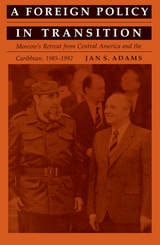
A Foreign Policy in Transition
Moscow's Retreat from Central America and the Carribbean, 1985-1992Jan S. Adams
Duke University Press, 1992
During his years of leadership in the Soviet Union, Mikhail Gorbachev initiated revolutionary changes in that country's foreign and domestic policies. A Foreign Policy in Transition charts the changing Soviet policies toward Central America and the Caribbean during the Gorbachev years, examines the effects of these policies on individual countries, and looks to the role that Russia and the other Soviet-successor states will play in this region in the 1990s.
Jan S. Adams analyzes the factors shaping Gorbachev's foreign policy in Central America by surveying Soviet political views old and new, by describing Gorbachev's bold restructuring of the Soviet foreign policy establishment, and by assessing the implications of his policy of perestroika. A series of country studies demonstrates how changes in Soviet policies and domestic and economic circumstances contributed to significant shifts in the internal conditions and external relations of the Central American and Caribbean nations. Adams discusses in detail such topics as the reduction of Soviet military and economic aid to the region and pressures exerted by Moscow on client states to effect the settlement of regional conflicts by political rather than military means.
The author concludes by speculating about which trends in foreign policy by Russia and other Soviet-successor states toward Central America and the Caribbean may persist in the post-Soviet period, discussing as the implications of these changes for future U.S. policy in the region.
[more]
Dehexing Sex
Russian Womanhood During and After GlasnostHelena Goscilo
University of Michigan Press, 1996
Glasnost and the collapse of the Soviet Union revolutionized Russian society. What effects, however, did they have on the status, role, and image of women in Russian culture? Examining the past turbulent decade of transition to "democracy" and a market economy, Dehexing Sex traces the ways in which Russia's concept of womanhood both changed and remained the same, taking into account dominant ideologies and social philosophies, sociopolitical organizations, women's writings, literary criticism, film, and popular cultural forms such as pornography. The lively, engaging chapters of this book examine texts by contemporary women writers in the context of the political, social, economic, biological, psychological, and aesthetic transformations that helped define them. Goscilo reveals that the Russian cultural revolution has reshaped the female image in varied and often contradictory ways. While increased interaction with the West fostered gender awareness, it also introduced imported Western sexist practices--especially the exploitation of female bodies--formerly proscribed by a puritanical censorship. Popular magazines, newspapers, and television propagated the image of woman as mother, ornament, and sexual object, even as women's fiction conceived of womanhood in complex psychological terms that undermined the gender stereotypes which had ruled Soviet thinking for more than 70 years. With the aid of feminist and cultural theory, Dehexing Sex investigates the overt and internalized misogyny that combined with the genuinely liberalizing forces unleashed by Gorbachev's policy of glasnost and perestroika. It exposes Russia's repressive romance with womanhood as a metaphor for nationhood and explores Russian women's ironic recasting of national mythologies. "Impressive . . . an important contribution to Russian studies and to women's studies. The author is an outstanding scholar, an energetic and original thinker, and her writing sparkles with imagination and wit." --Stephanie Sandler, Amherst College Helena Goscilo is Associate Professor and Chair of Slavic Languages and Literatures, University of Pittsburgh.
[more]
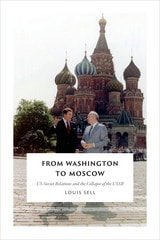
From Washington to Moscow
US-Soviet Relations and the Collapse of the USSRLouis Sell
Duke University Press, 2016
When the United States and the Soviet Union signed the first Strategic Arms Limitation Talks accords in 1972 it was generally seen as the point at which the USSR achieved parity with the United States. Less than twenty years later the Soviet Union had collapsed, confounding experts who never expected it to happen during their lifetimes. In From Washington to Moscow veteran US Foreign Service officer Louis Sell traces the history of US–Soviet relations between 1972 and 1991 and explains why the Cold War came to an abrupt end. Drawing heavily on archival sources and memoirs—many in Russian—as well as his own experiences, Sell vividly describes events from the perspectives of American and Soviet participants. He attributes the USSR's fall not to one specific cause but to a combination of the Soviet system's inherent weaknesses, mistakes by Mikhail Gorbachev, and challenges by Ronald Reagan and other US leaders. He shows how the USSR's rapid and humiliating collapse and the inability of the West and Russia to find a way to cooperate respectfully and collegially helped set the foundation for Vladimir Putin’s rise.
[more]

How the Soviet Union Disappeared
An Essay on the Causes of DissolutionWisla Suraska
Duke University Press, 1998
Many theories have been offered to explain the disintegration of the Soviet Union, yet none sufficiently explain the speed and profundity of the empire’s collapse. In this powerful polemic, Wisla Suraska disputes popular interpretations of the dissolution of the Soviet Union and explains how theories, such as totalitarian theory, have failed to examine the exigencies of arbitrary government. At the center of Suraska’s own theories on the Soviet collapse is her claim that it came about not simply because it was an economically declining country that contained too many nationalities but because it was despotic and that despotism is unworkable in modern societies.
Using numerous secondary sources, recently published memoir literature, and new archival research, Suraska’s multidimensional study delves into the many factors involved in the dissolution of the Soviet empire—the role of Gorbachev and his contest with Yeltsin, the weakness of the Soviet state, and the poverty of ideas that informed perestroika. She also examines the complex relationship between the Communist Party, the KGB, and the military; the way Gorbachev dealt with the German question; and the rise of post-Marxist thought in the Soviet Union. Whether discussing how insufficient control over coercive forces or the growing strength of provincial barons impacted the collapse, Suraska furthers her argument that the explosion of nationalisms in the Soviet Union was as much activated by the breakdown of central structures as it actually contributed to the final demolition of the regime. In the end, How the Soviet Union Disappeared reveals Gorbachev’s perestroika as having been nothing short of a radical attempt to rebuild power that the Soviet center had lost in the post-Stalinist period.
In its questioning of the assumptions of most previous scholarship and discourse on the Soviet Union, this book will be of interest to Sovietologists, political scientists, and students of communism and nationalism.
[more]
Melting the Ice Curtain
The Extraordinary Story of Citizen Diplomacy on the Russia-Alaska FrontierDavid Ramseur
University of Alaska Press, 2017
Just five years after a Soviet missile blew a civilian airliner out of the sky over the North Pacific, an Alaska Airlines jet braved Cold War tensions to fly into tomorrow. Crossing the Bering Strait between Alaska and the Russian Far East, the 1988 Friendship Flight reunited Native peoples of common languages and cultures for the first time in four decades. It and other dramatic efforts to thaw what was known as the Ice Curtain launched a thirty-year era of perilous, yet prolific, progress.
Melting the Ice Curtain tells the story of how inspiration, courage, and persistence by citizen-diplomats bridged a widening gap in superpower relations. David Ramseur was a first-hand witness to the danger and political intrigue, having flown on that first Friendship Flight, and having spent thirty years behind the scenes with some of Alaska’s highest officials. As Alaska celebrates the 150th anniversary of its purchase, and as diplomatic ties with Russia become perilous, Melting the Ice Curtain shows that history might hold the best lessons for restoring diplomacy between nuclear neighbors.
Melting the Ice Curtain tells the story of how inspiration, courage, and persistence by citizen-diplomats bridged a widening gap in superpower relations. David Ramseur was a first-hand witness to the danger and political intrigue, having flown on that first Friendship Flight, and having spent thirty years behind the scenes with some of Alaska’s highest officials. As Alaska celebrates the 150th anniversary of its purchase, and as diplomatic ties with Russia become perilous, Melting the Ice Curtain shows that history might hold the best lessons for restoring diplomacy between nuclear neighbors.
[more]
Post-Communism
An IntroductionLeslie Holmes
Duke University Press, 1997
[more]
Revolutionary Passage
From Soviet To Post-Soviet RussiaMarc Garcelon
Temple University Press, 2005
Revolutionary Passage is a cultural, social, and political history of Russia during its critical period of transformation at the end of the twentieth century. Marc Garcelon traces the history of perestroika and the rise of Vladimir Putin, arguing that the pressure Mikhail Gorbachev's reforms put on the Soviet system gave birth to movements for democratic change. He also shows that the very political arrangements that prompted the fall of Communism also killed hopes for subsequent reform. At the turning point of this political revolution stood Democratic Russia, or DemRossiia, the principal organization of the Russian democratic movement that helped to dismantle the Soviet system and force the Soviet leadership to change course. However, as post-Soviet Russia committed itself to globalization and U.S.-style economic reforms, the country directed itself away from the Democratic reforms called for by organizations like DemRossiia, and such groups collapsed. Revolutionary Passage provides a close examination of the DemRossiia. Garcelon deftly illuminates the rise and decline of this organization, and how the processes of revolutionary change impacted both Russia and the world.
[more]
Soviet-American Relations After the Cold War
Robert Jervis and Seweryn Bialer, eds.
Duke University Press, 1991
This important collection of essays explores the terrain of possible Soviet-American relations in the next decade. Starting from the premise that glasnost and perestroika will not be reversed, this expert group of contributors provides a wide-ranging and far-reaching analysis of Soviet-U.S. relations crucial to any current discussion of the topic.
Moving beyond the boundaries of traditional studies of international relations, the contributors here focus on such topics as public opinion and the relationship of domestic policy to foreign policy. Other areas of consideration include the Soviet-U.S. relationship and the Third World and East Asia, the role of the United Nations in Soviet and American policy in the 1990s, international environmental protection, and the Soviet opening to nonprovocative defense. A final section concludes with policy choices for the future regarding security strategies and prospects for peace.
Moving beyond the boundaries of traditional studies of international relations, the contributors here focus on such topics as public opinion and the relationship of domestic policy to foreign policy. Other areas of consideration include the Soviet-U.S. relationship and the Third World and East Asia, the role of the United Nations in Soviet and American policy in the 1990s, international environmental protection, and the Soviet opening to nonprovocative defense. A final section concludes with policy choices for the future regarding security strategies and prospects for peace.
Contributors. Seweryn Bialer, Robert Dallek, Charles Gati, Toby Trister Gati, Colin S. Gray, Ole R. Holsti, Robert Jervis, Alexander J. Motyl, John Mueller, Eric A. Nordlinger, George H. Quester, Harold H. Sanders, Glenn E. Schweitzer, Jack Snyder, Donald S. Zagoria, William Zimmerman
[more]
The USSR and Iraq
The Soviet Quest for InfluenceOles M. Smolansky, with Bettie M. Smolansky
Duke University Press, 1991
In The USSR and Iraq, the first major study of Soviet-Iraqi relations, Oles M. Smolansky examines the history of the relationship between these two countries during the past twenty years and attempts to dispel the misconception that the Soviet Union has enjoyed undue influence over Iraq.
Drawing on ten years of research in Western, Arab, and Soviet sources, Smolansky analyzes the complex issues at the center of Soviet-Iraqi relations from 1968 through 1988, including the nationalization of the oil industry, the Kurdish question, the Iraqi Communist Party, the affairs of the Persian/Arabian Gulf, and, ultimately, the war between Iraq and Iran.
Smolansky concludes that Iraq has never been under the dominant influence of Moscow, nor has it even been a loyal Soviet ally. In fact, Iraq has managed to reap major benefits from the relationship without losing its autonomy or sacrificing its major interests. The author discusses the Soviet Union and Iraq within the larger framework of the nature of influence relationships between great and small powers.
[more]