Results by title

15 books match the query '1989-1993'
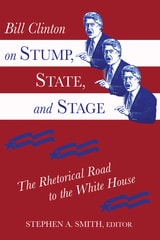
cover of Bill Clinton on Stump, State, and Stage: The Rhetorical Road to the White House

Bill Clinton on Stump, State, and Stage

The Rhetorical Road to the White House

Stephen A. Smith

University of Arkansas Press, 1994
These lively and penetrating essays by outstanding scholars of political communication examine President Clinton’s rhetorical work before he took the oath of office, presenting a unique perspective on the words and texts that brought him to the presidency and the dynamics of political media throughout the campaign. In these original, valuable, and deeply insightful interpretations, the success of Clinton as a public persuader and compelling orator is analyzed, as is the whole process of political communication in America at the end of the twentieth century.
[more]
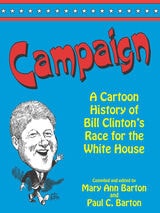
cover of Campaign: A Cartoon History of Bill Clinton's Race for the White House

Campaign

A Cartoon History of Bill Clinton's Race for the White House

Mary Ann Barton

University of Arkansas Press, 1993

This fascinating record chronicles Governor Bill Clinton’s 1992 bid for the presidency by gathering editorial cartoons from some of the nation’s premier magazines and newspapers. His meteoric rise from obscure origins as governor of a small southern state to his current position as the world’s most powerful head of state presents political cartoonists with a unique challenge.

For many people, in the United States and abroad, the dramas of the campaign created the character of Clinton. From the Gennifer Flowers debacle to Clinton’s
resurrection at the Democratic National Convention and the triumph of the election win, the incisive cartoons in this collection capture Clinton’s emerging image in a way that no written word can. The forty-five contributing artists use these cartoons to depict the breathtaking and colorful events that only a presidential campaign can produce and offer hours of entertainment for any reader.
[more]
cover of Catch and Release: An Oregon Life in Politics

Catch and Release

An Oregon Life in Politics

Les AuCoin

Oregon State University Press, 2019

In 1974, at the age of thirty-two, Les AuCoin became the first Democrat to win a US House seat in Oregon’s First District. He was one of the post-Watergate reformers who shook up an insular, autocratic Congress and led fights for affordable housing, “trickle-up” economics, wilderness protection, abortion rights, and nuclear arms control. In the 1980s, the Oregonian called him “the most powerful congressman in Oregon.”
 
In this compelling collection of life stories, AuCoin traces his unlikely rise from a fatherless childhood in Central Oregon to the top ranks of national power. Then came a painful defeat in one of the most controversial races in US Senate history, against incumbent Bob Packwood.
 
A fly fisher, AuCoin uses “catch and release” as a metaphor for succeeding and letting go of loss with dignity and equanimity. His memories are in turn funny, suspenseful, and revealing. AuCoin takes us to the Kremlin, pre-industrial China, the Arctic National Wildlife Refuge, and into the tortuous politics of the Northwest spotted owl crisis. He interacted with world figures like Mikhail Gorbachev, Ronald Reagan, House Speakers Tip O’Neill and Jim Wright, and Oregon legends Tom McCall and Mark Hatfield. Closer to home, AuCoin allied himself with activists like Sidney Lasseigne of the Newport Fishermen’s Wives.
 
Catch and Release offers readers a revealing glimpse behind the scenes of congressional life, as lived by the 535 souls who inhabit the US House and Senate—including the author, who assesses his own strengths and foibles with humility and candor.
[more]
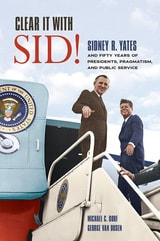
cover of Clear It with Sid!: Sidney R. Yates and Fifty Years of Presidents, Pragmatism, and Public Service

Clear It with Sid!

Sidney R. Yates and Fifty Years of Presidents, Pragmatism, and Public Service

Michael C. Dorf and George Van Dusen

University of Illinois Press, 2022

The son of a Lithuanian blacksmith, Sidney R. Yates rose to the pinnacle of Washington power and influence. As chair of a House Appropriations Subcommittee, Yates was a preeminent national figure involved in issues that ranged from the environment and Native American rights to Israel and support for the arts. Speaker Tip O'Neill relied on the savvy Chicagoan in the trenches and advised anyone with controversial legislation to first "clear it with Sid!"

Michael C. Dorf and George Van Dusen draw on scores of interviews and unprecedented access to private papers to illuminate the life of an Illinois political icon. Wise, energetic, charismatic, petty, stubborn--Sid Yates presented a complicated character to constituents and colleagues alike. Yet his get-it-done approach to legislation allowed him to bridge partisan divides in the often-polarized House of Representatives. Following Yates from the campaign trail to the negotiating table to the House floor, Dorf and Van Dusen offer a rich portrait of a dealmaker extraordinaire and tireless patriot on a fifty-year journey through postwar American politics.
[more]
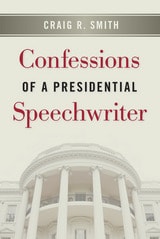
cover of Confessions of a Presidential Speechwriter

Confessions of a Presidential Speechwriter

Craig R. Smith

Michigan State University Press, 2014
An avid high school debater and enthusiastic student body president, Craig Smith seemed destined for a life in public service from an early age. As a sought-after speechwriter, Smith had a front-row seat at some of the most important events of the twentieth century, meeting with Robert Kennedy and Richard Nixon, advising Governor Ronald Reagan, writing for President Ford, serving as a campaign manager for a major U.S. senator’s reelection campaign, and writing speeches for a contender for the Republican nomination for president. Life in the volatile world of politics wasn’t always easy, however, and as a closeted gay man, Smith struggled to reconcile his private and professional lives. In this revealing memoir, Smith sheds light on what it takes to make it as a speechwriter in a field where the only constant is change. While bouncing in and out of the academic world, Smith transitions from consultantships with George H. W. Bush and the Republican caucus of the U.S. Senate to a position with Chrysler CEO Lee Iacocca. When Smith returns to Washington, D.C., as president and founder of the Freedom of Expression Foundation, he becomes a leading player on First Amendment issues in the nation’s capital. Returning at long last to academia, Smith finds happiness coming out of the closet and reaping the benefits of a dedicated and highly successful career.
[more]
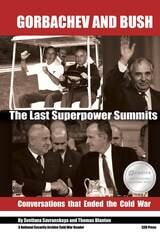
cover of Gorbachev and Bush: The Last Superpower Summits. Conversations that Ended the Cold War

Gorbachev and Bush

The Last Superpower Summits. Conversations that Ended the Cold War

The National Security Archive Savranskaya

Central European University Press, 2020
This book presents and interprets archival records of the meetings between Mikhail Gorbachev and George W. Bush between 1989 and 1991, including transcripts of conversations between top leaders on the rapid and monumental events of the final days of the Cold War. Particularly effective interlocutors were the foreign ministers Eduard Shevardnadze and James Baker, especially interesting when they interacted directly with Bush or Gorbachev. The documents were obtained from the Gorbachev Foundation and the Russian State Archives and from the United States government through requests under the Freedom of Information Act. Taking place at a time of revolutionary change in Eastern Europe, stimulated in part by Gorbachev and by Eastern Europeans (the Solidarity movement, dissidents, reform communists), the Malta Summit of 1989 and subsequent meetings helped defuse any potential for superpower conflict. Each of the five summits is covered in a separate chapter, introduced by an essay that places the transcripts in historical context. The anthology offers a fascinating glimpse into the relationship that defined the last, waning years of the Cold War—a unique record of these historic, highest-level conversations that effectively brought it to a close. The quality and scope of the dialogue between these world leaders was unprecedented and is likely never to be repeated.
[more]
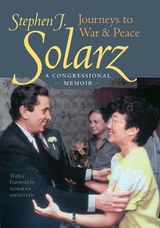
cover of Journeys to War and Peace: A Congressional Memoir

Journeys to War and Peace

A Congressional Memoir

Stephen J. Solarz

Brandeis University Press, 2011
In this remarkable book, recounting his long, influential career as a congressman from New York, Stephen Solarz gives an insider’s view of the life of a hard-working legislator in the forefront of democracy movements and human rights during a tumultuous time in our nation’s history. A member of the class of 1974, the so-called “Watergate” class, when 75 freshman Democrats were elected to the Congress, Solarz was part of the group that brought about a power shift in the House from an inner circle of senior committee chairs to a much larger group of subcommittee leaders. Early on he sought and won a seat on the House Foreign Affairs Committee, where he earned a reputation as an expert in international relations, traveling to more than 100 countries and meeting the likes of Anwar Sadat, Menachem Begin, Nelson Mandela, Indira Gandhi, Saddam Hussein, Kim Il Sung, and Robert Mugabe. Solarz gives fascinating, detailed descriptions of his role in bringing democracy to South Korea and Taiwan, the triumph of people power in the Philippines, the peace agreement in Cambodia, the abolition of apartheid in South Africa, and the adoption of the resolution authorizing the use of force in the first Gulf War. Written in an engaging style, Journeys to War and Peace will appeal to all who value the struggle for human rights and seek a better understanding between differing cultures and peoples.
[more]
cover of Organizing for Foreign Policy Crises: Presidents, Advisers, and the Management of Decision Making

Organizing for Foreign Policy Crises

Presidents, Advisers, and the Management of Decision Making

Patrick J. Haney

University of Michigan Press, 2002
Presidents often assemble ad hoc groups of advisers to help them make decisions during foreign policy crises. These advisers may include the holders of the traditional foreign policy positions--secretaries of state and defense--as well as others from within and without the executive branch. It has never been clear what role these groups play in the development of policy. In this landmark study, Patrick Haney examines how these crisis decision groups were structured and how they performed the tasks of providing information, advice, and analysis to the president. From this, Haney investigates the links between a president's crisis management structure and the decision-making process that took place during a foreign policy crisis.
Haney employs case studies to examine the different ways presidents from Truman through Bush used crisis decision-making groups to help manage foreign policy crises. He looks at the role of these groups in handling the Berlin blockade in 1948, the Suez Crisis in 1956, the Tet offensive in 1968, the Yom Kippur War in 1973, and the Panama invasion in 1989, among other crises. He extends our understanding of the organization, management and behavior of the decision-making groups presidents assemble during foreign policy crises. This book will appeal to scholars of the American presidency and American foreign policy.
Patrick Haney is Assistant Professor of Political Science, Miami University of Ohio.
[more]
cover of Peace Politics: The United States Between Old and New World Orders

Peace Politics

The United States Between Old and New World Orders

Paul Joseph

Temple University Press, 1993
"Joseph's book is especially valuable and distinctive for its freshly mapped avenues into the sometimes dense field of international relations. His sophisticated analysis of 20th century U.S. peace movements is richly textured and analytically revealing." --Cynthia Enloe, Clark University, and author of Bananas, Beaches, and Bases The end of the Cold War promises a new era of global peace in which domestic reform could be achieved. Yet armed conflict persists throughout the world. Economic inequality, declining public services, environmental degradation, and other forms of domestic decay threaten the quality of life in the U.S. In Peace Politics, Paul Joseph develops a systematic comparison of the "old" and "new" world orders that links foreign and domestic affairs. By examining the issues that are central to any realignment of American politics, he offers a sweeping account of the possibilities and obstacles for progressive change over the 1990s. Acknowledging that all nations and people have a right to security, he argues for a global attack against a broad range of shared threats, including human rights violations, nuclear devastation, poverty and despair, politically repressive governments, and environmental threats. Joseph also addresses the links between the militarism in the U.S. and deforestation of the Amazon, the uncertain victory of the Gulf War, the effect of public opinion on security issues, the impact of peace movements, nuclear weapons policy, and the need for a peace dividend. Linking war and peace issues with environmental renewal, stronger democracy, economic justice, and citizen activism, Peace Politics is a rallying cry for rationality, genuine security, and mutual survival. "Paul Joseph offers a much needed, coherent, progressive U.S. foreign policy, based on an analysis of the emerging world and the realities of American society." --Louis Kriesberg, Director, Program on the Analysis and Resolution of Conflicts, Syracuse University "Peace Politics is the first book that I have found that fully and systematically explores the implications of the dramatic shift in the international system that we have witnessed in the past few years." --William A. Gamson, Professor of Sociology, Boston College "This book is a tour de force. Joseph has packed an enormous amount of material and thoughtful analyses in a very readable presentation. The book is comprehensive, balanced, and wise." --S.M. Miller, Visiting Professor, Boston College and Senior Fellow, Commonwealth Institute
[more]
cover of Preface to the Presidency: Selected Speeches of Bill Clinton 1974-1992

Preface to the Presidency

Selected Speeches of Bill Clinton 1974-1992

Stephen Smith

University of Arkansas Press, 1996

Bill Clinton has long been touted as a master of public speaking form and political discourse. Taken from his speeches as a twenty-seven-year-old candidate for Congress though his 1992 victory speech, Preface to the Presidency reveals the power and range of his contribution to our nation's political dialogue.
[more]
cover of Soviet-American Relations After the Cold War

Soviet-American Relations After the Cold War

Robert Jervis and Seweryn Bialer, eds.

Duke University Press, 1991

This important collection of essays explores the terrain of possible Soviet-American relations in the next decade. Starting from the premise that glasnost and perestroika will not be reversed, this expert group of contributors provides a wide-ranging and far-reaching analysis of Soviet-U.S. relations crucial to any current discussion of the topic.
Moving beyond the boundaries of traditional studies of international relations, the contributors here focus on such topics as public opinion and the relationship of domestic policy to foreign policy. Other areas of consideration include the Soviet-U.S. relationship and the Third World and East Asia, the role of the United Nations in Soviet and American policy in the 1990s, international environmental protection, and the Soviet opening to nonprovocative defense. A final section concludes with policy choices for the future regarding security strategies and prospects for peace.

Contributors. Seweryn Bialer, Robert Dallek, Charles Gati, Toby Trister Gati, Colin S. Gray, Ole R. Holsti, Robert Jervis, Alexander J. Motyl, John Mueller, Eric A. Nordlinger, George H. Quester, Harold H. Sanders, Glenn E. Schweitzer, Jack Snyder, Donald S. Zagoria, William Zimmerman
[more]
cover of The Best of Fisher: 28 years of Editorial Cartoons from Faubus to Clinton

The Best of Fisher

28 years of Editorial Cartoons from Faubus to Clinton

George Fisher

University of Arkansas Press, 1993
Here, with George Fisher at his very best, is a unique telling of the story of Arkansas and much of America from the time Orval Faubus first came to represent the state to the nation and the world until the year Bill Clinton assumed that role on a very different stage. Fisher’s cartoons have put into perspective much of what has occurred in Arkansas and a good deal of the United States From the 1970 to the early 1990s. These cartoons are also, let us hasten to say, a lot of fun, and sometimes deeply touching, as Fisher creates metaphors to give us new insights into the events that have filled our news magazines, television screens, and conversations.
[more]
cover of The Gentleman from Illinois: Stories from Forty Years of Elective Public Service

The Gentleman from Illinois

Stories from Forty Years of Elective Public Service

Alan J. Dixon

Southern Illinois University Press, 2013
In 1993, Alan J. Dixon’s political career came to an end with a defeat—the first one in his forty-three years of elected service. Beginning his legislative career in 1950 as a Democrat in the Illinois House of Representatives, Dixon also served in the Illinois State Senate, worked as state treasurer and secretary of state, and concluded his political career as a U.S. senator. The Gentleman from Illinois is an insider’s account of Illinois politics in the second half of the twentieth century, providing readers with fascinating stories about the people he encountered and events he participated in and witnessed during his four decades of service.
 
With a degree of candor often unheard of in political memoirs, The Gentleman from Illinois reveals Dixon’s abilities as a storyteller. At times chatty and self-effacing, Dixon pulls no punches when it comes to detailing the personalities of major political figures—such as Mayor Richard J. Daley, Adlai Stevenson, Paul Simon, and presidents of the United States. Indeed, he uses this same honest approach when examining himself, fully describing the setbacks and embarrassing moments that peppered his own life.
 
As a moderate Democrat who regularly crossed party lines in his voting and his views, Dixon also shares his thoughts on the proper way to run a government, the difficulties of passing legislation, the balancing act required to be a statewide official, and other valuable observations on local, state, and national politics. Full of behind-the-scenes insights presented in 121 short vignettes, The Gentleman from Illinois entertains as much as it informs, making it a necessary book for everyone interested in Illinois politics.
[more]
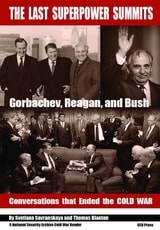
cover of The Last Superpower Summits: Reagan, Gorbachev and Bush. Conversations that Ended the Cold War.

The Last Superpower Summits

Reagan, Gorbachev and Bush. Conversations that Ended the Cold War.

The National Security Archive Savranskaya

Central European University Press, 2017
This book publishes for the first time in print every word the American and Soviet leaders – Ronald Reagan, Mikhail Gorbachev, and George H.W. Bush – said to each other in their superpower summits from 1985 to 1991. Obtained by the authors through the Freedom of Information Act in the U.S., from the Gorbachev Foundation and the State Archive of the Russian Federation in Moscow, and from the personal donation of Anatoly Chernyaev, these previously Top Secret verbatim transcripts combine with key declassified preparatory and after-action documents from both sides to create a unique interactive documentary record of these historic highest-level talks – the conversations that ended the Cold War. The summits fueled a process of learning on both sides, as the authors argue in contextual essays on each summit and detailed headnotes on each document. Geneva 1985 and Reykjavik 1986 reduced Moscow's sense of threat and unleashed Reagan's inner abolitionist. Malta 1989 and Washington 1990 helped dampen any superpower sparks that might have flown in a time of revolutionary change in Eastern Europe, set off by Gorbachev and by Eastern Europeans (Solidarity, dissidents, reform Communists). The high level and scope of the dialogue between these world leaders was unprecedented, and is likely never to be repeated.
[more]
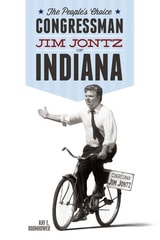
cover of The People's Choice: Congressman Jim Jontz of Indiana

The People's Choice

Congressman Jim Jontz of Indiana

Ray Boomhower

Indiana Historical Society Press, 2012

This first-ever biography of Congressman Jim Jontz examines his remarkable long-shot political career and lifetime involvement in local, state, and national environmental issues. As a liberal Democrat (he preferred the terms progressive or populist) usually running in conservative districts, Jontz had political pundits predicting his defeat in every election only to see him celebrating another victory with his happy supporters, always clad in a scruffy plaid jacket with a hood from high school that he wore for good luck. “I always hope for the best and fight for the worst,” said Jontz. He won five terms as state representative for the Twentieth District (Benton, Newton, Warren, and White Counties), served two years in the Indiana Senate, and captured three terms in the U.S. Congress representing the sprawling Fifth Congressional District in northwestern Indiana that stretched from Lake County in the north to Grant County in the south. Jontz told a reporter that his political career had always “been based on my willingness and role as a spokesman for the average citizen.” In his career Jontz also led an unsuccessful campaign to stop the passage of the North American Free Trade Agreement with the Citizens Trade Campaign, helped protect the Endangered Species Act when it was under attack in the 1990s as director of the Endangered Species Coalition, campaigned to save old-growth forests as executive director of the Western Ancient Forest Campaign, and tried to foster progressive causes as president of the Americans for Democratic Action.
[more]