Results by title
4 books match the query '1990 - 1994'
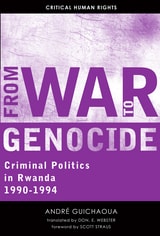
From War to Genocide
Criminal Politics in Rwanda, 1990–1994André Guichaoua, Translated by Don E. Webster, Foreword by Scott Straus
University of Wisconsin Press, 2017
Guichaoua draws on years of meticulous research to describe and analyze this history. He emphasizes that the same virulent controversies that fueled the conflict have often influenced judicial, political, and diplomatic responses to it, reproducing the partisan cleavages between the former belligerents and implicating state actors, international institutions, academics, and the media. Guichaoua insists upon the imperative of absolute intellectual independence in pursuing the truth about some of the gravest human rights violations of the twentieth century.
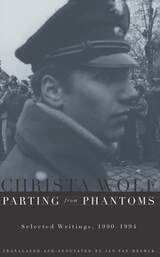
Parting from Phantoms
Selected Writings, 1990-1994Christa Wolf
University of Chicago Press, 1997
"The works in this book constitute an essential document of the history of reunified Germany, and this alone recommends it to scholars and those interested in current European events."— Publishers Weekly
"Christa Wolf was arguably the most influential writer of a nation that no longer exists. . . . Parting from Phantoms traces the fever chart of her anguish. . . . In some ways, the rawness of the present volume is its greatest contribution, and its bona fides—testifying to the human cost of deception and self-deception."—Todd Gitlin, Nation
"A thrilling display of ideological soul-searching."—Ilan Stavans, Newsday, Favorite Books of 1997

The Reincarnation of Russia
Struggling with the Legacy of Communism, 1990–1994John Löwenhardt
Duke University Press, 1995
Building on analysis of the failure of the Soviet system, Löwenhardt compares the emergence of Russia as a newborn state with other countries that have undergone transitions from authoritarianism toward democracy. Although it is often claimed that Russia is a unique case, the author argues that the lessons of other nations are relevant to the Russian situation. In conjunction with this comparative analysis and with consideration of the significance of the communist and Russian past, Löwenhardt discusses political and economic developments—including both foreign and domestic policy concerns—in Russia over the last four years. He provides a better understanding of the Russian condition and a guarded optimism regarding the ongoing process taking place in Russia today.
The Reincarnation of Russia will be welcomed by scholars with specialized interests in the democratization of Russia, political leaders, journalists, and general readers concerned with the global impact of Russia’s changing status.
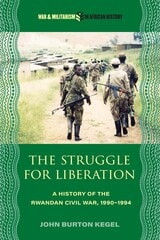
The Struggle for Liberation
A History of the Rwandan Civil War, 1990-1994John Burton Kegel
Ohio University Press, 2025
The story of the Rwandan Genocide has been told many times by scholars and journalists. Over the course of a hundred days in the spring and summer of 1994, about eight hundred thousand Tutsi and moderate Hutu were murdered by their extremist Hutu compatriots. Those hundred days were the final phase of a four-year civil war, also known as the Struggle for Liberation, which formed the immediate context of the genocide. Though scholars have researched preparations for the genocide and the international community’s role in it, none has placed the Struggle for Liberation at the heart of the narrative. However, the preparation of the genocide, the rise and fall of the moderate opposition, the degradation of the Forces armées rwandaises (FAR) from a respected fighting force to a genocidal militia, the role of the international community, the Arusha negotiations, and the execution of the genocide all took place in the context of that war. John Burton Kegel contends that the Struggle for Liberation forms the bedrock of any genuine understanding of Rwanda between 1990 and 1994, and indeed beyond. The Struggle for Liberation, which eventually led to the genocide, was fought between the FAR and the civilians and soldiers of the Rwandan Patriotic Front (RPF) and its armed wing, the Rwandan Patriotic Army (RPA). The civil war started on October 1, 1990, when the RPF entered Rwanda from Uganda, where Rwandan refugees had lived throughout the Great Lakes region since roughly 1959. This book traces the history of those refugees—and Rwanda’s deeper Hutu-Tutsi divide—from the precolonial period up to 1990. It also provides a wholly new take on how the disciplined RPF, which rules Rwanda to this day, was born and organized.