Results by title
10 books match the query '1999-'
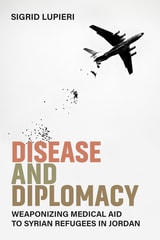
Disease and Diplomacy
Weaponizing Medical Aid to Syrian Refugees in JordanSigrid Lupieri
University of Michigan Press, 2026
When millions of Syrians fled civil war after 2011, international donors and humanitarian organizations mobilized to provide assistance to neighboring countries. Focusing on Jordan—one of the world’s largest refugee hosting states—Disease and Diplomacy investigates how medical aid to refugees operates as an instrument of diplomacy and control within the global refugee system. It argues that health, far from being an apolitical humanitarian good, is a bargaining tool that states commodify to extract resources and concessions.
Drawing on years of field research, interviews, and policy analysis, the book shows how the Jordanian government, international donors, and humanitarian agencies turned healthcare for refugees into a tool for negotiating power, resources, and responsibility. In these cases, refugees, caught within these negotiations, often found their access to care determined not by medical need, but by political calculation. Developing the concept of the weaponization of medical aid, the book extends theories of migration diplomacy and refugee rentierism to show how global power dynamics shape who receives healthcare. The analysis identifies a self-reinforcing “crisis loop” that privileges short-term, highly visible responses while neglecting chronic and long-term needs. Disease and Diplomacy advances an interdisciplinary framework for understanding how humanitarian practices reinforce global inequalities and argues for more equitable approaches to refugee health and responsibility-sharing in the international system.
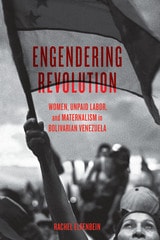
Engendering Revolution
Women, Unpaid Labor, and Maternalism in Bolivarian VenezuelaBy Rachel Elfenbein
University of Texas Press, 2019
In 1999, Venezuela became the first country in the world to constitutionally recognize the socioeconomic value of housework and enshrine homemakers’ social security. This landmark provision was part of a larger project to transform the state and expand social inclusion during Hugo Chávez’s presidency. The Bolivarian revolution opened new opportunities for poor and working-class—or popular—women’s organizing. The state recognized their unpaid labor and maternal gender role as central to the revolution. Yet even as state recognition enabled some popular women to receive public assistance, it also made their unpaid labor and organizing vulnerable to state appropriation.
Offering the first comprehensive analysis of this phenomenon, Engendering Revolution demonstrates that the Bolivarian revolution cannot be understood without comprehending the gendered nature of its state-society relations. Showcasing field research that comprises archival analysis, observation, and extensive interviews, these thought-provoking findings underscore the ways in which popular women sustained a movement purported to exalt them, even while many could not access social security and remained socially, economically, and politically vulnerable.
Old Town Road
A Song by Lil Nas X with Billy Ray CyrusChris Molanphy
Duke University Press, 2023
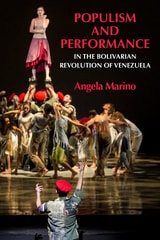
Populism and Performance in the Bolivarian Revolution of Venezuela
Angela Marino
Northwestern University Press, 2018
Based on ethnographic and archival research, Marino focuses on performances of the devil figure, tracing this beloved trickster through religious fiestas, mid-century theater and film, and other media as it both antagonizes and unifies a movement against dictatorship and neoliberalism. She then demonstrates that performance became a vehicle through which cultural producers negotiated boundaries of inclusion and exclusion in ways that overcame the simplistic logic of good versus evil, us versus them. The result is a nuanced insight into the process of building political mobilization out of crisis and through monumental times of change.
The book will interest readers of Latin American politics, cultural studies, political science, and performance studies by providing a vital record of the revolution, with valuable insights into its internal dynamics and lessons towards building a populist movement of the left in contentious times.
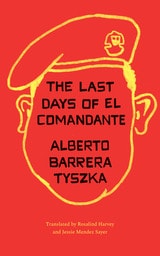
The Last Days of El Comandante
By Alberto Barrera Tyszka; translated by Rosalind Harvey and Jessie Mendez Sayer
University of Texas Press, 2020
2021 — Honorable Mention, Best Fiction Book Translation – International Latino Book Awards, Latino Literacy Now
Winner of the Tusquets Prize in 2015 and previously translated into French, German, Dutch, Polish, and Portuguese, Alberto Barrera Tyszka’s Patria o muerte is now available in English.
President Hugo Chávez’s cancer looms large over Venezuela in 2012, casting a shadow of uncertainty and creating an atmosphere of secrets, lies, and upheaval across the country. This literary thriller follows the connected lives of several Caracas neighbors consumed by the turmoil surrounding the Venezuelan president’s impending death.
Retired oncologist Miguel Sanabria, seeing the increasingly combustible world around him, feels on constant edge. He finds himself at odds with his wife, an extreme anti-Chavista, and his radical Chavista brother. These feelings grow when his nephew asks him to undertake the perilous task of hiding cell-phone footage of Chávez in Cuba. Fredy Lecuna, an unemployed journalist, takes a job writing a book about Chávez’s condition, which requires him to leave for Cuba while his landlord attempts to kick his wife and son out of their apartment. Nine-year-old María, long confined to an apartment with a neurotic mother intensely fearful of the city’s violence, finds her only contact with the outside world through a boy she messages online.
The Necromantic State
Spectral Remains in the Afterglow of Venezuela's Bolivarian RevolutionIrina R. Troconis
Duke University Press, 2025

The Real Venezuela
Making Socialism in the 21st CenturyIain Bruce
Pluto Press, 2008
Venezuela has become a huge source of hope and inspiration for the Left throughout the world. Some see it as a shining example of how to begin building a successful socialist state, but Western leaders see it as a dangerous enemy and accuse Chávez of being a dictator. This book reveals the truth by examining the country from the ground up.
Iain Bruce explores the political changes underway in Venezuela at the level of the lives of ordinary people. Through grassroots investigations and extended interviews, he explores a series of key transformations in Venezuela: a new social economy around a network of co-operatives; workplace democracy; popular education; radical agrarian reform; participatory budgets and community planning. The result is a clear picture of everyday life in Venezuela.
No other book on the country has this level of detail; it will be a key text for students of Latin American politics and social movements and of interest to anyone following the fortunes of the Bolivarian Revolution.
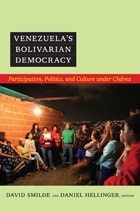
Venezuela's Bolivarian Democracy
Participation, Politics, and Culture under ChávezDavid Smilde and Daniel Hellinger, eds.
Duke University Press, 2011
Contributors
Carolina Acosta-Alzuru
Julia Buxton
Luis Duno Gottberg
Sujatha Fernandes
María Pilar García-Guadilla
Kirk A. Hawkins
Daniel Hellinger
Michael E. Johnson
Luis E. Lander
Margarita López-Maya
Elizabeth Gackstetter Nichols
Coraly Pagan
Guillermo Rosas
Naomi Schiller
David Smilde
Alejandro Velasco
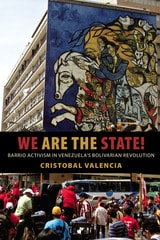
We Are the State!
Barrio Activism in Venezuela’s Bolivarian RevolutionCristobal Valencia
University of Arizona Press, 2015
The author offers an anthropological analysis of the state, social movements, and democracy as lived experiences of the poor, gendered, and racialized residents of two parishes in Caracas, Venezuela, and Afro-Venezuelan communities nearby. Ethnographic research reveals the shift in relationships of power and the evolving political practices among the Chavistas, the Chávez government, and the opposition. Examining the subjective experiences of barrio residents in everyday processes of state formation, this book provides a new perspective on the Chavistas, arguing that they are a broad-based social movement and driving force behind a revolution struggling to transfer state power to organized civil society.
Through his intense engagement with the constantly changing social, political, and economic dynamics, Valencia dramatically challenges top-down understandings of the state and power in Venezuela. He shows the unequal relationships between sectors of civil society, and he shows state formation as a process enmeshed in the struggles for social justice, demonstrating that the state is a sociopolitical entity that acts through civil society, rather than above it.
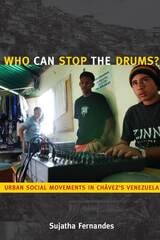
Who Can Stop the Drums?
Urban Social Movements in Chávez's VenezuelaSujatha Fernandes
Duke University Press, 2010
Fernandes portrays everyday life and politics in the shantytowns of Caracas through accounts of community-based radio, barrio assemblies, and popular fiestas, and the many interviews she conducted with activists and government officials. Most of the barrio activists she presents are Chávez supporters. They see the leftist president as someone who understands their precarious lives and has made important changes to the state system to redistribute resources. Yet they must balance receiving state resources, which are necessary to fund their community-based projects, with their desire to retain a sense of agency. Fernandes locates the struggles of the urban poor within Venezuela’s transition from neoliberalism to what she calls “post-neoliberalism.” She contends that in contemporary Venezuela we find a hybrid state; while Chávez is actively challenging neoliberalism, the state remains subject to the constraints and logics of global capital.