Results by title
8 books match the query '2014-'
On Our Way Home from the Revolution
Reflections on UkraineSonya Bilocerkowycz
The Ohio State University Press, 2019
In 2014 Sonya Bilocerkowycz is a tourist at a deadly revolution. At first she is enamored with the Ukrainians’ idealism, which reminds her of her own patriotic family. But when the romantic revolution melts into a war with Russia, she becomes disillusioned, prompting a return home to the US and the diaspora community that raised her. As the daughter of a man who studies Ukrainian dissidents for a living, the granddaughter of war refugees, and the great-granddaughter of a gulag victim, Bilocerkowycz has inherited a legacy of political oppression. But what does it mean when she discovers a missing page from her family’s survival story—one that raises questions about her own guilt?
In these linked essays, Bilocerkowycz invites readers to meet a swirling cast of post-Soviet characters, including a Russian intelligence officer who finds Osama bin Laden a few weeks after 9/11; a Ukrainian poet whose nose gets broken by Russian separatists; and a long-lost relative who drives a bus into the heart of Chernobyl. On Our Way Home from the Revolution muddles our easy distinctions between innocence and culpability, agency and fate.
Regionalism without Regions
Reconceptualizing Ukraine's HeterogeneityUlrich Schmid
Central European University Press, 2019
Russia's Imperial Endeavor and Its Geopolitical Consequences
The Russia-Ukraine War, Volume TwoBálint Madlovics
Central European University Press, 2024
Aside from the near-complete devastation of a sovereign state and reversal of the global balance of power, the Russian invasion of Ukraine in 2022 is leading to a radical transformation in the Eastern European and Eurasian regions – including Russia itself.
The 13 chapters in this volume examine the main geopolitical consequences of the resurgent imperialist aspirations of the Russian Federation. They examine the ideological tools of history falsification as an integral part of hybrid warfare. Turning to the economy, the book discusses how the war and economic sanctions imposed on Russia are redrawing the geopolitical map and how economic relations would change following a regime transformation. The book discusses the reactions of members of the international community to the invasion, whether threatened or neutral parties or allies. The collection therefore offers a comprehensive picture of the main consequences of the resurgent imperialist aspirations of the Russian Federation. Equipped with the conceptual tools of the analysis with a focus on the patronal features of the political-economic system, the book considers the aftermath of the war. This collection complements the book entitled Ukraine. Patronal Democracy and the Russian Invasion.
The Troubling State of India's Democracy
Šumit Ganguly, Dinsha Mistree, and Larry Diamond, Editors
University of Michigan Press, 2024
Despite this rich tradition, India’s democracy faces an unprecedented threat with the rise of Narendra Modi and his Hindu nationalist party, the Bharatiya Janata Party. After decisively winning general elections in 2014, Modi and the BJP have pursued a range of anti-democratic policies in which the state and society are used to undermine the opposition, to stifle free speech, and to harass religious minorities. The Troubling State of India’s Democracy brings together leading scholars from around the world to assess the conditions of India’s democracy across three important dimensions: politics, specifically the state of political parties and the party system; the state, including the condition of federalism and the health of various institutions; and society, including NGOs, ethnic and religious tensions, and control of the media. Even though elements of India’s democracy seem to function—like its commitment to elections—the contributors document a disturbing trajectory, one that not only threatens to undermine India’s own stability, but could also affect the global order.
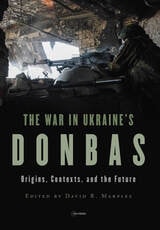
The War in Ukraine’s Donbas
Origins, Contexts, and the FutureDavid R. Marples
Central European University Press, 2022
This collective work analyzes the ongoing conflict in Ukraine, providing a coherent picture of Ukraine and Eastern Europe in the period 2013–2020. Giving voice to different social groups, scholarly communities and agencies relevant to Ukraine’s recent history, The War in Ukraine's Donbas goes beyond simplistic media interpretations that limit the analysis to Vladimir Putin and Russian aims to annex Ukraine. Instead, the authors identify the deeper roots linked to the autonomy and history of Donbas as a region. The contributions explore local society and traditions and the alienation from Ukraine caused by the events of Euromaidan, which saw the removal of the Donetsk-based president Viktor Yanukovych. Other chapters address the refugee crisis, the Minsk Accords in 2014 and the impact of the new president Volodymyr Zelensky and his efforts to bring the war to an end by negotiations among Russia, Ukraine, France, and Germany.
The book concludes with four proposals for a durable peace in Donbas: territorial power-sharing; the conversion of rebels into legitimate political parties; amnesty for all participants of the armed conflict; and a transitional period of several years until political institutions are fully re-established.
Ukraine in the Crosshairs of Geopolitical Power Play
Edited by Peter W. Schulze and Winfried Veit
Campus Verlag, 2020
Peace in Ukraine seemed possible following Volodymyr Zelensky’s 2019 election. The new president reopened conversations with both the European Union and separatist authorities, bringing an end to the Donbass conflict in sight. Such an achievement promised revitalized talks between Europe and Russia, and so the nearly forgotten conflict returned to global prominence. Ukraine in the Crosshairs of Geopolitical Power Play analyzes why European and Russian objectives in Ukraine place daunting limits of any potential compromise.
Ukraine's Patronal Democracy and the Russian Invasion
The Russia-Ukraine War, Volume OneBálint Madlovics
Central European University Press, 2023
The Russian invasion of Ukraine in 2022 jeopardizes the country's independence and its chances for Western-style development. However, the heroic attitude of the Ukrainian people, combined with a solidifying national identity, makes the domestic foundations for a western turn stronger than ever. After the invasion, building strong foundations of liberal democracy will be a top priority. In addition to alleviating immediate problems, the country must also address its post-communist legacy and address the constraints of patronalism.
The authors of this edited volume, leading Ukrainian scholars supplemented by colleagues from Hungary, examine the chances of an anti-patronal transformation after the war. The book provides an overview of the development of Ukraine's political-economic system: color revolutions in 2004 and 2014 brought democratic transformation, but no change in the patronage system The result was patronal regime cycles instead of the emergence of a Western-type liberal democracy in the country. Building on the conceptual framework of the editors' The Anatomy of Post-Communist Regimes (CEU Press, 2020), the 12 chapters examine the impact of the war on patronal democracy, the relational economy, clientelist society, and the international environment in which Ukraine operates.
This collection is complemented by the book entitled Russia. Imperial Endeavor and Geopolitical Consequences.
Undermining the Idea of India
Gautam Patel
Seagull Books, 2022
“India is improbable. By any measure of logic or reason, it should not be. Not in this form. And yet it is.”
With this provocation, Justice Gautam Patel of the Bombay High Court sketches the exoskeleton of this improbability—the “Constitutional” idea of India. Justice Patel argues that the devolution of power is necessary for the survival of any liberal democracy, maintaining the idea that “the right to choose one’s own government is the right to dissent.” Decrying the portrayal of politics as sport, Patel elucidates the strategies and tactics used by “nimble” governments to enforce a culture of “broad-spectrum illiberalism.” A champion of transparency in the judiciary, Patel argues that the Internet and the judiciary must serve as beacons in this age of precarity. A timely text that comes at a juncture where liberal democracies across the world are facing existential threats, Undermining the Idea of India is a searing manifesto for our troubled times.