Results by title
2 books match the query '20h century'
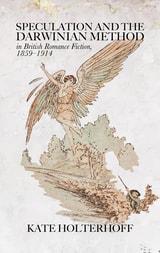
Speculation and the Darwinian Method in British Romance Fiction, 1859-1914
Kate Holterhoff
Ohio University Press, 2025
This study explores how British romance fictions published between 1859 and 1914 absorbed distinctly Darwinian attitudes toward the epistemology of science—one that accorded with scientific speculation. Following the 1859 publication of On the Origin of Species, in which Charles Darwin acknowledged arriving at his thesis by allowing himself “to speculate on the subject” of species transmutation, many romance fiction writers embraced, criticized, and promoted acts of speculating characterized as scientific. The romance fictions discussed in this book recurred to Darwin’s speculative methodology more than to rigorous Baconian empiricism because it permitted them to draw pointedly imaginative conclusions in reasonable ways. Kate Holterhoff’s book examines how romance authors like Grant Allen, H. G. Wells, and Arthur Conan Doyle incorporated Darwinian ideas and speculative thinking into their works to advance their ideological and aesthetic goals. Holterhoff uses five paired genres and methods to analyze this engagement:
- scientific romance and experimentation,
- metaphysical romance and thought experiments,
- anthropological romance and reasoning with imperfect data,
- gothic romance and probability, and
- utopian romance and Malthusian political economy.
By focusing on Darwin’s influence in legitimizing speculative methods in science, the book places the interplay between British science and romance fiction into critical perspective and highlights Darwin’s enduring impact on Western culture.
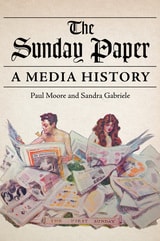
The Sunday Paper
A Media HistoryPaul Moore and Sandra Gabriele
University of Illinois Press, 2022