Results by title

5 books match the query '265-30 B.C'
cover of Caesar in Gaul and Rome: War in Words

Caesar in Gaul and Rome

War in Words

By Andrew M. Riggsby

University of Texas Press, 2006

Winner, AAP/PSP Award for Excellence, Classics and Ancient History, 2006

Anyone who has even a passing acquaintance with Latin knows "Gallia est omnis divisa in partes tres" ("All Gaul is divided into three parts"), the opening line of De Bello Gallico, Julius Caesar's famous commentary on his campaigns against the Gauls in the 50s BC. But what did Caesar intend to accomplish by writing and publishing his commentaries, how did he go about it, and what potentially unforeseen consequences did his writing have? These are the questions that Andrew Riggsby pursues in this fresh interpretation of one of the masterworks of Latin prose.

Riggsby uses contemporary literary methods to examine the historical impact that the commentaries had on the Roman reading public. In the first part of his study, Riggsby considers how Caesar defined Roman identity and its relationship to non-Roman others. He shows how Caesar opens up a possible vision of the political future in which the distinction between Roman and non-Roman becomes less important because of their joint submission to a Caesar-like leader. In the second part, Riggsby analyzes Caesar's political self-fashioning and the potential effects of his writing and publishing the Gallic War. He reveals how Caesar presents himself as a subtly new kind of Roman general who deserves credit not only for his own virtues, but for those of his soldiers as well. Riggsby uses case studies of key topics (spatial representation, ethnography, virtus and technology, genre, and the just war), augmented by more synthetic discussions that bring in evidence from other Roman and Greek texts, to offer a broad picture of the themes of national identity and Caesar's self-presentation.
[more]
cover of Ceremony and Power: Performing Politics in Rome between Republic and Empire

Ceremony and Power

Performing Politics in Rome between Republic and Empire

Geoffrey S. Sumi

University of Michigan Press, 2015
In Ceremony and Power, Geoffrey Sumi is concerned with the relationship between political power and public ceremonial in the Roman Republic, with particular focus on the critical months following Caesar's assassination and later as Augustus became the first emperor of Rome. The book traces the use of a variety of public ceremonies, including assemblies of the people, triumphs, funerals, and games, as a means for politicians in this period of instability and transition to shape their public images and consolidate their power and prestige. Ultimately, Sumi shows that the will of the people, whether they were the electorate assembled at the comitia, the citizen body at the contio, the spectators at the theater, the crowd at the triumph, or mourners at a funeral, strongly influenced the decisions and actions of Roman aristocrats.

[more]
cover of The Crowd in Rome in the Late Republic

The Crowd in Rome in the Late Republic

Fergus Millar

University of Michigan Press, 2002

It has often been thought that Roman politics was dominated by a governing class, or even aristocracy, and it has sometimes been presumed that the Senate was a legislative body. The Crowd in Rome in the Late Republic takes a dramatically new tack, and explores the consequences of a democracy in which public office could be gained only by direct election by the people. And while the Senate could indeed debate public matters, advise other office-holders, and make some administrative decisions, it could not legislate. An office-holder who wanted to pass a law had to step out of the Senate-house and propose it to the people in the Forum--where there were few guarantees.
In this important study, Fergus Millar explores the development of the Roman Republic, which, as it drew to a close in the middle decades of the first century B.C.E., had come to cover most of Italy. There were nearly a million adult male voters in the time of Cicero, but there were no constituencies, and no absentee ballots. To exercise their rights, voters had to come in person to Rome and to meet in the Forum. Millar takes the period from the dictatorship of Sulla to Caesar's crossing of the Rubicon and shows how the politics of the crowd was central to the great changes that took place year after year, and altered the Republic forever.
The originality of Millar's highly accessible work lies first in its serious treatment of the importance of open-air oratory in Roman public life, and second, in its use of the narratives of events that evidence provides. Third, it refuses to interpret these narratives in the light of modern theories about the importance of the client-patron system, or the domination of the Senate. This work questions how we should understand the Roman Republic: as a network of aristocratic families dominating the people, or an erratic and volatile democracy in which power was exercised by the tiny proportion of citizens who actually came to listen to speeches and to vote.
This work speaks to those interested in ancient history and its consequences in the modern world.
Fergus Millar is Camden Professor of Ancient History, Brasenose College, Oxford University.
[more]
cover of The Voting Districts of the Roman Republic: The Thirty-five Urban and Rural Tribes

The Voting Districts of the Roman Republic

The Thirty-five Urban and Rural Tribes

Lily Ross Taylor

University of Michigan Press, 2013
Fundamental to an understanding of the Roman Republic is comprehension of the tribal system employed to organize citizens. Used first for the census, raising an army, and tax collection, tribes later became voting districts for the election of magistrates. Voting districts were distributed geographically in and around the city of Rome and eventually throughout the Italian countryside, and they have been studied through evidence largely textual and epigraphical. In this volume, first published in 1960, evidence is adduced to locate and describe the tribes' locations. In his major new update, Lily Ross Taylor's disciple and scholarly follower Jerzy Linderski brings forward new evidence resolving earlier cruces, updates the lengthy bibliography on voting districts, and situates this invaluable work in its historical perspective.
[more]
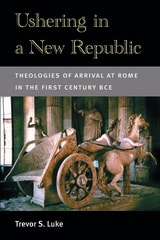
cover of Ushering in a New Republic: Theologies of Arrival at Rome in the First Century BCE

Ushering in a New Republic

Theologies of Arrival at Rome in the First Century BCE

Trevor S. Luke

University of Michigan Press, 2014

The ancient Romans are well known for their love of the pageantry of power. No single ceremony better attests to this characteristic than the triumph, which celebrated the victory of a Roman commander through a grand ceremonial entrance into the city that ended in rites performed to Rome’s chief tutelary deity, Jupiter Optimus Maximus, on the Capitoline hill. The triumph, however, was only one form of ceremonial arrival at the city, and Jupiter was not the only god to whom vows were made and subsequently fulfilled at the end of a successful assignment. Ushering in a New Republic expands our view beyond a narrow focus on the triumph to look at the creative ways in which the great figures of Rome in the first century BCE (men such as Sulla, Caesar, Augustus, and others) crafted theological performances and narratives both in and around their departures from Rome and then returned to cast themselves in the role of divinely supported saviors of a faltering Republic.

Trevor S. Luke tackles some of the major issues of the history of the Late Republic and the transition to the empire in a novel way. Taking the perspective that Roman elites, even at this late date, took their own religion seriously as a way to communicate meaning to their fellow Romans, the volume reinterprets some of the most famous events of that period in order to highlight what Sulla, Caesar, and figures of similar stature did to make a religious argument or defense for their actions. This exploration will be of interest to scholars of religion, political science, sociology, classics, and ancient history and to the general history enthusiast. While many people are aware of the important battles and major thinkers of this period of Roman history, the story of its theological discourse and competition is unfolded here for the first time.
[more]