Results by title
10 books match the query '43 B.C.-17 or 18 A.D'

Abandoned Women
Rewriting the Classics in Dante, Boccaccio, and ChaucerSuzanne Hagedorn
University of Michigan Press, 2003
Medievalists have long been interested in the "abandoned woman," a figure historically used to examine the value of traditional male heroism. Moving beyond previous studies which have focused primarily on Virgil's Dido, Suzanne Hagedorn focuses on the vernacular works of Dante, Bocaccio, and Chaucer, arguing that revisiting the classical tradition of the abandoned woman enables one to reconsider ancient epics and myths from a female perspective and question assumptions about gender roles in medieval literature.
[more]
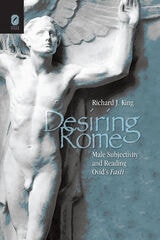
DESIRING ROME
Male Subjectivity and Reading Ovid’s FastiRichard J. King
The Ohio State University Press, 2006
During his last two decades (ca. 2 BCE–17 CE), Ovid composed, but never completed, his Fasti, an elegiac representation of Rome’s rites and festivals: only six of twelve month-books remain. Earlier scholars have claimed that this is due either to Ovid’s exile from Rome (which put him out of touch with the Roman literary world) or else his frustration over the Roman calendar’s discontinuity. Drawing upon recent scholarship in gender studies and Lacanian film theory, Richard J. King analyzes this exilic incompletion as inviting the citizen male reader into what he calls an “angular” or “skewed” viewpoint, which interrogates the Roman hierarchical and male-dominated social order, insofar as it is mirrored in the Roman calendar of rites and festivals. Ovid (already well known and even infamous as the composer of erotic poems and the Metamorphoses) does this by emulating the civic gesture of “calendar presentation,” whereby upwardly mobile adult male citizens caused calendars to be carved in stone and set up in conspicuous public places to reflect the city’s pride and to build their own prestige as public figures. In this innovative study, King discusses the Fasti as Ovid’s socially strategic use of this gesture. Interrupted by exile and filled with varying explanations of Roman festivals, Ovid’s poetic version manifests a form whose brokenness comments on the fractured identity of the exiled poet and citizen subjects generally in an imperial order ambivalent toward its greatest poet.
Desiring Rome expands upon recent recognition of the Fasti’s centrality to early imperial politics by situating the poem’s “failure” within broader negotiations of identity between early imperial citizen-subjects and the cultural ideology of Roman manhood.
Desiring Rome expands upon recent recognition of the Fasti’s centrality to early imperial politics by situating the poem’s “failure” within broader negotiations of identity between early imperial citizen-subjects and the cultural ideology of Roman manhood.
[more]
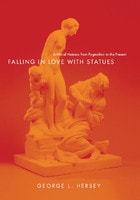
Falling in Love with Statues
Artificial Humans from Pygmalion to the PresentGeorge L. Hersey
University of Chicago Press, 2009
If, as a child, you conducted conversations with beloved dolls, or if, as an adult, you have entered virtual worlds inhabited by digital humans who inspire devotion in real people, you have participated in one of humanity’s most potent yet least explored traditions. Falling in love (and out of love) with statues, George Hersey reveals here, has been an instrumental practice since antiquity in our efforts to understand, improve, and empower ourselves.
Hersey’s history of statue love begins in Cyprus, home of the legendary sculptor Pygmalion, who famously grew enamored of his own creation. Examining the island’s prehistoric images of Aphrodite—the love goddess who brought Pygmalion’s sculpture to life—Hersey traces the origins of statue love back to the Cypriot followers who adored her terra-cotta likenesses. He goes on to explore ideas about human replicas in the works of Empedocles, Aristotle, Lucretius, and Ovid, whose definitive account of the Pygmalion myth introduced the notion that statues have the potential to induce physical responses in their viewers. Finding avatars of Ovid’s living image in everything from pagan idols and early Christian statuary to eighteenth-century painting to modern action figures and marionettes, Hersey concludes by investigating the concern that these automata will eventually replace humans.
In the process, he narrates a powerful history of artificial life at a moment when—with the development of robot soldiers, ever more sophisticated genetic engineering, and a continually expanding digital universe—it seems more real than ever.
[more]
Harmful Eloquence
Ovid's Amores from Antiquity to ShakespeareM. L. Stapleton
University of Michigan Press, 1996
M. L . Stapleton's Harmful Eloquence: Ovid's "Amores" from Antiquity to Shakespeare traces the influence of the early elegiac poetry of Ovid (43 b.c.e.-17 c.e.) on European literature from 500-1600 c.e. The Amores served as a classical model for love poetry in the Middle Ages and the Renaissance and were essential to the formation of fin' Amors, or "courtly love." Medieval Latin poets, the troubadours, Dante, Petrarch, and Shakespeare were all familiar with Ovid in his various forms, and all depended greatly upon his Amores in composing their cansos, canzoniere, and sonnets.
Harmful Eloquence begins with a detailed analysis of the Amores themselves and their artistic unity. It moves on to explain the fragmentary transmission of the Amores in the "Latin Anthology" and the cohesion of the fragments into the conventions of Medieval Latin and troubadour "courtly love" poetry. Two subsequent chapters explain the use of the Amores, their narrator, and the conventions of "courtly love" in the poetry of both Dante and Petrarch. The final chapter concentrates on Shakespeare's reprocessing and parody of this material in his sonnets.
Harmful Eloquence analyzes the intertextual transmission of the Amores in major medieval and Renaissance love poetry for the first time. No previous study has devoted itself exclusively to this Ovidian text in this particular way. The premise that Ovid consciously used the device of persona from the very beginning of his writing career is fully explored, as is the "Ovidian hypothesis" of Wilibald Schroetter. Connections between Dante's La vita nuova and the Amores are newly discovered; significant for Shakespeare studies, the use of Christopher Marlowe's translation of the Amores by Shakespeare in his "dark lady" sonnets is also carefully analyzed for the first time.
Medievalists, classicists, and scholars of Renaissance studies will find Harmful Eloquence particularly engaging and useful, as will all those interested in the process and methods of literary transmission.
M. L. Stapleton is Associate Professor of English, Stephen F. Austin University.
[more]
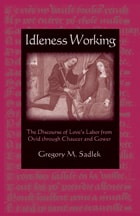
Idleness Working
the Discourse of Love's Labor from Ovid through Chaucer and GowerGregory M. Sadlek
Catholic University of America Press, 2004
Inspired by the critical theories of M. M. Bakhtin, Idleness Working is a groundbreaking study of key works in the Western literature of love from Classical Rome to the late Middle Ages.
[more]
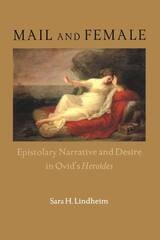
Mail and Female
Epistolary Narrative and Desire in Ovid's HeroidesSara H. Lindheim
University of Wisconsin Press, 2003
In the Heroides, the Roman poet Ovid wittily plucks fifteen abandoned heroines from ancient myth and literature and creates the fiction that each woman writes a letter to the hero who left her behind. But in giving voice to these heroines, is Ovid writing like a woman, or writing "Woman" like a man?
Using feminist and psychoanalytic approaches to examine the "female voice" in the Heroides, Sara H. Lindheim closely reads these fictive letters in which the women seemingly tell their own stories. She points out that in Ovid’s verse epistles all the women represent themselves in a strikingly similar and disjointed fashion. Lindheim turns to Lacanian theory of desire to explain these curious and hauntingly repetitive representations of the heroines in the "female voice." Lindheim’s approach illuminates what these poems reveal about both masculine and feminine constructions of the feminine
Using feminist and psychoanalytic approaches to examine the "female voice" in the Heroides, Sara H. Lindheim closely reads these fictive letters in which the women seemingly tell their own stories. She points out that in Ovid’s verse epistles all the women represent themselves in a strikingly similar and disjointed fashion. Lindheim turns to Lacanian theory of desire to explain these curious and hauntingly repetitive representations of the heroines in the "female voice." Lindheim’s approach illuminates what these poems reveal about both masculine and feminine constructions of the feminine
[more]
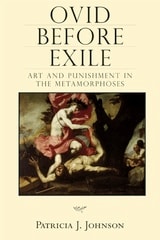
Ovid before Exile
Art and Punishment in the MetamorphosesPatricia J. Johnson
University of Wisconsin Press, 2007
The epic Metamorphoses, Ovid’s most renowned work, has regained its stature among the masterpieces of great poets such as Vergil, Horace, and Tibullus. Yet its irreverent tone and bold defiance of generic boundaries set the Metamorphoses apart from its contemporaries. Ovid before Exile provides a compelling new reading of the epic, examining the text in light of circumstances surrounding the final years of Augustus’ reign, a time when a culture of poets and patrons was in sharp decline, discouraging and even endangering artistic freedom of expression.
Patricia J. Johnson demonstrates how the production of art—specifically poetry—changed dramatically during the reign of Augustus. By Ovid’s final decade in Rome, the atmosphere for artistic work had transformed, leading to a drop in poetic production of quality. Johnson shows how Ovid, in the episodes of artistic creation that anchor his Metamorphoses, responded to his audience and commented on artistic circumstances in Rome.
Patricia J. Johnson demonstrates how the production of art—specifically poetry—changed dramatically during the reign of Augustus. By Ovid’s final decade in Rome, the atmosphere for artistic work had transformed, leading to a drop in poetic production of quality. Johnson shows how Ovid, in the episodes of artistic creation that anchor his Metamorphoses, responded to his audience and commented on artistic circumstances in Rome.
[more]
Ovid's Causes
Cosmogony and Aetiology in the MetamorphosesK. Sara Myers
University of Michigan Press, 1994
Ovid’s Causes offers a new reassessment of the poet’s longest and most difficult poem, the Metamorphoses. This poem has long been denied epic stature because of its stylistic and thematic diversity. K. Sara Myers demonstrates that the poem must be understood as the inheritor and interpreter of the Roman tradition of cosmological epic. She situates the poem in the traditions and conventions of Roman poetry and considers the ways in which it both fulfills and overturns the expectations of the epic genre.
The first and final chapters of this book examine the scientific and cosmological framework of the poem. Ovid’s juxtaposition of scientific and mythological explanations is an aspect of his sophisticated manipulation of truth and fiction, and of the claims of philosophical poetry and mythological poetry.
This illuminating study presents much useful material for students of Roman poetry or of Greek literary influences that profoundly influenced its development. Students and scholars of ancient poetical traditions will likewise find much of interest.
[more]
Ovid's Literary Loves
Influence and Innovation in the AmoresBarbara Weiden Boyd
University of Michigan Press, 1997
Ovid's poetry has in recent years enjoyed a remarkable renaissance: in particular, there has been a surge of interest in the Heroides, the Fasti, and his exile poetry. Ovid's Literary Loves, by Barbara Weiden Boyd, reopens the Amores for the modern reader. The volume establishes a context for the recent reception of the Amores, and proposes an alternative approach to the collection by discussing recent trends in the discussion of imitation in Roman poetry. A premise basic to most Ovidian studies has been that the Amores are not only imitative, but parodic, both of the elegiac genre writ large and of Propertius in particular. In contrast, Boyd emphasizes the many nonelegiac, non-Propertian features of the collection. Ovid's irony and its consequences are also discussed with special attention to the narrative structure of the three books.
Boyd's thoughtful approach to imitation in Latin poetry brings into prominence the formative role played by Virgil in shaping Ovid's "poetic memory," even in the Amores. The detailed examination of Ovidian extended similes shows how the poet exploits the literary past precisely in order to free himself from generic restraint and to expand the narrow horizons of elegy. Boyd argues that this paradox is the essence of Ovidian poetics.
Ovid's Literary Loves is an imaginative approach to imitation in Latin poetry and makes a significant contribution to current discussions of the subject. This is one of the first contemporary scholarly monographs on the Amores, and it will find a large and welcoming audience of Latinists at all levels of study.
Barbara Weiden Boyd is Associate Professor of Classics, Bowdoin College, Brunswick, Maine.
[more]
The Image of the Poet in Ovid’s Metamorphoses
Barbara Pavlock
University of Wisconsin Press, 2009
Barbara Pavlock unmasks major figures in Ovid’s Metamorphoses as surrogates for his narrative persona, highlighting the conflicted revisionist nature of the Metamorphoses. Although Ovid ostensibly validates traditional customs and institutions, instability is in fact a defining feature of both the core epic values and his own poetics.
The Image of the Poet explores issues central to Ovid’s poetics—the status of the image, the generation of plots, repetition, opposition between refined and inflated epic style, the reliability of the narrative voice, and the interrelation of rhetoric and poetry. The work explores the constructed author and complements recent criticism focusing on the reader in the text.
The Image of the Poet explores issues central to Ovid’s poetics—the status of the image, the generation of plots, repetition, opposition between refined and inflated epic style, the reliability of the narrative voice, and the interrelation of rhetoric and poetry. The work explores the constructed author and complements recent criticism focusing on the reader in the text.
2009 Outstanding Academic Title, Choice Magazine
[more]