Results by title
2 books match the query '559 B.C.-330 B.C'

Political Memory in and after the Persian Empire
Jason M. Silverman
SBL Press, 2015
An interdisciplinary study of the Persian Period
Various disciplines that deal with Achaemenid rule offer starkly different assessments of Persian kingship. While Assyriologists treat Cyrus's heirs as legitimate successors of the Babylonian kings, biblical scholars often speak of a "kingless era" in which the priesthood took over the function of the Davidic monarch. Egyptologists see their land as uniquely independently minded despite conquests, while Hellenistic scholarship tends to evaluate the interface between Hellenism and native traditions without reference to the previous two centuries of Persian rule. This volume brings together in dialogue a broad array of scholars with the goal of seeking a broader context for assessing Persian kingship through the anthropological concept of political memory.
Features
- Articles present the results of an international symposium held in Leiden, the Netherlands, 2014
- More than twenty illustrations
- Seventeen articles, an introduction, and a summary response
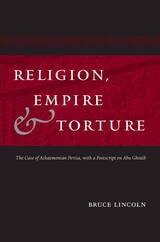
Religion, Empire, and Torture
The Case of Achaemenian Persia, with a Postscript on Abu GhraibBruce Lincoln
University of Chicago Press, 2007
Lincoln identifies three core components of an imperial theology that have transhistorical and contemporary relevance: dualistic ethics, a theory of divine election, and a sense of salvific mission. Beyond this, he asks, how did the Achaemenians understand their place in the cosmos and their moral status in relation to others? Why did they feel called to intervene in the struggle between good and evil? What was their sense of historic purpose, especially their desire to restore paradise lost? And how did this lead them to deal with enemies and critics as imperial power ran its course? Lincoln shows how these religious ideas shaped Achaemenian practice and brought the Persians unprecedented wealth, power, and territory, but also produced unmanageable contradictions, as in a gruesome case of torture discussed in the book’s final chapter. Close study of that episode leads Lincoln back to the present with a postscript that provides a searing and utterly novel perspective on the photographs from Abu Ghraib.