Results by title
3 books match the query 'À la recherche du temps perdu'
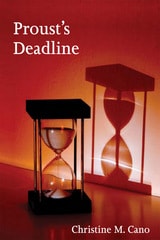
Proust's Deadline
Christine M. Cano
University of Illinois Press, 2006
Marcel Proust’s multivolume masterpiece, À la recherche du temps perdu, began to appear in 1913. Over the next fifty years, it gained a reputation as one of the greatest literary works of the twentieth century. But the novel’s classic image as a completed work was later shattered by the discovery of unpublished drafts, and the “war of the Prousts” has kept scholars arguing over its definitive form ever since.
Christine M. Cano’s Proust’s Deadline presents a concise history of the publishing and reception of À la recherche du temps perdu, and sorts out the most important issues that have arisen from the ensuing debates about the text. She ultimately shows how this quintessential “book about time” tells another story about time’s passage: the story of Proust’s mortal confrontation with the temporality of writing, publishing, and reading.
The Timelessness of Proust
Charles R. Embry
St. Augustine's Press, 2016
Marcel Proust’s À la recherche du temps perdu—In Search of Lost Time—is one of the most important and influential novels of the modern era. In recent decades, Proust has enjoyed a new surge of critical attention, as well as a sustained growth in readership—well beyond that of other prose masters of twentieth century modernism such as Joyce, Woolf, Kafka, and Beckett. The MLA Bibliography presently lists over 3,000 citations to scholarly works devoted to Proust’s novel, and if one Googles “Proust,” the number of hits exceeds 2,000,000.
The temporal nature of human existence and consciousness is one of the many themes explored in In Search of Lost Time, and it is this dimension of Proust’s work that unifies this collection of essays that grew from a roundtable discussion entitled “The Timelessness of Proust” conducted at the 31st annual meeting of the Eric Voegelin Society. The collection includes the following essays:
“In Search of Lost Time: Biographies of Consciousness,” Charles R. Embry
“Proust, Transcendence, and Metaxic Existence,” Glenn Hughes
“The Normative Flow of Consciousness and the Self: A Philosophical Meditation on
Proust’s In Search of Lost Time,” Thomas J. McPartland;
“Imprisonment and Freedom: Resisting and Embracing the Tension of Existence in
Marcel Proust’s In Search of Lost Time,” Paulette Kidder;
“Proust’s Luminous Memory and L’Homme Éternel: The Quest for Limitless Meaning,”
Michael Henry
“Unsought Revelations of Eternal Reality in Eliot’s Four Quartets and Proust’s In Search
of Lost Time,” Glenn Hughes
Persons who are interested not only in the philosophical importance of literary masterworks and in how the philosophical thought of Eric Voegelin may illuminate them, but also in letting Proust serve as a guide in the exploration and understanding of their own lives, will find these essays to be of lasting interest and value.
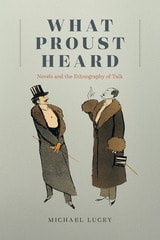
What Proust Heard
Novels and the Ethnography of TalkMichael Lucey
University of Chicago Press, 2022
What happens when we talk? This deceptively simple question is central to Marcel Proust’s monumental novel In Search of Lost Time. Both Proust’s narrator and the novel that houses him devote considerable energy to investigating not just what people are saying or doing when they talk, but also what happens socioculturally through their use of language. Proust, in other words, is interested in what linguistic anthropologists call language-in-use.
Michael Lucey elucidates Proust’s approach to language-in-use in a number of ways: principally in relation to linguistic anthropology, but also in relation to speech act theory, and to Pierre Bourdieu’s sociology. The book also includes an interlude after each of its chapters that contextualizes Proust’s social-scientific practice of novel writing in relation to that of a number of other novelists, earlier and later, and from several different traditions, including Honoré de Balzac, George Eliot, Virginia Woolf, Nathalie Sarraute, and Rachel Cusk. Lucey is thus able to show how, in the hands of quite different novelists, various aspects of the novel form become instruments of linguistic anthropological analysis. The result introduces a different way of understanding language to literary and cultural critics and explores the consequences of this new understanding for the practice of literary criticism more generally.