Results by title
14 books match the query 'ACCESS'
ACCESS
Multiple Avenues for Deaf PeopleDoreen DeLuca
Gallaudet University Press, 2008
The companion to Signs and Voices: Deaf Culture, Identity, Language, and Arts, this volume presents an accomplished group of contributors who address the major technological, institutional, and societal advances in access for deaf people, as well as the remaining hurdles. Part One: Assistive Technologies begins with Maggie Casteel’s description of the latest innovative hearing assistive technology. Al Sonnenstrahl discusses his career as a deaf engineer who segued into advocating for equal access in telecommunications. Robert C. O’Reilly, Amanda J. Mangiardi, and H. Timothy Bunnell outline the process of cochlear implantation in children.
Jami N. Fisher and Philip J. Mattiacci open Part Two: Education and Literacy by examining civil rights issues in education. Michael Stinson considers the conflict that inclusion creates in developing a deaf identity. Lisa Herbert discusses her identity as a signing deaf person who also has a cochlear implant. Grace Walker focuses on her experiences with a cochlear implant that eventually led her to stop using it.
In the final section, Part Three: Civil Rights, Christy Hennessey describes her work as an advocate and job placement counselor with deaf and hard of hearing people. Tony Saccente discusses HIV/AIDs counseling to the deaf gay community. Leila Monaghan follows by reviewing recent studies of deaf attitudes towards HIV/AIDs. Greg Hlibok concludes with his commentary on leading the Deaf President Now! movement and its subsequent effects on deaf civil rights.
Access to Origins
Affines, Ancestors, and AristocratsBy Mary W. Helms
University of Texas Press, 1998
In many non-industrial, non-Western societies, power and prestige are closely linked to the extent of an individual's or group's perceived connection to the supernatural realm, which also explains and validates tangible activities such as economic success, victories in war, or control over lucrative trade. Affines (in-laws), ancestors, and aristocrats, in particular, are connected to the realm of creative cosmological origins (i.e., to Genesis), which accords them distinctive, supernatural powers and gives them a natural and legitimate right to worldly authority.
This is the hypothesis that Mary W. Helms pursues in this broadly cross-cultural study of aristocracy in chiefly societies. She begins with basic ideas about the dead, ancestors, affines, and concepts of cosmological origins. This leads her to a discussion of cosmologically defined hierarchies, the qualities that characterize aristocracy, and the political and ideological roles of aristocrats as wife-givers and wife-takers (that is, as in-laws). She concludes by considering various models that explain how societies may develop or define aristocracies.

Access with Attitude
An Advocate’s Guide to Freedom of Information in OhioDavid Marburger
Ohio University Press, 2011
For those who find themselves in a battle for public records, Access with Attitude: An Advocate’s Guide to Freedom of Information in Ohio is an indispensable weapon. First Amendment lawyer David Marburger and investigative journalist Karl Idsvoog have written a simply worded, practical guide on how to take full advantage of Ohio’s so-called Sunshine Laws.
Journalists, law firms, labor unions, private investigators, genealogists, realty companies, banks, insurers—anyone who regularly needs access to publicly held information—will find this comprehensive and contentious guide to be invaluable. Marburger, who drafted many of the provisions that Ohio adopted in its open records law, and coauthor Idsvoog have been fighting for broader access to public records their entire careers. They offer field-tested tips on how to avoid “no,” and advise readers on legal strategies if their requests for information go unmet. Step by step, they show how to avoid delays and make the law work.
Whether you’re a citizen, a nonprofit organization, a journalist, or an attorney going after public records, Access with Attitude is an essential resource.
Access, Fronthaul and Backhaul Networks for 5G & Beyond
Muhammad Ali Imran
The Institution of Engineering and Technology, 2017

Crip Spacetime
Access, Failure, and Accountability in Academic LifeMargaret Price
Duke University Press, 2024
Economic Inequality and Higher Education
Access, Persistence, and SuccessStacy Dickert-Conlin
Russell Sage Foundation, 2007

Exploring Digital Cultural Heritage
Access, Use, Value and SustainabilityEdited by Eirini Goudarouli, Anna-Maria Sichani, and Jane Winters
University of London Press, 2026
An accessible starting point for those interested in the past, present, and future of digital cultural heritage.
The digitization of cultural heritage has reshaped humanities research and professional practice, though its full impact is still emerging. As more cultural heritage becomes born-digital, new archives and collections introduce complexity, challenges, and shared methods across sectors. Exploring Digital Cultural Heritage examines interpretations, contexts, and uses across four themes—access, use and reuse, value(s), and sustainability—spanning digitized and born-digital materials. Drawing on case studies and practical examples, it provides an overview of the concepts, processes, and technologies shaping digital cultural heritage, as well as its future challenges and directions.
Interpreter Education in the Digital Age
Innovation, Access, and ChangeSuzanne Ehrlich
Gallaudet University Press, 2015
Initiatives described in this collection range from the implementation of on-demand interpreting using iPad technology to create personalized, small-group, multidimensional models suited to digital media for 160 languages; introducing students to interpreting in a 3D world through an IVY virtual environment; applying gaming principles to interpreter education; assessing the amenability of the digital pen in the hybrid mode of interpreting; developing multimedia content for both open access and structured interpreter education environments; to preparing interpreting students for interactions in social media forums, and more. Interpreter Education in the Digital Age provides a context for the application of technologies in interpreter education from an international viewpoint across languages and modalities.
Just Don't Get Sick
Access to Health Care in the Aftermath of Welfare ReformSeccombe, Karen
Rutgers University Press, 2007
Drawing upon statistical data and in-depth interviews with over five hundred families in Oregon, Karen Seccombe and Kim Hoffman assess the ways in which welfare reform affects the well-being of adults and children who leave the program for work. We hear of asthmatic children whose uninsured but working mothers cannot obtain the preventive medicines to keep them well, and stories of pregnant women receiving little or no prenatal care who end up in emergency rooms with life-threatening conditions.
Representative of poor communities nationwide, the vivid stories recounted here illuminate the critical relationship between health insurance coverage and the ability to transition from welfare to work.
Networks of Champions
Leadership, Access, and Advocacy in the U.S. House of RepresentativesChristine A. DeGregorio
University of Michigan Press, 1999
Open Praxis, Open Access
Digital Scholarship In ActionDarren Chase
American Library Association, 2020
Many in the world of scholarship share the conviction that open access will be the engine of transformation leading to more culture, more research, more discovery, and more solutions to small and big problems. This collection brings together librarians, scholars, practitioners, policymakers, and thinkers to take measure of the open access movement. The editors meld critical essays, research, and case studies to offer an authoritative exploration of
- the concept of openness in scholarship, with an overview of how it is evolving in the US, Canada, Europe, and Asia;
- open access publishing, including funding models and the future of library science journals;
- the state of institutional repositories;
- Open Educational Resources (OER) at universities and a consortium, in subject areas ranging from literary studies to textbooks; and
- open science, open data, and a pilot data catalog for raising the visibility of protected data.

RDA
Resource Description and AccessAmerican Library Association, 2015
RDA
Resource Description and AccessAmerican Library Association, 2014
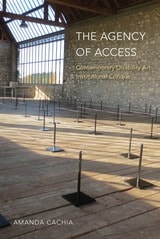
The Agency of Access
Contemporary Disability Art & Institutional CritiqueAmanda Cachia
Temple University Press, 2025
Showcasing artwork by contemporary disabled artists Corban Walker, Christine Sun Kim, and Carmen Papalia, among others, The Agency of Access inscribes contemporary disability art in the broad canon of contemporary art, where the artistic past is regarded differently.
Cachia is an outspoken advocate for artists living with sensory disabilities. She understands disabled artists’ experiences in both the world and the gallery. The artists she has curated make bold, astonishing, and compelling statements about interdependency, care, and the ways in which our environment affects disabled, ill, and immunocompromised bodies.