Results by title
5 books match the query 'AIDS (Disease) in women'
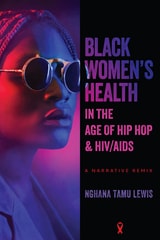
Black Women’s Health in the Age of Hip Hop and HIV/AIDS
A Narrative RemixNghana tamu Lewis
The Ohio State University Press, 2025
In Black Women’s Health in the Age of Hip Hop and HIV/AIDS, Nghana tamu Lewis chronicles the work of five black women creators to demonstrate how hip hop feminism operates as a vital tool for interpreting and building knowledge about the lived experiences of black women and girls. Between 1996 and 2006, novelists Sapphire and Sister Souljah, television producer Mara Brock Akil, and playwrights Nikkole Salter and Danai Gurira addressed the neglect of black women’s health in mainstream biomedical and public health discourses. At a time when responses to the HIV/AIDS epidemic largely focused on gay white men, Lewis argues, these creators deployed the strategies of hip hop feminism to frame and untangle issues of self-care, risk, and the ways that caregiving roles place black women and girls at disproportionate risk of adverse health outcomes. Building on previous intersectionality and social justice advocacy scholarship, Lewis argues that Sapphire, Souljah, Brock Akil, and Salter and Gurira both documented the effects of the epidemic on black women and girls and equipped the masses with solutions-oriented responses to the crisis, thus intervening in ways that mainstream biomedical and public health research has yet to do.
[more]
Lethal Decisions
The Unnecessary Deaths of Women and Children from HIV/AIDSArthur J. Ammann
Vanderbilt University Press, 2017
This first-person account by one of the pioneers of HIV/AIDS research chronicles the interaction among the pediatric HIV/AIDS community, regulatory bodies, governments, and activists over more than three decades. After the discovery of AIDS in a handful of infants in 1981, the next fifteen years showed remarkable scientific progress in prevention and treatment, although blood banks, drug companies, and bureaucrats were often slow to act. 1996 was a watershed year when scientific and clinical HIV experts called for treating all HIV-infected individuals with potent triple combinations of antiretroviral drugs that had been proven effective. Aggressive implementation of prevention and treatment in the United States led to marked declines in the number of HIV-related deaths, fewer new infections and hospital visits, and fewer than one hundred infants born infected each year.
Inexplicably, the World Health Organization recommended withholding treatment for the majority of HIV-infected individuals in poor countries, and clinical researchers embarked on studies to evaluate inferior treatment approaches even while the pandemic continued to claim the lives of millions of women and children. Why did it take an additional twenty years for international health organizations to recommend the treatment and prevention measures that had had such a profound impact on the pandemic in wealthy countries? The surprising answers are likely to be debated by medical historians and ethicists.
At last, in 2015, came a universal call for treating all HIV-infected individuals with triple-combination antiretroviral drugs. But this can only be accomplished if the mistakes of the past are rectified. The book ends with recommendations on how the pediatric HIV/AIDS epidemic can finally be brought to an end.
[more]

Physics
The First ScienceLindenfeld, Peter
Rutgers University Press, 2011
Today's physics textbooks have become encyclopedic, offering students dry discussions, rote formulas, and exercises with little relation to the real world. Physics: The First Science takes a different approach by offering uniquely accessible, student-friendly explanations, historical and philosophical perspectives and mathematics in easy-to-comprehend dialogue. It emphasizes the unity of physics and its place as the basis for all science. Examples and worked solutions are scattered throughout the narrative to help increase understanding. Students are tested and challenged at the end of each chapter with questions ranging from a guided-review designed to mirror the examples, to problems, reasoning skill building exercises that encourage students to analyze unfamiliar situations, and interactive simulations developed at the University of Colorado. With their experience instructing both students and teachers of physics for decades, Peter Lindenfeld and Suzanne White Brahmia have developed an algebra-based physics book with features to help readers see the physics in their lives. Students will welcome the engaging style, condensed format, and economical price.
[more]
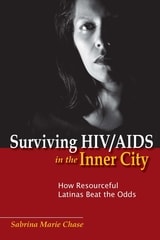
Surviving HIV/AIDS in the Inner City
How Resourceful Latinas Beat the OddsChase, Sabrina
Rutgers University Press, 2011
Surviving HIV/AIDS in the Inner City explores the survival strategies of poor, HIV-positive Puerto Rican women by asking four key questions: Given their limited resources, how did they manage an illness as serious as HIV/AIDS? Did they look for alternatives to conventional medical treatment? Did the challenges they faced deprive them of self-determination, or could they help themselves and each other? What can we learn from these resourceful women?
Based on her work with minority women living in Newark, New Jersey, Sabrina Marie Chase illuminates the hidden traps and land mines burdening our current health care system as a whole. For the women she studied, alliances with doctors, nurses, and social workers could literally mean the difference between life and death. By applying the theories of sociologist Pierre Bourdieu to the day-to-day experiences of HIV-positive Latinas, Chase explains why some struggled and even died while others flourished and thrived under difficult conditions. These gripping, true-life stories advocate for those living with chronic illness who depend on the health care "safety net." Through her exploration of life and death among Newark's resourceful women, Chase provides the groundwork for inciting positive change in the U.S. health care system.
Based on her work with minority women living in Newark, New Jersey, Sabrina Marie Chase illuminates the hidden traps and land mines burdening our current health care system as a whole. For the women she studied, alliances with doctors, nurses, and social workers could literally mean the difference between life and death. By applying the theories of sociologist Pierre Bourdieu to the day-to-day experiences of HIV-positive Latinas, Chase explains why some struggled and even died while others flourished and thrived under difficult conditions. These gripping, true-life stories advocate for those living with chronic illness who depend on the health care "safety net." Through her exploration of life and death among Newark's resourceful women, Chase provides the groundwork for inciting positive change in the U.S. health care system.
[more]
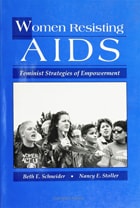
Women Resisting AIDS
Feminist Strategies of Empowermentedited by Beth E. Schneider and Nancy E. Stoller
Temple University Press, 1995
This collection of original essays discusses the increasingly rapid spread of AIDS among women, considering the varying experiences and responses of women of color, lesbians, and economically impoverished women. The essays range widely from policy assessments to case studies, focusing on women as sufferers, caretakers, policy activists, community organizers, and educators.
[more]