Results by title
5 books match the query 'Abandoned children'

Charity and Children in Renaissance Florence
The Ospedale degli Innocenti, 1410-1536Philip Gavitt
University of Michigan Press, 1991
Alongside the architectural splendor and intellectual brilliance of early Renaissance Florence there existed a second world of poverty, misery, social despair, and child abandonment. The Ospedale degli Innocenti (Hospital of the Innocents), designed and built between 1419 and 1445 by the renowned architect Filippo Brunelleschi, united these disparate worlds. Christian charity and compassion, as well as the humanist commitment to social perfection, family values, and love for children, were intertwined with a civic pride in which charity curried God's favor and invoked God's blessings on the city's fortunes.
Based on a close and attentive reading of archival material from the hospital and from the Florentine State Archives, Charity and Children in Renaissance Florence both chronicles the concerns and ambivalence of parents who abandoned children and follows the lives of the hospital's inhabitants from childhood to death. The book also demonstrates how hospital officials deliberately duplicated the structure and values of the Florentine family within the hospital walls. Gavitt's research shows that early modern foundling hospitals were not charnel houses where parents knowingly and impersonally abandoned their unwanted children to certain death. Charity and Children in Renaissance Florence provokes reflection on the contrast between our own views on the care of homeless children and those of the Italian Renaissance.
Winner of the Society for Italian Historical Studies 1988 Award for Best Unpublished Manuscript.
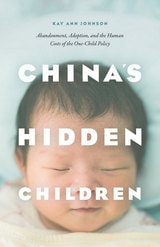
China's Hidden Children
Abandonment, Adoption, and the Human Costs of the One-Child PolicyKay Ann Johnson
University of Chicago Press, 2016
Johnson spent years talking with the Chinese parents driven to relinquish their daughters during the brutal birth-planning campaigns of the 1990s and early 2000s, and, with China’s Hidden Children, she paints a startlingly different picture. The decision to give up a daughter, she shows, is not a facile one, but one almost always fraught with grief and dictated by fear. Were it not for the constant threat of punishment for breaching the country’s stringent birth-planning policies, most Chinese parents would have raised their daughters despite the cultural preference for sons. With clear understanding and compassion for the families, Johnson describes their desperate efforts to conceal the birth of second or third daughters from the authorities. As the Chinese government cracked down on those caught concealing an out-of-plan child, strategies for surrendering children changed—from arranging adoptions or sending them to live with rural family to secret placement at carefully chosen doorsteps and, finally, abandonment in public places. In the twenty-first century, China’s so-called abandoned children have increasingly become “stolen” children, as declining fertility rates have left the dwindling number of children available for adoption more vulnerable to child trafficking. In addition, government seizures of locally—but illegally—adopted children and children hidden within their birth families mean that even legal adopters have unknowingly adopted children taken from parents and sent to orphanages.
The image of the “unwanted daughter” remains commonplace in Western conceptions of China. With China’s Hidden Children, Johnson reveals the complex web of love, secrecy, and pain woven in the coerced decision to give one’s child up for adoption and the profound negative impact China’s birth-planning campaigns have on Chinese families.
Haphazard Families
Romanticism, Nation, and the Prehistory of Modern AdoptionEric C. Walker
The Ohio State University Press, 2024
There are no provisions for adoption in English common law, and adoption wasn't legally formalized in England and Wales until 1926. But a century earlier, untimely adoptions navigated the new exceptionalism of childhood in Romanticism. In Haphazard Families, Eric C. Walker explores the history of the adopted child in Romantic-era England. Taking up the stories of both fictional and historical adoptees, he demonstrates how these children, diminished to nonpersons, shouldered the burden of social constructs of nation, family, gender, and class. Walker further demonstrates how Rousseau’s infamous failure to follow his own ideals of parenthood shaped British reactions in famous texts such as Frankenstein and Emma. Incorporating perspectives from Romantic scholarship and critical adoption studies and examining the stories of adopted children associated with Queen Caroline, Anna Letitia Barbauld, Jane Austen, the Wordsworth siblings, Mary Shelley, Charles and Mary Lamb, Letitia Landon, and others, Haphazard Families considers how Romantic constructions of childhood supply foundational structures of modern adoptee subjectivity.
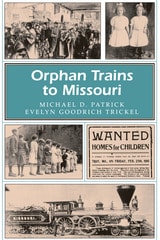
Orphan Trains to Missouri
Michael D. Patrick & Evelyn Goodrich Trickel
University of Missouri Press, 1997
As an "orphan train" crossed the country, it left part of its cargo at each stop, a few children in one small town and a few in another. Even though farmers needed many hands for labor, most of the small farm communities could not or would not take all of the children on the train. As the train moved to its next stop, those children not taken feared no one would ever want them.
Early immigration laws encouraged the poor of Europe to find new hope with new lives in the United States. But sometimes the immigrants exchanged a bad situation in their native country for an even worse one on the streets of New York and other industrial cities. As a result, the streets were filled with crowds of abandoned children that the police called "street arabs." Many New York citizens blamed the street arabs for crime and violence in the city and wanted them placed in orphan homes or prisons.
In 1853 a man by the name of Charles Loring Brace, along with other well-to-do men in New York City, founded the Children's Aid Society. The society planned to give food, lodging, and clothing to homeless children and provide educational and trade opportunities for them. But the number of children needing help was so large that the Children's Aid Society was unable to care for them, and Brace developed a plan to send many of the children to the rural Midwest by train. He was convinced that the children of the streets would find many benefits in rural America. In 1854 he persuaded the board of the society to send the first trainload of orphans west. With this, the orphan trains were born.
Cheap fares, the central location of the state, and numerous small farming towns along the railroad tracks made Missouri the perfect hub for the orphan trains, even though many areas of the state were still largely unsettled. Researchers have estimated that from 150,000 to 400,000 children were sent out on orphan trains, with perhaps as many as 100,000 being placed in Missouri.
Orphan Trains to Missouri documents the history of the children on those Orphan Trains--their struggles, their successes, and their failures. Touching stories of volunteers who oversaw the placement of the orphans as well as stories of the orphans themselves make this a rich record of American and midwestern history.
The Kindness of Strangers
The Abandonment of Children in Western Europe from Late Antiquity to the RenaissanceJohn Boswell
University of Chicago Press, 1998