Results by title
3 books match the query 'Abolitionist'
Hinton Rowan Helper
Abolitionist and RacistHugh C. Bailey
University of Alabama Press, 1965
The compelling biography of a man whose opposition to slavery was matched only by the contradictions that defined his life.
Hinton Rowan Helper: Abolitionist and Racist by Hugh C. Bailey is a compelling scholarly biography of one of the most controversial and contradictory figures in nineteenth-century American history. Born in North Carolina and raised in the slaveholding South, Hinton Rowan Helper emerged as one of the era's most outspoken critics of slavery, arguing that the institution harmed the economic prospects of nonslaveholding white Southerners and hindered regional development. Yet despite his vigorous opposition to slavery, Helper also espoused deeply racist views, creating a paradox that has long challenged historians seeking to understand his place in American history.
Drawing on extensive research, Bailey examines Helper's career as an antislavery activist, political propagandist, reformer, and public intellectual while exploring the social, economic, and political forces that shaped his worldview. The biography traces Helper's influence on sectional tensions before the Civil War, his connections to the emerging Republican movement, and his later involvement in a variety of ambitious political and economic ventures.
More than a biography, this book offers a revealing study of the complexities of race, reform, and ideology in antebellum America. It remains an essential resource for understanding the contradictions that characterized both Helper and the broader society in which he lived.
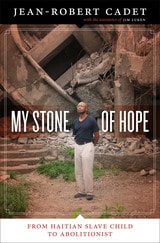
My Stone of Hope
From Haitian Slave Child to AbolitionistBy Jean-Robert Cadet
University of Texas Press, 2011
There are 27 million slaves living in the world today—more than at any time in history. Three hundred thousand of them are impoverished children in Haiti, who "stay with" families as unpaid and uneducated domestic workers, subject to physical, emotional, and sexual abuse. This practice, known locally as restavek ("staying with"), is so widespread that one in ten Haitian children is caught up in this form of slavery.
Jean-Robert Cadet was a restavek in Haiti from the late 1950s until the early 1970s. He told the harrowing story of his youth in Restavec: From Haitian Slave Child to Middle-Class American—a landmark book that exposed ongoing child slavery in Haiti. Now in My Stone of Hope, Cadet continues his story from his early attempts to adjust to freedom in American society to his current life mission of eliminating child slavery through advocacy and education. As he recounts his own struggles to surmount the psychological wounds of slavery, Cadet puts a human face on the suffering that hundreds of thousands of Haitians still endure daily. He also builds a convincing case that child slavery is not just one among many problems that Haiti faces as the Western Hemisphere's poorest nation. Rather, he argues that the systematic abuse of so many of its children is Haiti's fundamental problem, because it creates damaged adults who seem incapable of governing the country justly or managing its economy productively.
For everyone concerned about the fate of Haiti, the welfare of children, and the freedom of people around the globe, My Stone of Hope sounds an irresistible call to action.
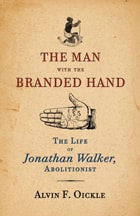
The Man with the Branded Hand
The Life of Jonathan Walker, AbolitionistAlvin F. Oickle
Westholme Publishing, 2011
Captured While Attempting to Smuggle Slaves to Freedom in 1844, the Only Man Branded in a Courtroom by a United States Marshal
Sailing around the Florida Keys in 1844, forty-five-year-old Jonathan Walker had a price on his head. On board the small boat he had built that winter in Alabama were seven fugitives from slavery. The Cape Cod sailor and abolitionist was wanted in Pensacola, Florida, for his crime: stealing slaves. The slaves’ owners had posted $100 each as reward money for their property and $1,000 for Walker’s apprehension. Only a day’s sail from their goal of freedom in British-controlled Bahamas, Walker and the slaves were stopped and seized by bounty hunters and taken to a Key West court. Ordered back to Pensacola for trial, Walker ended up spending a year in jail. He was fined and sentenced to stand in the pillory; in addition, he was to suffer a unique punishment in American history: while a packed courtroom watched, a United States marshal was ordered to use a hot branding iron to burn the letters SS, for “slave stealer,” into Walker’s right hand.
Walker survived his ordeal, spending much of his incarceration in isolation. Once released, he remained active in the antislavery movement even while he and his devoted wife Jane raised their nine children. His attempt to help form a new colony in Mexico for runaway American slaves also led to punishing experiences for Walker and one of his sons. Living later with his family in Plymouth, Massachusetts, in the years before the Civil War, Walker made room in his crowded house to shelter runaway slaves along the Underground Railroad. He participated in abolitionist lecture tours across the North where he would be urged to reveal his branded hand—made famous by John Greenleaf Whittier’s poem “The Branded Hand”—to astonished audiences. Too old to enlist in the Civil War, Walker instead headed to Virginia in the war’s final year to help educate African Americans fleeing Confederate forces. In The Man With the Branded Hand: The Life of Jonathan Walker, Abolitionist, distinguished journalist Alvin F. Oickle relates this entire remarkable story of a life devoted to the supposition that “all men are created equal.”