Results by title
5 books match the query 'Abortion in literature'
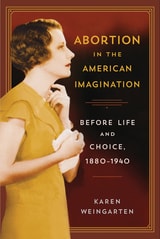
Abortion in the American Imagination
Before Life and Choice, 1880-1940Weingarten, Karen
Rutgers University Press, 2014
Abortion in the American Imagination returns to the moment when American writers first dared to broach the controversial subject of abortion. What was once a topic avoided by polite society, only discussed in vague euphemisms behind closed doors, suddenly became open to vigorous public debate as it was represented everywhere from sensationalistic melodramas to treatises on social reform. Literary scholar and cultural historian Karen Weingarten shows how these discussions were remarkably fluid and far-ranging, touching upon issues of eugenics, economics, race, and gender roles.
Weingarten traces the discourses on abortion across a wide array of media, putting fiction by canonical writers like William Faulkner, Edith Wharton, and Langston Hughes into conversation with the era’s films, newspaper articles, and activist rhetoric. By doing so, she exposes not only the ways that public perceptions of abortion changed over the course of the twentieth century, but also the ways in which these abortion debates shaped our very sense of what it means to be an American.

Abortion, Choice, and Contemporary Fiction
The Armageddon of the Maternal InstinctJudith Wilt
University of Chicago Press, 1990
In the opening of the book, Wilt discusses real case histories of several women. After studying the ambiguities of their decisions, she turns to their counterpoints depicted in contemporary fiction. Working from a feminist perspective, Wilt traces the theme of maternal choice in works by Margaret Atwood, Margaret Drabble, Joan Didion, Mary Gordon, Alice Walker, Toni Morrison, Gloria Naylor, Marge Piercy, Thomas Keneally, Graham Swift, Ernest Hemingway, William Faulkner, John Barth, John Irving, and others.
Behind the political, medical, and moral debates on abortion, Wilt argues, is a profound psychocultural shock at the recognition that maternity is passing from the domain of instinct to that of conscious choice. Although never wholly instinctual, maternity's potential capture by consciousness raises complex questions. The novels Wilt discusses portray worlds in which principles are endangered by sexual inequality, male power and hidden male fear of abandonment, impotence, female submission, and covert rage, and, in the case of black maternity, the hideous aftermath of slavery.
Wilt provides a resonant new context for debates—whether political or personal—on the issue of abortion and maternal choice. Ultimately she enables us to rethink how we shape our own identities and lives.
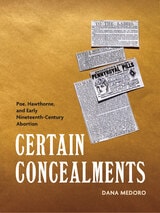
Certain Concealments
Poe, Hawthorne, and Early Nineteenth-Century AbortionDana Medoro
University of Massachusetts Press, 2022
Antebellum America saw a great upsurge in abortion, driven in part by the rise of the pharmaceutical industry. Unsurprisingly, the practice became increasingly visible in the popular culture and literature of the era, appearing openly in advertisements, popular fiction, and newspaper reports. One figure would come to dominate national headlines from the 1840s onward: Madame Restell. Facing public condemnation and mob attacks at her home for her dogged support of women’s reproductive rights, Restell built an empire selling her powders, pills, and services along the Eastern Seaboard.
Edgar Allan Poe and Nathaniel Hawthorne undoubtedly knew of Restell’s work and would go on to depict the incompatibility of abortion and nationalism in their writings. Through the thwarted plotlines, genealogical interruptions, and terminated ideas of Poe’s Dupin trilogy and Hawthorne’s The Scarlet Letter, The House of Seven Gables, and The Blithedale Romance, these authors consider new concepts around race, reproduction, and American exceptionalism. Dana Medoro demonstrates that their work can be usefully read in the context of debates on fetal life and personhood that circulated in the era.
Ordinary Abortion
Reproductive Choice in Twenty-First-Century Women’s WritingMary Thompson
The Ohio State University Press, 2026
The Supreme Court’s Dobbs v. Jackson (2022) decision, which erased the constitutional right to abortion, abruptly redramatized access in the United States. Yet twenty-first-century literature written before Dobbs reflects a landscape in which abortion appears as an undramatic, routine part of women’s lives. In Ordinary Abortion, Mary Thompson argues that many contemporary women writers depict abortion as a commonplace decision intertwined with health, education, career, sexuality, relationships, family-making, and motherhood.
Drawing on American poetry, fiction, nonfiction, memoir, and dystopian writing, Ordinary Abortion examines how ideas about abortion circulate through literature and how literary forms, in turn, shape readers’ understandings of reproduction and politics. Thompson traces new plots, characters, narrative strategies, and genres emerging around birth control, unplanned pregnancy, termination, and family formation. These works reveal renewed thematic attention to abortion’s relationship with motherhood and mother-loss, neoliberal pressures, stratified reproduction, masculinity, violence, care work, and disability.
Ultimately, Ordinary Abortion shows that abortion literature extends far beyond stories centered on crisis or choice. Instead, twenty-first-century women’s writing reveals a quiet, pervasive truth: Abortion has long been woven into everyday American life, normalized in ways that public discourse has often failed to acknowledge.
Textual Contraception
Birth Control and Modern American FictionBeth Widmaier Capo
The Ohio State University Press, 2007
Merging cultural analysis and literary scholarship, this compelling work moves from a consideration of how cultural forces shaped literary production and political activism to a close examination of how fictional representations of contraception influenced the terms of public discourse on marriage, motherhood, economics, and eugenics.
By analyzing popular fiction such as Mother by Kathleen Norris, radical periodicals such as The Masses and Birth Control Review, and literature by authors from Theodore Dreiser to William Faulkner, and Nella Larsen to Mary McCarthy, Beth Widmaier Capo reveals the rich cross-influence of contraceptive and literary history.