Results by title
9 books match the query 'Abstraction'
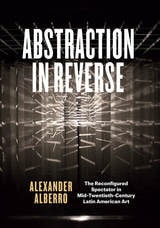
Abstraction in Reverse
The Reconfigured Spectator in Mid-Twentieth-Century Latin American ArtAlexander Alberro
University of Chicago Press, 2017
During the mid-twentieth century, Latin American artists working in several different cities radically altered the nature of modern art. Reimagining the relationship of art to its public, these artists granted the spectator an unprecedented role in the realization of the artwork. The first book to explore this phenomenon on an international scale, Abstraction in Reverse traces the movement as it evolved across South America and parts of Europe.
Alexander Alberro demonstrates that artists such as Tomás Maldonado, Jesús Soto, Julio Le Parc, and Lygia Clark, in breaking with the core tenets of the form of abstract art known as Concrete art, redefined the role of both the artist and the spectator. Instead of manufacturing autonomous art, these artists produced artworks that required the presence of the spectator to be complete. Alberro also shows the various ways these artists strategically demoted regionalism in favor of a new modernist voice that transcended the traditions of the nation-state and contributed to a nascent globalization of the art world.
Alexander Alberro demonstrates that artists such as Tomás Maldonado, Jesús Soto, Julio Le Parc, and Lygia Clark, in breaking with the core tenets of the form of abstract art known as Concrete art, redefined the role of both the artist and the spectator. Instead of manufacturing autonomous art, these artists produced artworks that required the presence of the spectator to be complete. Alberro also shows the various ways these artists strategically demoted regionalism in favor of a new modernist voice that transcended the traditions of the nation-state and contributed to a nascent globalization of the art world.
[more]
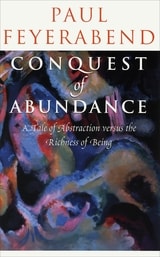
Conquest of Abundance
A Tale of Abstraction versus the Richness of BeingPaul Feyerabend
University of Chicago Press, 1999
From flea bites to galaxies, from love affairs to shadows, Paul Feyerabend reveled in the sensory and intellectual abundance that surrounds us. He found it equally striking that human senses and human intelligence are able to take in only a fraction of these riches. "This a blessing, not a drawback," he writes. "A superconscious organism would not be superwise, it would be paralyzed." This human reduction of experience to a manageable level is the heart of Conquest of Abundance, the book on which Feyerabend was at work when he died in 1994.
Prepared from drafts of the manuscript left at his death, working notes, and lectures and articles Feyerabend wrote while the larger work was in progress, Conquest of Abundance offers up rich exploration and startling insights with the charm, lucidity, and sense of mischief that are his hallmarks. Feyerabend is fascinated by how we attempt to explain and predict the mysteries of the natural world, and he looks at the ways in which we abstract experience, explain anomalies, and reduce wonder to formulas and equations. Through his exploration of the positive and negative consequences of these efforts, Feyerabend reveals the "conquest of abundance" as an integral part of the history and character of Western civilization.
"Paul Feyerabend . . . was the Norman Mailer of philosophy. . . . brilliant, brave, adventurous, original and quirky."—Richard Rorty, New Republic
"As much a smudged icon as a philosophical position holder, [Feyerabend] was alluring and erotic, a torch singer for philosophical anarchy."—Nancy Maull, New York Times Book Review
"[A] kind of final testament of Feyerabend's thought . . . Conquest of Abundance is as much the product of a brilliant, scintillating style as of an immense erudition and culture. . . . This book is as abundant and rich as the world it envisions."—Arkady Plotnitsky, Chicago Tribune
[more]
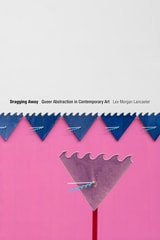
Dragging Away
Queer Abstraction in Contemporary ArtLex Morgan Lancaster
Duke University Press, 2022
In Dragging Away Lex Morgan Lancaster traces the formal and material innovations of contemporary queer and feminist artists, showing how they use abstraction as a queering tactic for social and political ends. Through a process Lancaster theorizes as a drag—dragging past aesthetics into the present and reworking them while pulling their work away from direct representation—these artists reimagine midcentury forms of abstraction and expose the violence of the tendency to reduce abstract form to a bodily sign or biographical symbolism. Lancaster outlines how the geometric enamel objects, grid paintings, vibrant color, and expansive installations of artists ranging from Ulrike Müller, Nancy Brooks Brody, and Lorna Simpson to Linda Besemer, Sheila Pepe, and Shinique Smith offer direct challenges to representational and categorical legibility. In so doing, Lancaster demonstrates that abstraction is not apolitical, neutral, or universal; it is a form of social praxis that actively contributes to queer, feminist, critical race, trans, and crip politics.
[more]
Kinds of Value
An Experiment in Modal AnthropologyPaul Kockelman
Prickly Paradigm Press, 2020
In this slim volume, anthropologist Paul Kockelman showcases, reworks, and extends some of the core resources anthropologists and like-minded scholars have developed for thinking about value. Rather than theorize value head on, he offers a careful interpretation of a Mayan text about an offering to a god that lamentably goes awry. Kockelman analyzes the text, its telling, and the conditions of possibility for its original publication. Starting with a relatively simple definition of value—that which stands at the intersection of what signs stand for and what agents strive for—he unfolds, explicates, and experiments with its variations. Contrary to widespread claims in and around the discipline, Kockelman argues that it is not so-called relations, but rather relations between relations, that are at the heart of the interpretive endeavor.
[more]

Pulses of Abstraction
Andrew R. Johnston
University of Minnesota Press, 2020
[more]
The Matter of Language
Abstraction and PoetryBenjamin Noys
Seagull Books, 2023
A critical intervention on the relationship between language and matter.
If the twentieth century was the century in which language was at the center of thought, the twenty-first century has, so far, been the century of matter. The Matter of Language is a critical intervention that aims to return to the relationship between language and matter to think of our present moment as one dominated by abstractions that rule our lives. In a series of dated chapters, that form punctual moments of intervention, this book both rehabilitates key thinkers, like Marx, Freud, and Saussure, and engages with poetic thinking on matter in David Jones, Diane di Prima, William Blake, Leslie Kaplan, and others. It is a matter of understanding language as a site of struggle, which is intimately bound to the material but also crucial in formulating and expressing the material and the abstractions that shape language and matter. Working between theory and poetry, The Matter of Language reconceives notions of alienation and class struggle as essential modes of reading and analysis for our fractured present.
If the twentieth century was the century in which language was at the center of thought, the twenty-first century has, so far, been the century of matter. The Matter of Language is a critical intervention that aims to return to the relationship between language and matter to think of our present moment as one dominated by abstractions that rule our lives. In a series of dated chapters, that form punctual moments of intervention, this book both rehabilitates key thinkers, like Marx, Freud, and Saussure, and engages with poetic thinking on matter in David Jones, Diane di Prima, William Blake, Leslie Kaplan, and others. It is a matter of understanding language as a site of struggle, which is intimately bound to the material but also crucial in formulating and expressing the material and the abstractions that shape language and matter. Working between theory and poetry, The Matter of Language reconceives notions of alienation and class struggle as essential modes of reading and analysis for our fractured present.
[more]
Universal Prostitution and Modernist Abstraction
A CounterhistoryJaleh Mansoor
Duke University Press, 2025
In Universal Prostitution and Modernist Abstraction, Jaleh Mansoor provides a counternarrative of modernism and abstraction and a reexamination of Marxist aesthetics. Mansoor draws on Marx’s concept of prostitution—a conceptual device through which Marx allegorized modern labor—to think about the confluences of generalized and gendered labor in modern art. Analyzing works ranging from Édouard Manet’s Olympia and Georges Seurat’s The Models to contemporary work by Hito Steyerl and Hannah Black, she shows how avant-garde artists can detect changing modes of production and capitalist and biopolitical processes of abstraction that assign identities to subjects in the interest of value’s impersonal circulation. She demonstrates that art and abstraction resist modes of production and subjugation at the level of process and form rather than through referential representation. By studying gendered and generalized labor, abstraction, automation, and the worker, Mansoor shifts focus away from ideology, superstructure, and culture toward the ways art indexes crisis and transformation in the political economic base. Ultimately, she traces the outlines of a counterpraxis to capital while demonstrating how artworks give us a way to see through the abstractions of everyday life.
[more]
When Formality Works
Authority and Abstraction in Law and OrganizationsArthur L. Stinchcombe
University of Chicago Press, 2001
In this innovative exploration of the concept of formality, or governing by abstraction, Arthur Stinchcombe breathes new life into an idea that scholars have all but ignored in recent years.
We have come to assume that governing our social activities by advance planning—by creating abstract descriptions of what ought to happen and adjusting these descriptions as situations change—is not as efficient and responsive as dealing directly with the real substance of the situation at hand. Stinchcombe argues the opposite. When a plan is designed to correct itself and keep up with the reality it is meant to govern, it can be remarkably successful. He points out a wide range of examples where this is the case, including architectural blueprints, immigration law, the construction of common law by appeals courts, Fannie Mae's secondary mortgage market, and scientific paradigms and programs.
Arguing that formality has been misconceived as consisting mainly of its defects, Stinchcombe shows how formality, at its best, can serve us much better than ritual obedience to poorly laid plans or a romantic appeal to "real life."
[more]
When Maps Become the World
Rasmus Grønfeldt Winther
University of Chicago Press, 2020
Map making and, ultimately, map thinking is ubiquitous across literature, cosmology, mathematics, psychology, and genetics. We partition, summarize, organize, and clarify our world via spatialized representations. Our maps and, more generally, our representations seduce and persuade; they build and destroy. They are the ultimate record of empires and of our evolving comprehension of our world.
This book is about the promises and perils of map thinking. Maps are purpose-driven abstractions, discarding detail to highlight only particular features of a territory. By preserving certain features at the expense of others, they can be used to reinforce a privileged position.
When Maps Become the World shows us how the scientific theories, models, and concepts we use to intervene in the world function as maps, and explores the consequences of this, both good and bad. We increasingly understand the world around us in terms of models, to the extent that we often take the models for reality. Winther explains how in time, our historical representations in science, in cartography, and in our stories about ourselves replace individual memories and become dominant social narratives—they become reality, and they can remake the world.
[more]