Results by title
25 books match the query 'Academic achievement'
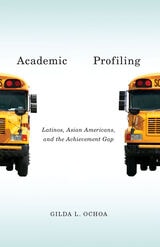
Academic Profiling
Latinos, Asian Americans, and the Achievement GapGilda L. Ochoa
University of Minnesota Press, 2013
Today the achievement gap is hotly debated among pundits, politicians, and educators. In particular this conversation often focuses on the two fastest-growing demographic groups in the United States: Asian Americans and Latinos. In Academic Profiling, Gilda L. Ochoa addresses this so-called gap by going directly to the source. At one California public high school where the controversy is lived every day, Ochoa turns to the students, teachers, and parents to learn about the very real disparities—in opportunity, status, treatment, and assumptions—that lead to more than just gaps in achievement.
In candid and at times heart-wrenching detail, the students tell stories of encouragement and neglect on their paths to graduation. Separated by unequal middle schools and curriculum tracking, they are divided by race, class, and gender. While those channeled into an International Baccalaureate Program boast about Socratic classes and stress-release sessions, students left out of such programs commonly describe uninspired teaching and inaccessible counseling. Students unequally labeled encounter differential policing and assumptions based on their abilities—disparities compounded by the growth in the private tutoring industry that favors the already economically privileged.
Despite the entrenched inequality in today’s schools, Academic Profiling finds hope in the many ways students and teachers are affirming identities, creating alternative spaces, and fostering critical consciousness. When Ochoa shares the results of her research with the high school, we see the new possibilities—and limits—of change.
An Age of Accountability
How Standardized Testing Came to Dominate American Schools and Compromise EducationJohn L. Rury
Rutgers University Press, 2024

Blacked Out
Dilemmas of Race, Identity, and Success at Capital HighSignithia Fordham
University of Chicago Press, 1996
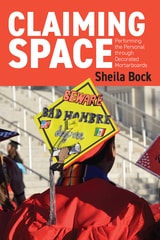
Claiming Space
Performing the Personal through Decorated MortarboardsSheila Bock
Utah State University Press, 2023
Claiming the space of these graduation caps is a popular and widespread way that individuals make their voices heard, or rather seen, in the visual landscape of commencement ceremonies. The forms and meanings of these material displays take shape in relation to broader, ongoing conversations about higher education in the United States, conversations grounded in discourses of belonging, citizenship, and the promises of the American Dream. Integrating observational fieldwork with extensive interviews and surveys, author Sheila Bock highlights the interpretations of individuals participating in this tradition. She also attends to the public framings of this tradition, including how images of mortarboards have grounded online enactments of community through hashtags such as #LatinxGradCaps and #LetTheFeathersFly, as well as what rhetorical framings are employed in news coverage and legal documents in cases where the value of the practice is both called into question and justified.
As university administrators and cultural commentators seek to make sense of the current state of higher education, these forms of material expression offer insight into how students themselves are grappling with higher ed's promises and shortcomings. Claiming Space is a meaningful contribution to folklore, cultural studies, media studies, and education.
Closing the Education Achievement Gaps for African American Males
Theodore S. Ransaw
Michigan State University Press, 2016
The distinguished and expert contributors whose work comprises this volume include an achievement-gap specialist for males of color, two psychologists, a math teacher, an electrical engineer, a former school principal, a social worker, and a former human rights commissioner. From black male learning styles to STEM, this book shows that issues pertaining to educational outcomes for black males are nuanced and complex but not unsolvable.
With its combination of fresh new approaches to closing achievement gaps and up-to-date views on trends, this volume is an invaluable resource on vital contemporary social and educational issues that aims to improve learning, equity, and access for African American males.
Empowering Men of Color on Campus
Building Student Community in Higher EducationBrooms, Derrick R.
Rutgers University Press, 2018
Family Life and School Achievement
Why Poor Black Children Succeed or FailReginald M. Clark
University of Chicago Press, 1984
To support his contentions, Clark offers ten intimate portraits of Black families in Chicago. Visiting the homes of poor one- and two-parent families of high and low achievers, Clark made detailed observations on the quality of home life, noting how family habits and interactions affect school success and what characteristics of family life provide children with "school survival skills," a complex of behaviors, attitudes, and knowledge that are the essential elements in academic success.
Clark's conclusions lead to exciting implications for educational policy. If school achievement is not dependent on family structure or income, parents can learn to inculcate school survival skills in their children. Clark offers specific suggestions and strategies for use by teachers, parents, school administrators, and social service policy makers, but his work will also find an audience in urban anthropology, family studies, and Black studies.
Futuring Black Lives
Independent Black Institutions and the Literary ImaginationMaisha T. Winn
Vanderbilt University Press, 2025
The rationale for establishing and valuing IBIs remains highly relevant, given the sociopolitical landscape of education today. In addition to persistent racial disparities in academic achievement and Black students’ highly disproportionate experiences of punishment and “discipline,” friction and legislation against critical examination of race, racism, and racist ideas in school settings are front and center, and children’s and young adult literature are under attack through censorship and outright book bans. Yet Black institution builders left useful maps of and for the educational future/s of Black children that remain available in journals, newspapers, pamphlets, and other ephemera. Author Maisha T. Winn demonstrates how and why the historiography-grounded futuring of Black education can and should inform current pursuits of equity, justice, and liberation through education.
Giants Among Us
First-Generation College Graduates Who Lead Activist LivesSandria Rodriguez
Vanderbilt University Press, 2001
The daughter of parents who didn't finish elementary school, Rodriguez uses many examples from her own life in the course of examining the participants' experiences before, during, and after college that directed them toward social or educational activism. Together, the seventeen represent a wide range of diversity in terms of race, ethnicity, age, geographical area of childhood, and profession. Twelve of the seventeen hold advanced degrees, all are working professionals, and all come from families who were poor. Jerry, the son of German immigrants, owns an engineering company in Chicago; Chang, a native of China, is the first from his village to go to college; Grant, a sharecropper's son, is a lawyer with a nationally prominent law firm in Washington, D.C., and patron of fine arts; Arlene, a Mohawk Indian, is a storyteller and social activist; Alex, from Spanish Harlem, is an elementary school principal.
The book is divided into four parts. In the first two chapters, we meet the participants. In the three chapters that follow, Rodriguez examines how the participants as children perceived themselves within their families, schools, and communities. Chapters four and five focus on the campus life and the participants' activist experiences. Finally, chapter six offers recommendations for mentoring disadvantaged children, so that they can successfully "switch the track" and aim for something better.
Giants Among Us is an essential resource for college administrators, faculty, counselors, and student support-services staff--as well as K-12 educators--concerned with preparing, retaining and mentoring first-generation students.
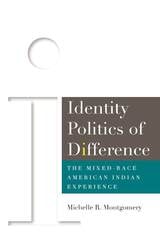
Identity Politics of Difference
The Mixed-Race American Indian ExperienceMichelle Montgomery
University Press of Colorado, 2021
In Identity Politics of Difference, author Michelle R. Montgomery uses a multidisciplinary approach to examine questions of identity construction and multiracialism through the experiences of mixed-race Native American students at a tribal school in New Mexico. She explores the multiple ways in which these students navigate, experience, and understand their racial status and how this status affects their educational success and social interactions.
Montgomery contextualizes students’ representations of their racial identity choices through the compounded race politics of blood quantum and stereotypes of physical features, showing how varying degrees of "Indianness" are determined by peer groups. Based on in-depth interviews with nine students who identify as mixed-race (Native American–White, Native American–Black, and Native American–Hispanic), Montgomery challenges us to scrutinize how the category of “mixed-race” bears different meanings for those who fall under it based on their outward perceptions, including their ability to "pass" as one race or another.
Identity Politics of Difference includes an arsenal of policy implications for advancing equity and social justice in tribal colleges and beyond and actively engages readers to reflect on how they have experienced the identity politics of race throughout their own lives. The book will be a valuable resource to scholars, policy makers, teachers, and school administrators, as well as to students and their families.
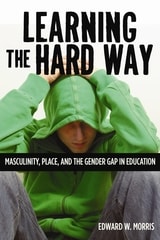
Learning the Hard Way
Masculinity, Place, and the Gender Gap in EducationMorris, Edward
Rutgers University Press, 2012
An avalanche of recent newspapers, weekly newsmagazines, scholarly journals, and academic books has helped to spark a heated debate by publishing warnings of a “boy crisis” in which male students at all academic levels have begun falling behind their female peers. In Learning the Hard Way, Edward W. Morris explores and analyzes detailed ethnographic data on this purported gender gap between boys and girls in educational achievement at two low-income high schools—one rural and predominantly white, the other urban and mostly African American. Crucial questions arose from his study of gender at these two schools. Why did boys tend to show less interest in and more defiance toward school? Why did girls significantly outperform boys at both schools? Why did people at the schools still describe boys as especially “smart”?
Morris examines these questions and, in the process, illuminates connections of gender to race, class, and place. This book is not simply about the educational troubles of boys, but the troubled and complex experience of gender in school. It reveals how particular race, class, and geographical experiences shape masculinity and femininity in ways that affect academic performance. His findings add a new perspective to the “gender gap” in achievement.

Messages From Home
The Parent-Child Home Program For Overcoming Educational DisadvantagePhyllis Levenstein and Susan Levenstein
Temple University Press, 2008
The Parent-Child Home Program, a pre-preschool home visiting program, has grown greatly since the first edition of Messages from Home was published in 1988. This expanded and updated edition shows the continued success of this program-spearheaded by the late Phyllis Levenstein-which prepares at-risk children for school success, overcoming educational disadvantage.
Since The Parent-Child Home Program was founded in the 1960s, it has enriched the cognitive, social, and emotional school readiness of tens of thousands of children. The Program's methods, its theoretical underpinnings, and its impressive results are presented in detail. The success stories of both parents and children make inspiring reading. The combination of lively writing and data-driven scientific rigor give it both broad appeal and academic relevance.
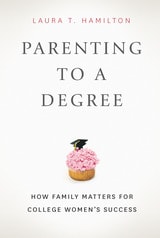
Parenting to a Degree
How Family Matters for College Women's SuccessLaura T. Hamilton
University of Chicago Press, 2016
Hamilton vividly captures the parenting approaches of mothers and fathers from all walks of life—from a CFO for a Fortune 500 company to a waitress at a roadside diner. As she shows, parents are guided by different visions of the ideal college experience, built around classed notions of women’s work/family plans and the ideal age to “grow up.” Some are intensively involved and hold adulthood at bay to cultivate specific traits: professional helicopters, for instance, help develop the skills and credentials that will advance their daughters’ careers, while pink helicopters emphasize appearance, charm, and social ties in the hopes that women will secure a wealthy mate. In sharp contrast, bystander parents—whose influence is often limited by economic concerns—are relegated to the sidelines of their daughter’s lives. Finally, paramedic parents—who can come from a wide range of class backgrounds—sit in the middle, intervening in emergencies but otherwise valuing self-sufficiency above all.
Analyzing the effects of each of these approaches with clarity and depth, Hamilton ultimately argues that successfully navigating many colleges and universities without involved parents is nearly impossible, and that schools themselves are increasingly dependent on active parents for a wide array of tasks, with intended and unintended consequences. Altogether, Parenting to a Degree offers an incisive look into the new—and sometimes problematic—relationship between students, parents, and universities.
Potential on the Periphery
College Access from the Ground UpOmari Scott Simmons
Rutgers University Press, 2019

Producing Success
The Culture of Personal Advancement in an American High SchoolPeter Demerath
University of Chicago Press, 2009
Middle- and upper-middle-class students continue to outpace those from less privileged backgrounds. Most attempts to redress this inequality focus on the issue of access to financial resources, but as Producing Success makes clear, the problem goes beyond mere economics. In this eye-opening study, Peter Demerath examines a typical suburban American high school to explain how some students get ahead.
Demerath undertook four years of research at a Midwestern high school to examine the mercilessly competitive culture that drives students to advance. Producing Success reveals the many ways the community’s ideology of achievement plays out: students hone their work ethics and employ various strategies to succeed, from negotiating with teachers to cheating; parents relentlessly push their children while manipulating school policies to help them get ahead; and administrators aid high performers in myriad ways, even naming over forty students “valedictorians.” Yet, as Demerath shows, this unswerving commitment to individual advancement takes its toll, leading to student stress and fatigue, incivility and vandalism, and the alienation of the less successful. Insightful and candid, Producing Success is an often troubling account of the educationally and morally questionable results of the American culture of success.
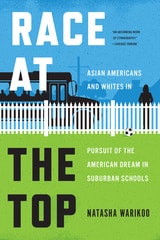
Race at the Top
Asian Americans and Whites in Pursuit of the American Dream in Suburban SchoolsNatasha Warikoo
University of Chicago Press, 2022
The American suburb conjures an image of picturesque privilege: manicured lawns, quiet streets, and—most important to parents—high-quality schools. These elite enclaves are also historically white, allowing many white Americans to safeguard their privileges by using public schools to help their children enter top colleges. That’s changing, however, as Asian American professionals increasingly move into wealthy suburban areas to give their kids that same leg up for their college applications and future careers.
As Natasha Warikoo shows in Race at the Top, white and Asian parents alike will do anything to help their children get to the top of the achievement pile. She takes us into the affluent suburban East Coast school she calls “Woodcrest High,” with a student body about one-half white and one-third Asian American. As increasing numbers of Woodcrest’s Asian American students earn star-pupil status, many whites feel displaced from the top of the academic hierarchy, and their frustrations grow. To maintain their children’s edge, some white parents complain to the school that schoolwork has become too rigorous. They also emphasize excellence in extracurriculars like sports and theater, which maintains their children’s advantage.
Warikoo reveals how, even when they are bested, white families in Woodcrest work to change the rules in their favor so they can remain the winners of the meritocracy game. Along the way, Warikoo explores urgent issues of racial and economic inequality that play out in affluent suburban American high schools. Caught in a race for power and privilege at the very top of society, what families in towns like Woodcrest fail to see is that everyone in their race is getting a medal—the children who actually lose are those living beyond their town’s boundaries.
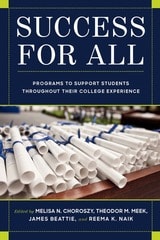
Success for All
Programs to Support Students Throughout Their College ExperienceMelisa N. Choroszy
University of Nevada Press, 2019
Success for All is a strategic guide for administrators and educators that offers methods for advising students through the myriad of challenges they face. Every bit of success contributes to the accomplishment of a larger goal, and this book highlights success at every level. It provides a specific roadmap to the research, services, and programs at the University of Nevada, Reno and Truckee Meadows Community College that support student success in undergraduate and graduate programs regardless of a student’s social, emotional, or prior academic experiences. Contributors discuss how to make students feel welcome in their social and educational environments and how to directly assist them with the timely completion of their degree. Administrators and educators demonstrate how these programs help make a positive contribution to the students and the institutions they serve while implementing practical solutions to increase graduation rates.
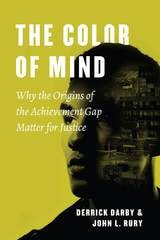
The Color of Mind
Why the Origins of the Achievement Gap Matter for JusticeDerrick Darby and John L. Rury
University of Chicago Press, 2018
Telling the story of what they call the Color of Mind—the idea that there are racial differences in intelligence, character, and behavior—they show how philosophers, such as David Hume and Immanuel Kant, and American statesman Thomas Jefferson, contributed to the construction of this pernicious idea, how it influenced the nature of schooling and student achievement, and how voices of dissent such as Frederick Douglass, Frances Ellen Watkins Harper, and W. E. B. Du Bois debunked the Color of Mind and worked to undo its adverse impacts.
Rejecting the view that racial differences in educational achievement are a product of innate or cultural differences, Darby and Rury uncover the historical interplay between ideas about race and American schooling, to show clearly that the racial achievement gap has been socially and institutionally constructed. School leaders striving to bring justice and dignity to American schools today must work to root out the systemic manifestations of these ideas within schools, while still doing what they can to mitigate the negative effects of poverty, segregation, inequality, and other external factors that adversely affect student achievement. While we cannot expect schools alone to solve these vexing social problems, we must demand that they address the dignitary injustices associated with how we track, discipline, and deal with special education that reinforce long-standing racist ideas. That is the only way to expel the Color of Mind from schools, close the racial achievement gap, and afford all children the dignity they deserve.
The Myth of Achievement Tests
The GED and the Role of Character in American LifeEdited by James J. Heckman, John Eric Humphries, and Tim Kautz
University of Chicago Press, 2013
The Myth of Achievement Tests shows that achievement tests like the GED fail to measure important life skills. James J. Heckman, John Eric Humphries, Tim Kautz, and a group of scholars offer an in-depth exploration of how the GED came to be used throughout the United States and why our reliance on it is dangerous. Drawing on decades of research, the authors show that, while GED recipients score as well on achievement tests as high school graduates who do not enroll in college, high school graduates vastly outperform GED recipients in terms of their earnings, employment opportunities, educational attainment, and health. The authors show that the differences in success between GED recipients and high school graduates are driven by character skills. Achievement tests like the GED do not adequately capture character skills like conscientiousness, perseverance, sociability, and curiosity. These skills are important in predicting a variety of life outcomes. They can be measured, and they can be taught.
Using the GED as a case study, the authors explore what achievement tests miss and show the dangers of an educational system based on them. They call for a return to an emphasis on character in our schools, our systems of accountability, and our national dialogue.
Contributors
Eric Grodsky, University of Wisconsin–Madison
Andrew Halpern-Manners, Indiana University Bloomington
Paul A. LaFontaine, Federal Communications Commission
Janice H. Laurence, Temple University
Lois M. Quinn, University of Wisconsin–Milwaukee
Pedro L. Rodríguez, Institute of Advanced Studies in Administration
John Robert Warren, University of Minnesota, Twin Cities
The Ocean in the School
Pacific Islander Students Transforming Their UniversityRick Bonus
Duke University Press, 2020
The Public School Advantage
Why Public Schools Outperform Private SchoolsChristopher A. Lubienski and Sarah Theule Lubienski
University of Chicago Press, 2013
For decades research showing that students at private schools perform better than students at public ones has been used to promote the benefits of the private sector in education, including vouchers and charter schools—but much of these data are now nearly half a century old. Drawing on two recent, large-scale, and nationally representative databases, the Lubienskis show that any benefit seen in private school performance now is more than explained by demographics. Private schools have higher scores not because they are better institutions but because their students largely come from more privileged backgrounds that offer greater educational support. After correcting for demographics, the Lubienskis go on to show that gains in student achievement at public schools are at least as great and often greater than those at private ones. Even more surprising, they show that the very mechanism that market-based reformers champion—autonomy—may be the crucial factor that prevents private schools from performing better. Alternatively, those practices that these reformers castigate, such as teacher certification and professional reforms of curriculum and instruction, turn out to have a significant effect on school improvement.
Despite our politics, we all agree on the fundamental fact: education deserves our utmost care. The Public School Advantage offers exactly that. By examining schools within the diversity of populations in which they actually operate, it provides not ideologies but facts. And the facts say it clearly: education is better off when provided for the public by the public.

The State of the African American Male
Eboni M. Zamani-Gallaher
Michigan State University Press, 2010
The circumstances affecting many African American males in schools and society remain complex and problematic. In spite of modest gains in school achievement and graduation rates, conditions that impede the progress of African American males persist: high rates of school violence and suspensions, overrepresentation in special education classes, poor access to higher education, high incidence of crime and incarceration, gender and masculine identity issues, and HIV/AIDS and other health crises.
The essays gathered here focus on these issues as they exist for males in grades K-12 and postsecondary education in Michigan. However, the authors intend their analyses and policy recommendations to apply to African American males nationally.
Although it recognizes the current difficulties of this population overall, this is an optimistic volume, with a goal of creating policies and norms that help African American males achieve their educational and social potential. In this era of widespread change for all members of American society-regardless of race-this book is a must-read for educators and policymakers alike.
What Every Science Student Should Know
Justin L. Bauer, Yoo Jung Kim, Andrew H. Zureick, and Daniel K. Lee
University of Chicago Press, 2016
In 2012, the White House put out a call to increase the number of STEM graduates by one million. Since then, hundreds of thousands of science students have started down the path toward a STEM career. Yet, of these budding scientists, more than half of all college students planning to study science or medicine leave the field during their academic careers.
What Every Science Student Should Know is the perfect personal mentor for any aspiring scientist. Like an experienced lab partner or frank advisor, the book points out the pitfalls while providing encouragement. Chapters cover the entire college experience, including choosing a major, mastering study skills, doing scientific research, finding a job, and, most important, how to foster and keep a love of science.
This guide is a distillation of the authors’ own experiences as recent science graduates, bolstered by years of research and interviews with successful scientists and other science students. The authorial team includes former editors-in-chief of the prestigious Dartmouth Undergraduate Journal of Science. All have weathered the ups and downs of undergrad life—and all are still pursuing STEM careers. Forthright and empowering, What Every Science Student Should Know is brimming with insider advice on how to excel as both a student and a scientist.

Why Afterschool Matters
Nelson, Ingrid A.
Rutgers University Press, 2017
Why Afterschool Matters takes a different approach, closely following ten Mexican American students who attended the same extracurricular program in California, then chronicling its long-term effects on their lives, from eighth grade to early adulthood. Discovering that participation in the program was life-changing for some students, yet had only a minimal impact on others, sociologist Ingrid A. Nelson investigates the factors behind these very different outcomes. Her research reveals that while afterschool initiatives are important, they are only one component in a complex network of school, family, community, and peer interactions that influence the educational achievement of disadvantaged students.
Through its detailed case studies of individual students, this book brings to life the challenges marginalized youth en route to college face when navigating the intersections of various home, school, and community spheres. Why Afterschool Matters may focus on a single program, but its findings have major implications for education policy nationwide.

Writing Pathways to Student Success
Lillian Craton
University Press of Colorado, 2017
Teachers of first-year composition courses do essential work. Teaching argumentation and conventions of university-level writing; demystifying citation and punctuation; promoting reading comprehension and analysis. Yet such skills, as important as they are, do not reflect the full scope of our discipline. Some of the best learning in composition coursework relates to students' growth as successful individuals able to live and write in a complex world. Composition instructors demand civil discourse and respect for diversity. They coach students in time management and the creative process. They build up confidence, break down learning obstacles, and promote self-examination. The essays found in Writing Pathways for Student Success, written by and for instructors of college writing, examine life lessons that both students and instructors learn from first-year composition courses.
Contributors: Lori Brown, Kathryn Crowther, Casie Fedukovich, Rachel Anya Fomalhaut, Lynée Lewis Gaillet, Christopher Garland, Ruth A. Goldfine, Pamela Henney, Rachel McCoppin, Deborah Mixson-Brookshire, Karen Bishop Morris, Sarah O’Connor, Abigail G. Scheg, Lisa Whalen