Results by title
9 books match the query 'Accidents'
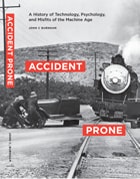
Accident Prone
A History of Technology, Psychology, and Misfits of the Machine AgeJohn C. Burnham
University of Chicago Press, 2009
Technology demands uniformity from human beings who encounter it. People encountering technology, however, differ from one another. Thinkers in the early twentieth century, observing the awful consequences of interactions between humans and machines—death by automobiles or dismemberment by factory machinery, for example—developed the idea of accident proneness: the tendency of a particular person to have more accidents than most people. In tracing this concept from its birth to its disappearance at the end of the twentieth century, Accident Prone offers a unique history of technology focused not on innovations but on their unintended consequences.
Here, John C. Burnham shows that as the machine era progressed, the physical and economic impact of accidents coevolved with the rise of the insurance industry and trends in twentieth-century psychology. After World War I, psychologists determined that some people are more accident prone than others. This designation signaled a shift in social strategy toward minimizing accidents by diverting particular people away from dangerous environments. By the 1960s and 1970s, however, the idea of accident proneness gradually declined, and engineers developed new technologies to protect all people, thereby introducing a hidden, but radical, egalitarianism.
Lying at the intersection of the history of technology, the history of medicine and psychology, and environmental history, Accident Prone is an ambitious intellectual analysis of the birth, growth, and decline of an idea that will interest anyone who wishes to understand how Western societies have grappled with the human costs of modern life.
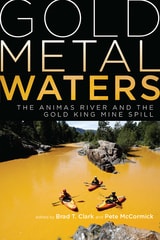
Gold Metal Waters
The Animas River and the Gold King Mine SpillBrad T. Clark
University Press of Colorado, 2022
This singular event is surveyed and interpreted from multiple diverse perspectives—college professors, students, and scientists and activists from a range of academic and epistemological backgrounds—with each chapter reflecting unique professional and personal experiences. Contributors examine both the context for this event and responses to it, embedding this discussion within the broader context of the tens of thousands of mines leaking pollutants into waterways and soils throughout Colorado and the failure to adequately mitigate the larger ongoing crisis.
The Gold King Mine spill was the catalyst that finally brought Superfund listing to the Silverton area; it was a truly sensational event in many respects. Gold Metal Waters will be of interest to students and scholars in all disciplines, but especially in environmental history, western history, mining history, politics, and communication, as well as general readers concerned with human relationships with the environment.
Contributors: Alane Brown, Brian L. Burke, Karletta Chief, Steven Chischilly, Becky Clausen, Michael A. Dichio, Betty Carter Dorr, Cynthia Dott, Gary Gianniny, David Gonzales, Andrew Gulliford, Lisa Marie Jacobs, Ashley Merchant, Teresa Montoya, Scott W. Roberts, Lorraine L. Taylor, Jack Turner, Keith D. Winchester, Megan C. Wrona, Janene Yazzie
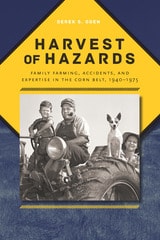
Harvest of Hazards
Family Farming, Accidents, and Expertise in the Corn Belt, 1940-1975Derek S. Oden
University of Iowa Press, 2017
In this study of the farm safety movement in the Corn Belt, historian Derek Oden examines why agriculture was so dangerous and why improvements were so difficult to achieve. Because farmers were self-employed business owners whose employees were mainly family members; because they lived far from aid such as hospitals and fire stations; and because they had to manage such a diverse array of new technologies, they could not easily adopt the workplace safety and public health reforms designed for factories and urban settings. In response, beginning in the 1940s, farmers and a new breed of farm safety specialists relied upon an increasingly elaborate educational campaign to lessen injuries and illnesses on the farm.
Several government, business, and nonprofit organizations—from the US Department of Agriculture to the National Safety Council and 4-H and the Future Farmers of America—worked together to publicize both the dangers of farming and the information farmers needed to stay safe while driving tractors, applying anhydrous ammonia, or repairing machinery. By the 1960s, however, the partnership began to break down, and by the 1970s the safety movement became increasingly contested as professional and policy divisions emerged. This groundbreaking study incorporates agriculture into the histories of occupational safety and public health.

Judith Resnik
Unsung AstronautMarlene Targ Brill
Ohio University Press, 0
Judith Resnik didn’t grow up dreaming of space, but when NASA opened its doors to women astronauts in the late 1970s, she stepped forward—and soared. One of the first six women ever accepted into NASA’s space shuttle astronaut-training program, Resnik brought her sharp mind, determination, and creativity to a field that had long been closed to women. Although she wasn’t the first American woman in space, she became one of the most accomplished astronauts of her time.
Resnik’s journey wasn’t easy. She faced challenges at home and in school, but she never let obstacles stop her. A gifted student, she excelled in math, science, and music—she even considered becoming a concert pianist before choosing a career in engineering. Her hard work paid off: She earned multiple degrees and helped design improvements for the space shuttle itself. She proved that astronauts aren’t just pilots—they’re problem solvers, inventors, and explorers.
In 1984, Resnik launched into space for the first time aboard the shuttle Discovery. Two years later, she joined the crew of Challenger. Tragically, that mission ended in disaster, cutting her life short. While the world focused on the loss of teacher Christa McAuliffe, who was a passenger on that flight, Resnik’s story was often overlooked. Yet her contributions to science and space exploration live on through programs, schools, and scholarships that bear her name.
This inspiring biography brings Resnik’s remarkable life to light. Readers will discover how a girl from Ohio became a trailblazer in space and how her courage and brilliance continue to inspire new generations. Her story reminds us that even if you’re not first, you can still make history—and that reaching for the stars starts with believing in yourself.
Nearly Nuclear
A Mismanaged Energy Transitionleroy smith
Michigan State University Press, 2021
Oil and Water
A NovelMei Mei Evans
University of Alaska Press, 2013
Evans’s compelling story, influenced by her own experiences during the Exxon Valdez oil spill, is a provocative look at the choice that must be made between environmental safety and economic survival. A PEN/Bellwether Prize finalist, it will have readers reconsidering where they draw their own lines.
The Challenger Launch Decision
Risky Technology, Culture, and Deviance at NASADiane Vaughan
University of Chicago Press, 1995
Journalists and investigators have historically cited production problems and managerial wrong-doing as the reasons behind the disaster. The Presidential Commission uncovered a flawed decision-making process at the space agency as well, citing a well-documented history of problems with the O-ring and a dramatic last-minute protest by engineers over the Solid Rocket Boosters as evidence of managerial neglect.
Why did NASA managers, who not only had all the information prior to the launch but also were warned against it, decide to proceed? In retelling how the decision unfolded through the eyes of the managers and the engineers, Vaughan uncovers an incremental descent into poor judgment, supported by a culture of high-risk technology. She reveals how and why NASA insiders, when repeatedly faced with evidence that something was wrong, normalized the deviance so that it became acceptable to them.
No safety rules were broken. No single individual was at fault. Instead, the cause of the disaster is a story not of evil but of the banality of organizational life. This powerful work explains why the Challenger tragedy must be reexamined and offers an unexpected warning about the hidden hazards of living in this technological age.
The Challenger Launch Decision
Risky Technology, Culture, and Deviance at NASA, Enlarged EditionDiane Vaughan
University of Chicago Press, 2015
When the Space Shuttle Challenger exploded on January 28, 1986, millions of Americans became bound together in a single, historic moment. Many still vividly remember exactly where they were and what they were doing when they heard about the tragedy. Diane Vaughan recreates the steps leading up to that fateful decision, contradicting conventional interpretations to prove that what occurred at NASA was not skullduggery or misconduct but a disastrous mistake.
Why did NASA managers, who not only had all the information prior to the launch but also were warned against it, decide to proceed? In retelling how the decision unfolded through the eyes of the managers and the engineers, Vaughan uncovers an incremental descent into poor judgment, supported by a culture of high-risk technology. She reveals how and why NASA insiders, when repeatedly faced with evidence that something was wrong, normalized the deviance so that it became acceptable to them. In a new preface, Vaughan reveals the ramifications for this book and for her when a similar decision-making process brought down NASA's Space Shuttle Columbia in 2003.
The Iconoclastic Imagination
Image, Catastrophe, and Economy in America from the Kennedy Assassination to September 11Ned O'Gorman
University of Chicago Press, 2015
In The Iconoclastic Imagination, Ned O’Gorman approaches each of these moments as an image of icon-destruction that give us distinct ways to imagine social existence in American life. He argues that the Cold War gave rise to crises in political, aesthetic, and political-aesthetic representations. Locating all of these crises within a “neoliberal imaginary,” O’Gorman explains that since the Kennedy assassination, the most powerful way to see “America” has been in the destruction of representative American symbols or icons. This, in turn, has profound implications for a neoliberal economy, social philosophy, and public policy. Richly interwoven with philosophical, theological, and rhetorical traditions, the book offers a new foundation for a complex and innovative approach to studying Cold War America, political theory, and visual culture.