Results by title
9 books match the query 'Acquisitions'
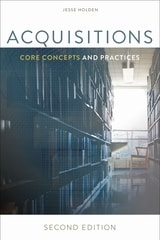
Acquisitions
Core Concepts and PracticesJesse Holden
American Library Association, 2016
[more]
Archival Accessioning
Audra Eagle Yun
Society of American Archivists, 2021
An archival accessioning program is the keystone of responsible collection stewardship and essential to providing both equitable access and meaningful contextualization of archives. In Archival Accessioning, editor Audra Eagle Yun approaches the acquisition of materials as a holistically oriented, programmatic activity that establishes and maintains baseline control for archival holdings.
Combining principles, best practice, and real-world examples from eleven archival practitioners, Archival Accessioning is a forward-thinking guide that archivists can apply in a variety of institutional settings. Those working with archives, special collections, and local history materials will learn how to
• Identity core components of archival accessioning and critically analyze such work,
• Establish a thoughtful and successful program for taking intellectual and physical custody of materials, and
• Adapt firsthand professional perspectives to improve or modify existing practices.
This book’s set of principles, applied procedures, and variety of examples will benefit archivists, records managers, and librarians as well as information science students at all levels.
[more]

Customer-Based Collection Development
An OverviewKarl Bridges
American Library Association, 2014
[more]
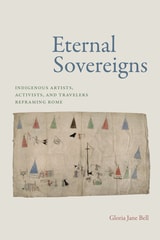
Eternal Sovereigns
Indigenous Artists, Activists, and Travelers Reframing RomeGloria Jane Bell
Duke University Press, 2024
In 1925, Pius XI staged the Vatican Missionary Exposition in Rome’s Vatican City. Offering a narrative of the Catholic Church’s beneficence to a global congregation, the exposition displayed thousands of cultural belongings stolen from Indigenous communities, which were seen by one million pilgrims. Gloria Jane Bell’s Eternal Sovereigns offers critical revision to that story. Bell reveals the tenacity, mobility, and reception of Indigenous artists, travelers, and activists in 1920s Rome. Animating these conjunctures, the book foregrounds competing claims to sovereignty from Indigenous and papal perspectives. Bell deftly juxtaposes the “Indian Museum” of nineteenth-century sculptor Ferdinand Pettrich, acquired by the Vatican, with the oeuvre of Indigenous artist Edmonia Lewis. Focusing on Turtle Island, Bell analyzes Indigenous cultural belongings made by artists from nations including Cree, Lakota, Anishinaabe, Nipissing, Kanien’kehá:ka, Wolastoqiyik, and Kwakwaka’wakw. Drawing on years of archival research and field interviews, Bell provides insight into the Catholic Church’s colonial collecting and its ongoing ethnological display practices. Written in a voice that questions the academy’s staid conventions, the book reclaims Indigenous belongings and other stolen treasures that remain imprisoned in the stronghold of the Vatican Museums.
[more]
Guide to Ethics in Acquisitions
Wyoma vanDuinkerken
American Library Association, 2015
[more]
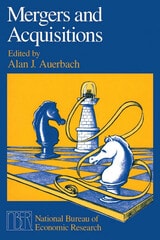
Mergers and Acquisitions
Edited by Alan J. Auerbach
University of Chicago Press, 1988
Do mergers lead to financial instability? How are shareholders' interests best served? How significant a role do taxes play? What are the implications for the structure and concentration of industry? Mergers and Acquisitions, prepared in an nontechnical format, answers these and other questions that have arisen from the takeover boom that began in the mid-1980s.
[more]
Museum Matters
Making and Unmaking Mexico’s National CollectionsEdited by Miruna Achim, Susan Deans-Smith, Sandra Rozental
University of Arizona Press, 2021
This is a book about objects. Stones, ruins, bones, mummies, mannequins, statues, photographs, fakes, instruments, and natural history specimens all formed part of Mexico’s National Museum complex at different moments across two centuries of collecting and display.
Museum Matters traces the emergence, consolidation, and dispersal of this national museum complex by telling the stories of its objects. Objects that have been separated over time are brought back together in this book in order to shed light on the interactions and processes that have forged things into symbols of science, aesthetics, and politics. The contributors to this volume illuminate how collections came into being or ceased to exist over time, or how objects moved in and out of collections and museum spaces. They explore what it means to move things physically and spatially, as well as conceptually and symbolically.
Museum Matters unravels the concept of the national museum. By unmaking the spaces, frameworks, and structures that form the complicated landscape of national museums, this volume brings a new way to understand the storage, displays, and claims about the Mexican nation’s collections today.
Contributors
Miruna Achim, Christina Bueno, Laura Cházaro, Susan Deans-Smith, Frida Gorbach, Haydeé López Hernández, Carlos Mondragón, Bertina Olmedo Vera, Sandra Rozental, Mario Rufer
[more]
Placing Papers
The American Literary Archives MarketAmy Hildreth Chen
University of Massachusetts Press, 2020
The sale of authors' papers to archives has become big news, with collections from James Baldwin and Arthur Miller fetching record-breaking sums in recent years. Amy Hildreth Chen offers the history of how this multimillion dollar business developed from the mid-twentieth century onward and considers what impact authors, literary agents, curators, archivists, and others have had on this burgeoning economy.
The market for contemporary authors' archives began when research libraries needed to cheaply provide primary sources for the swelling number of students and faculty following World War II. Demand soon grew, and while writers and their families found new opportunities to make money, so too did book dealers and literary agents with the foresight to pivot their businesses to serve living authors. Public interest surrounding celebrity writers had exploded by the late twentieth century, and as Placing Papers illustrates, even the best funded institutions were forced to contend with the facts that acquiring contemporary literary archives had become cost prohibitive and increasingly competitive.
The market for contemporary authors' archives began when research libraries needed to cheaply provide primary sources for the swelling number of students and faculty following World War II. Demand soon grew, and while writers and their families found new opportunities to make money, so too did book dealers and literary agents with the foresight to pivot their businesses to serve living authors. Public interest surrounding celebrity writers had exploded by the late twentieth century, and as Placing Papers illustrates, even the best funded institutions were forced to contend with the facts that acquiring contemporary literary archives had become cost prohibitive and increasingly competitive.
[more]
Twentieth-Century Popular Culture in Museums and Libraries
Fred E.H. Schroeder
University of Wisconsin Press, 1981
Although libraries and museums for many centuries have taken the lead, under one rational or another, in recovering, storing, and displaying various kinds of culture of their periods, lately, as the gap between elite and popular culture has apparently widened, these repositories of artifacts of the present for the future have tended to drift more and more to what many people call the aesthetically pleasing elements of our culture. The degree to which our libraries and museums have ignored our culture is terrifying, when one scans the documents and artifacts of our time which, if history in any wise repeats itself, will in the immediate and distant future become valuable indices of our present culture to future generations. As Professor Schroeder dramatically states it, “No doubt about it, it is the contemporary popular culture that is the endangered species.”
The essays in this book investigate the reasons for present-day neglect of popular culture materials and chart the various routes by which conscientious and insightful librarians and museum directors can correct this disastrous oversight.
The essays in this book investigate the reasons for present-day neglect of popular culture materials and chart the various routes by which conscientious and insightful librarians and museum directors can correct this disastrous oversight.
[more]